
Antonín Dvořák Award 2026
The laureate of the 2026 Antonín Dvořák Award for outstanding contributions to Czech classical music is the Pavel Haas Quartet. The award will be presented at a gala concert featuring Philharmonix & special guest Josef Špaček.
Ticket prices:
1290 – 3290 CZK

Date
2/12/2026
Location
The Spanish Hall
Time
7 pm
Doors Closed
6.50 pm
End of Concert
8.15 pm
Dress Code
dark suit
Laureate 2026
petra-hajska-042026-1.avif)
The Pavel Haas Quartet stands as one of the world’s premier chamber ensembles, commanding the most prestigious concert stages globally. Its recordings have earned it five Gramophone Awards, along with a multitude of other significant accolades. In 2022, BBC Music Magazine ranked the ensemble among the top 10 greatest string quartets of all time.
The Quartet’s performances regularly grace revered venues such as Concertgebouw and Muziekgebouw in Amsterdam, NCPA in Beijing, the Philharmonie and Konzerthaus in Berlin, Queen's Hall in Edinburgh, Elbphilharmonie in Hamburg, Wigmore Hall in London, Philharmonie in Luxembourg, Carnegie Hall in New York, Théâtre de la Ville in Paris, Accademia di Santa Cecilia in Rome, LG Arts Centre in Seoul, Musikverein in Vienna, and Tonhalle in Zürich, etc.
In the 2024/2025 concert season, the Pavel Haas Quartet will once again return to illustrious Carnegie Hall and London’s Wigmore Hall. The ensemble will embark on a European tour during the first half of the season, visiting Austria, Germany, Belgium, and the United Kingdom. It will close out 2024 with a tour across the United States. Audiences in the Czech Republic can look forward to several performances at the Dvořák Prague Festival, where the Quartet has served as an artist-in-residence and curator of chamber concerts since September 2022, including a three-season exploration of Dvořák’s string quartets and chamber works.
The Pavel Haas Quartet records exclusively for Supraphon. Its most recent album, *Brahms Viola and Piano Quintets* (2022), featuring Boris Giltburg and former member Pavel Nikl, met with widespread acclaim. The Quartet’s prior release, *Shostakovich String Quartets* (2019), garnered the Recording of the Year prize at the Classic Prague Awards, and The Times hailed it as one of the 100 best recordings of the year.
The ensemble has received five Gramophone Awards for its recordings of Dvořák, Smetana, Schubert, Janáček, and Haas as well as for Dvořák’s String Quartets No. 12 “American” and No. 13, which also took the 2011 Gramophone Recording of the Year award. Additional honours include a BBC Music Magazine Award and the 2010 Diapason d’Or de l’Année for the ensemble’s recording of Prokofiev’s String Quartets No. 1 and No. 2.
A victory at the Paolo Borciani Competition in Italy in 2005 marked the first milestone of the Pavel Haas Quartet’s career. A nomination for ECHO Rising Stars in 2007 followed, along with participation in the BBC New Generation Artists program from 2007-2009, and a Borletti-Buitoni Trust Special Ensemble Scholarship in 2010.
The Pavel Haas Quartet was founded in 2002 by Veronika Jarůšková, and violist Pavel Nikl, who remained a member until 2016 and who continues to be a frequent guest performer at string quintet concerts. The ensemble’s members studied under the legendary violist Milan Škampa of the Smetana Quartet. The Quartet takes its name from the Czech composer Pavel Haas (1899–1944), Janáček’s most promising pupil, who was imprisoned by the Nazis in the Terezín ghetto in 1941 and tortured to death three years later in the Auschwitz concentration camp. His musical legacy includes three exquisite string quartets.
source: artevisio
Antonín Dvořák Award
Music Award
The Antonín Dvořák Award is a prestigious prize in the field of classical music. It is intended to highlight people, artistic collectives or institutions for exceptional artistic achievements or significant merit in promoting and popularising Czech classical music in the Czech Republic and abroad. The award has been presented by the Academy of Classical Music since 2009.
The first laureate was the great-grandson of Antonín Dvořák: the violinist, violist and conductor Josef Suk. He was followed by figures such as the pianist Ivan Moravec, cellist Yo-Yo Ma and the world-famous choreographer and dancer Jiří Kylián. Recent laureates include Jakub Hrůša, currently the most successful Czech conductor, and the Prague Philharmonic Choir.
In the past, the award ceremony has been held on special occasions and at notable venues, underscoring the prize’s significance. Soprano Ludmila Dvořáková received the Antonín Dvořák Award in the Spanish Hall of Prague Castle during a recital by pianist Lang Lang, conductor Jiří Bělohlávek was given the award in 2014 at Carnegie Hall in New York, the Czech Philharmonic received it at its concert celebrating 100 years of Czech statehood at the Kennedy Center in Washington, D.C., and Sir András Schiff accepted the award at the Dvořák Prague International Music Festival in the Rudolfinum’s Dvořák Hall.
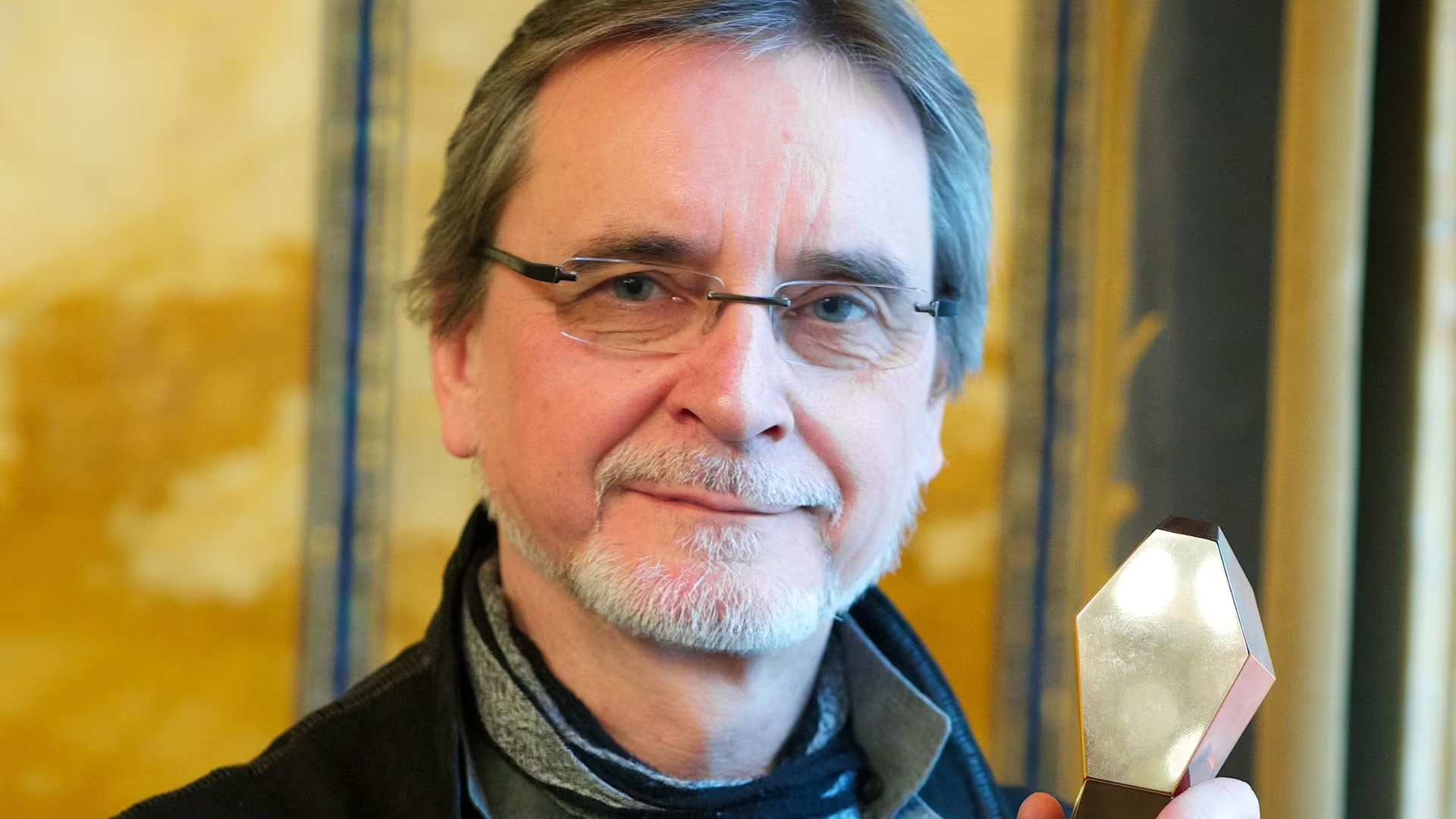
Laureates of the Antonín Dvořák Award receive a glass sculpture of a cello designed by architect Jiří Pelcl and produced by Moser glassmakers.
Laureates of Previous Editions
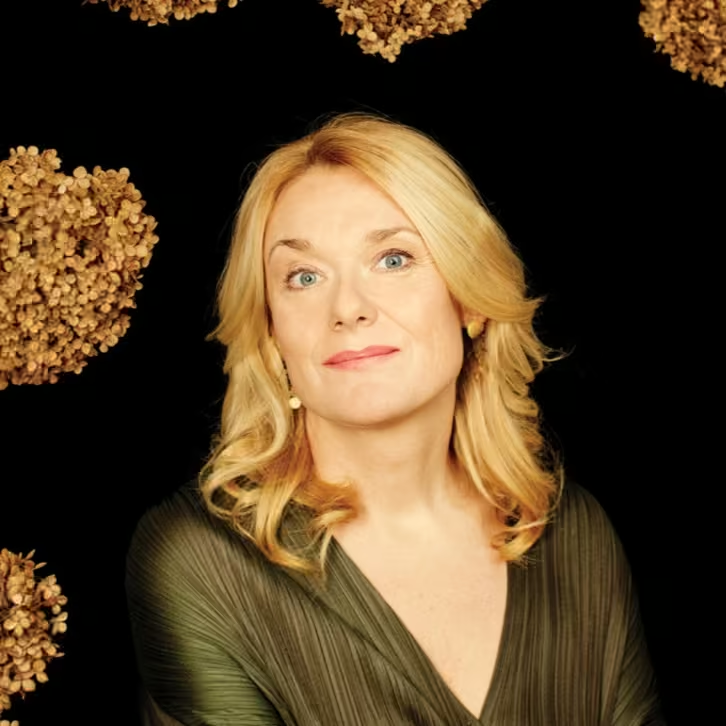
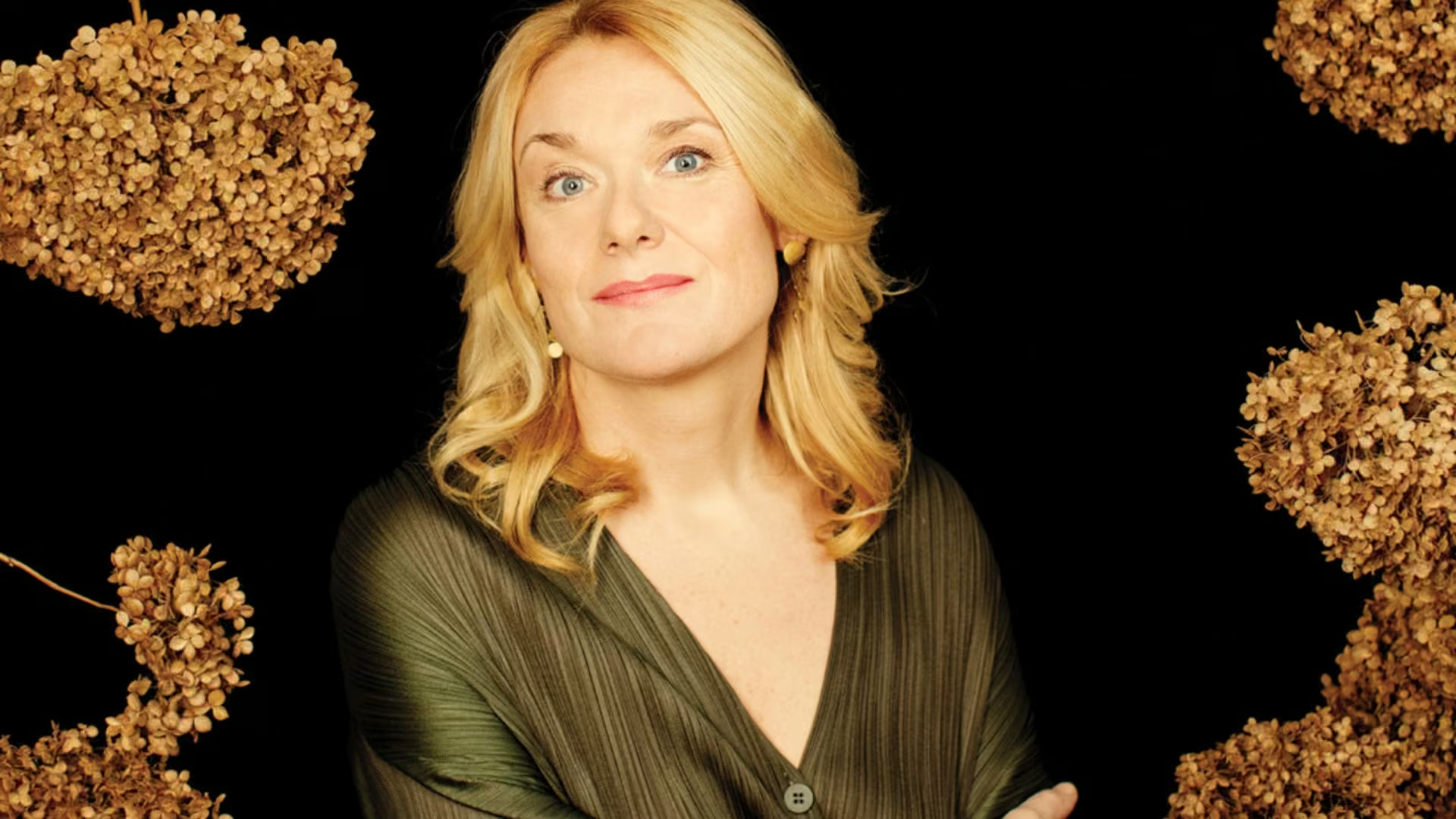
Magdalena Kožená is one of the most sought-after singers of our time. Her wide-ranging repertoire spans from Baroque music through works of the Classical and Romantic masters to 20th-century compositions. She studied singing at the Conservatory in Brno, her native city, and later with Eva Blahová at the Academy of Performing Arts in Bratislava. The most prominent of her many national and international competition successes was her first-place victory at the International Mozart Competition in Salzburg in 1995. During her prolific artistic career to date, she has appeared on many of the world’s leading concert stages and at renowned festivals and has performed numerous roles at celebrated opera houses including London’s Royal Opera House Covent Garden and the Metropolitan Opera in New York. Her recordings for Deutsche Grammophon, EMI Classics, Linn Records and Pentatone have won her virtually every major award bestowed by music magazines, including prestigious Gramophone Awards in several categories.
Magdalena Kožená is not only an outstanding singer, but also a cultural ambassador for the Czech Republic. She actively promotes Czech music and its cultural heritage abroad, both in concert and through her recordings. Her repertoire includes a rich selection of songs by classic Czech composers, especially Antonín Dvořák, Leoš Janáček and Bohuslav Martinů, as well as works by Petr Eben and Jewish composers born in the Czech lands such as Erwin Schulhoff and Hans Krása. She also performs works from the Czech operatic repertoire, as evidenced by acclaimed recordings of Janáček’s Katya Kabanova and Bohuslav Martinů’s Julietta.
Magdalena Kožená is also dedicated to advocating for primary arts education in the Czech Republic. To this end, she founded a charitable foundation that e.g. organises the nationwide Art Schools Open Festival for young performers. She has received numerous prestigious honours for her diverse musical activities. She is a Chevalier de l’Ordre des Arts et des Lettres of the French Republic and, in 2023, received the First-Class Medal of Merit in the Field of Art from the President of the Czech Republic. She has also been honoured with the Gratias Agit Award from the Czech Ministry of Foreign Affairs for promoting the country’s good name and the Gold Medal for Merit in the Arts from the Kennedy Center International Committee on the Arts in Washington, D.C. The city of Halle awarded her the Georg Friedrich Handel Prize, named after the city’s famous native. She holds an honorary doctorate from the Janáček Academy of Performing Arts. In 2025, Magdalena Kožená received the Antonín Dvořák Award in recognition of her outstanding contribution to Czech music and its international promotion.
source: C.E.M.A. – Central European Music Agency
photo © Julia Wesely
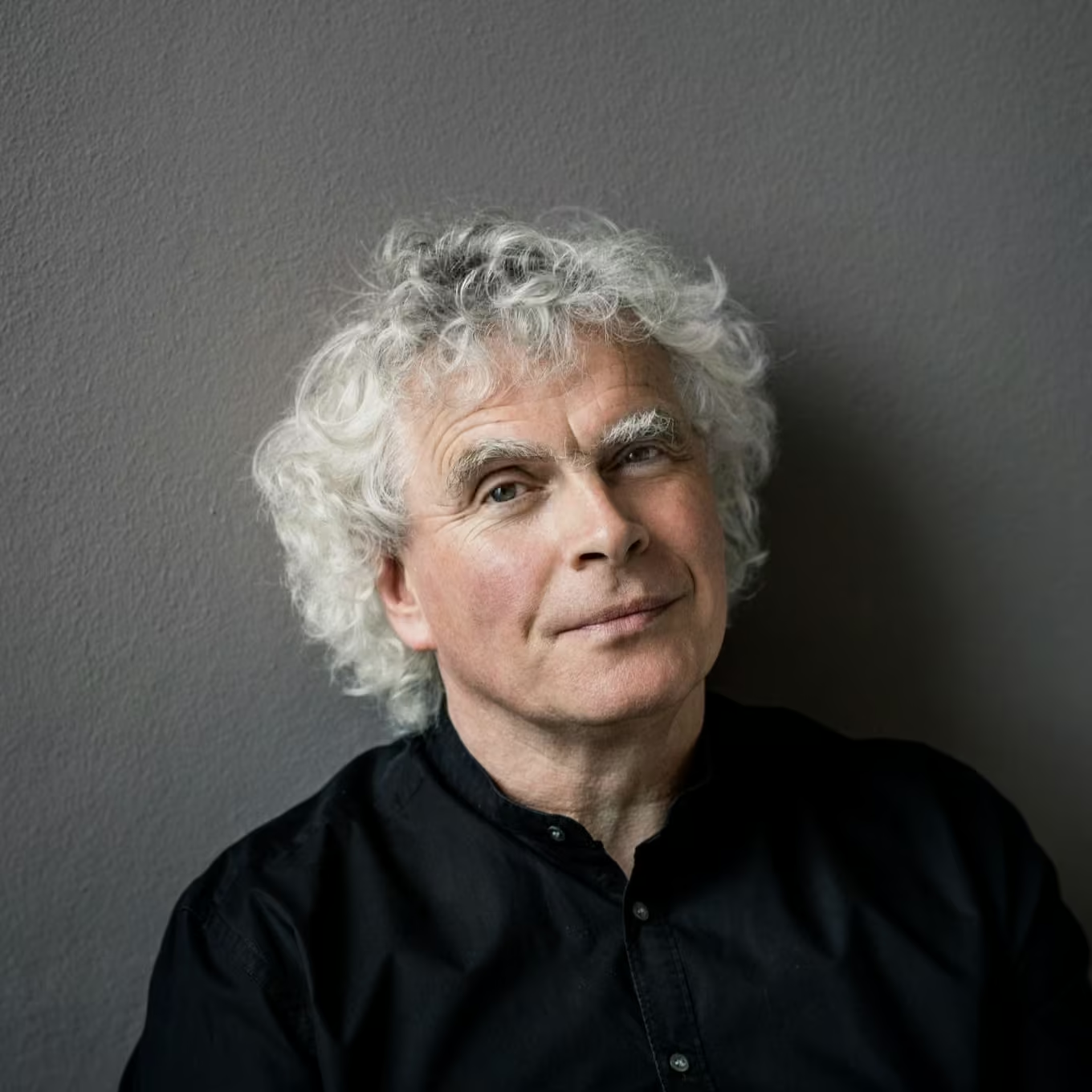
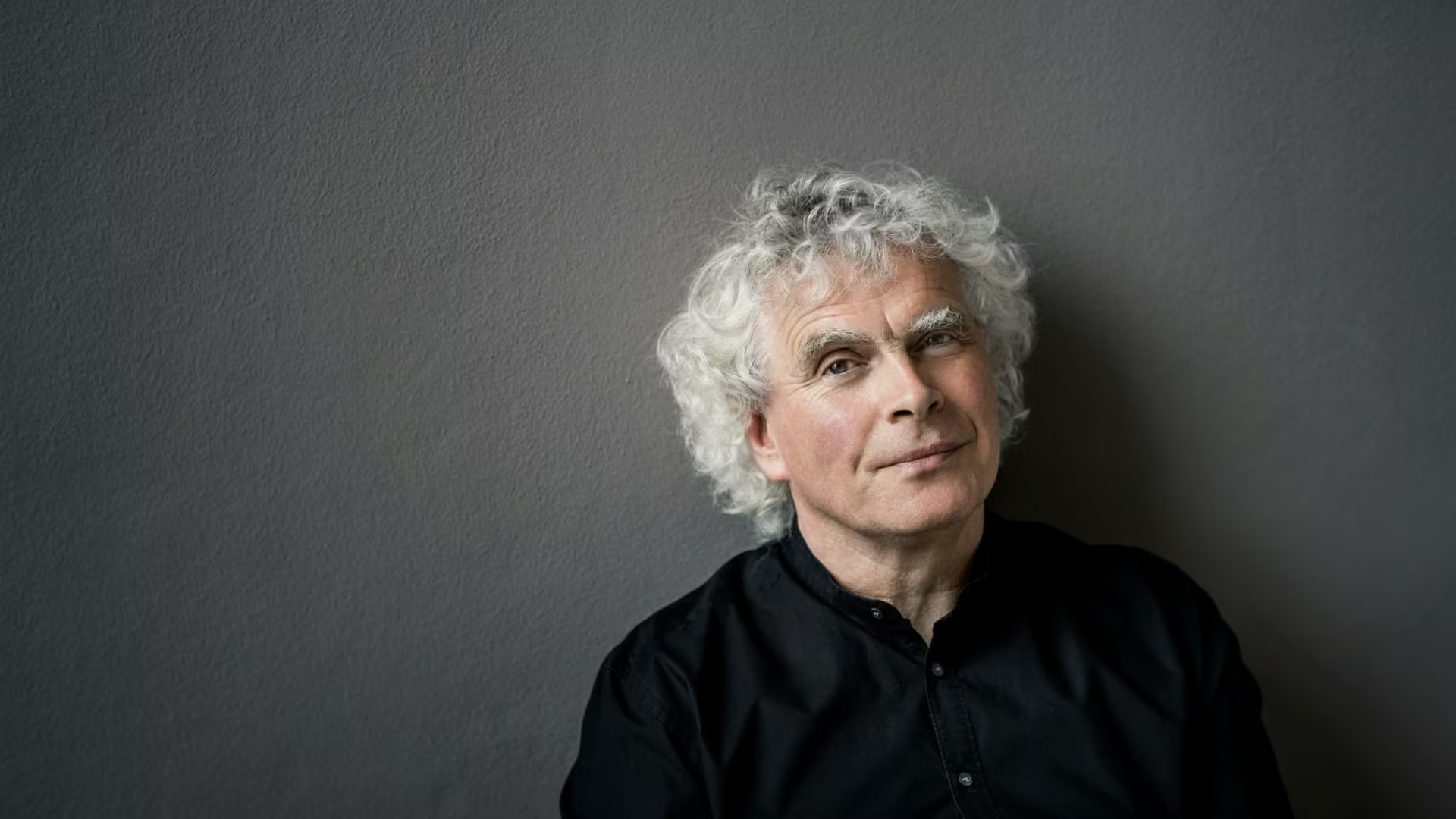
Sir Simon Rattle has long ranked among the most respected conductors in the world. A native of Liverpool, he studied at the Royal Academy of Music in London and began his professional career with the City of Birmingham Symphony Orchestra. He became renowned primarily as Chief Conductor of the Berlin Philharmonic, a position he held from 2002 to 2018. During his 16-year tenure there, the orchestra significantly expanded its activities, for example through the Digital Concert Hall project, which allows audiences around the world to experience Philharmonic concerts online. From 2017 to 2023, Simon Rattle served as Music Director of the London Symphony Orchestra, with which he remains affiliated as Conductor Emeritus. He currently works closely with the Orchestra of the Age of Enlightenment and is Principal Guest Conductor of the Czech Philharmonic, where he holds the title “Rafael Kubelík Chair.” He also collaborates with other top orchestras including the Vienna Philharmonic, Staatskapelle Berlin and the Mahler Chamber Orchestra, as well as with leading opera houses such as the Royal Opera House Covent Garden in London, Berlin State Opera and the Metropolitan Opera in New York.
Simon Rattle’s musical sensibility was shaped from an early age by Czech musical culture. At the age of seven, he was already listening to LPs of the Czech Philharmonic under Karel Ančerl, through which he discovered the distinctive musical language of Leoš Janáček. With his father, he played Dvořák’s Slavonic Dances on the piano – works that, by his own account, played a key role in his decision to become a musician. At 15, he attended his first live concert by Rafael Kubelík. The legendary Czech conductor became Rattle’s favourite and, as he says, “changed my life.” Today, Simon Rattle is one of the foremost international performers championing Czech music. His repertoire includes Janáček’s Sinfonietta, Taras Bulba and Glagolitic Mass, Dvořák’s Slavonic Dances and other orchestral works, as well as concertos by Bohuslav Martinů. He has made an acclaimed recording of the complete set of Dvořák’s symphonic poems inspired by Karel Jaromír Erben’s poetry, a live recording of Janáček’s opera The Cunning Little Vixen, and – released last year – the album Czech Songs, featuring songs by Bohuslav Martinů, Antonín Dvořák, Hans Krása and Gideon Klein. Simon Rattle has received many awards, including, among others, the Order of the British Empire, the Order of Merit and the Wolf Prize in the Arts. In 2022, he was awarded an honorary doctorate by the Janáček Academy of Performing Arts.
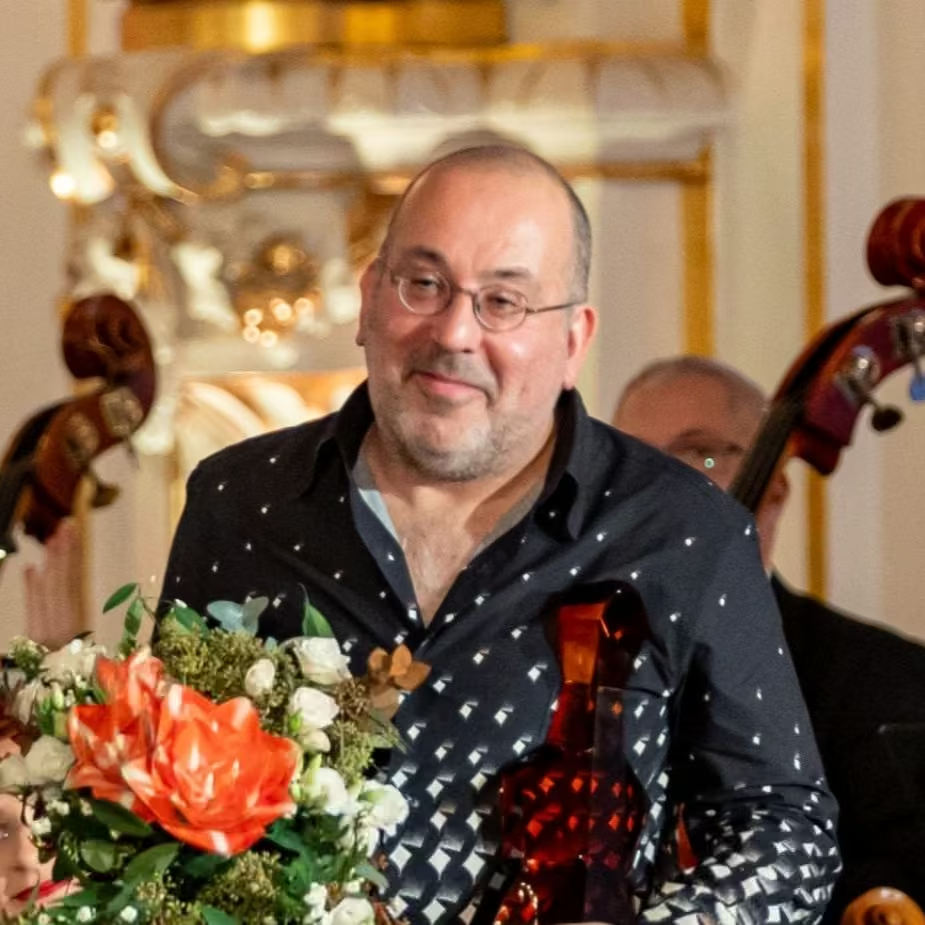
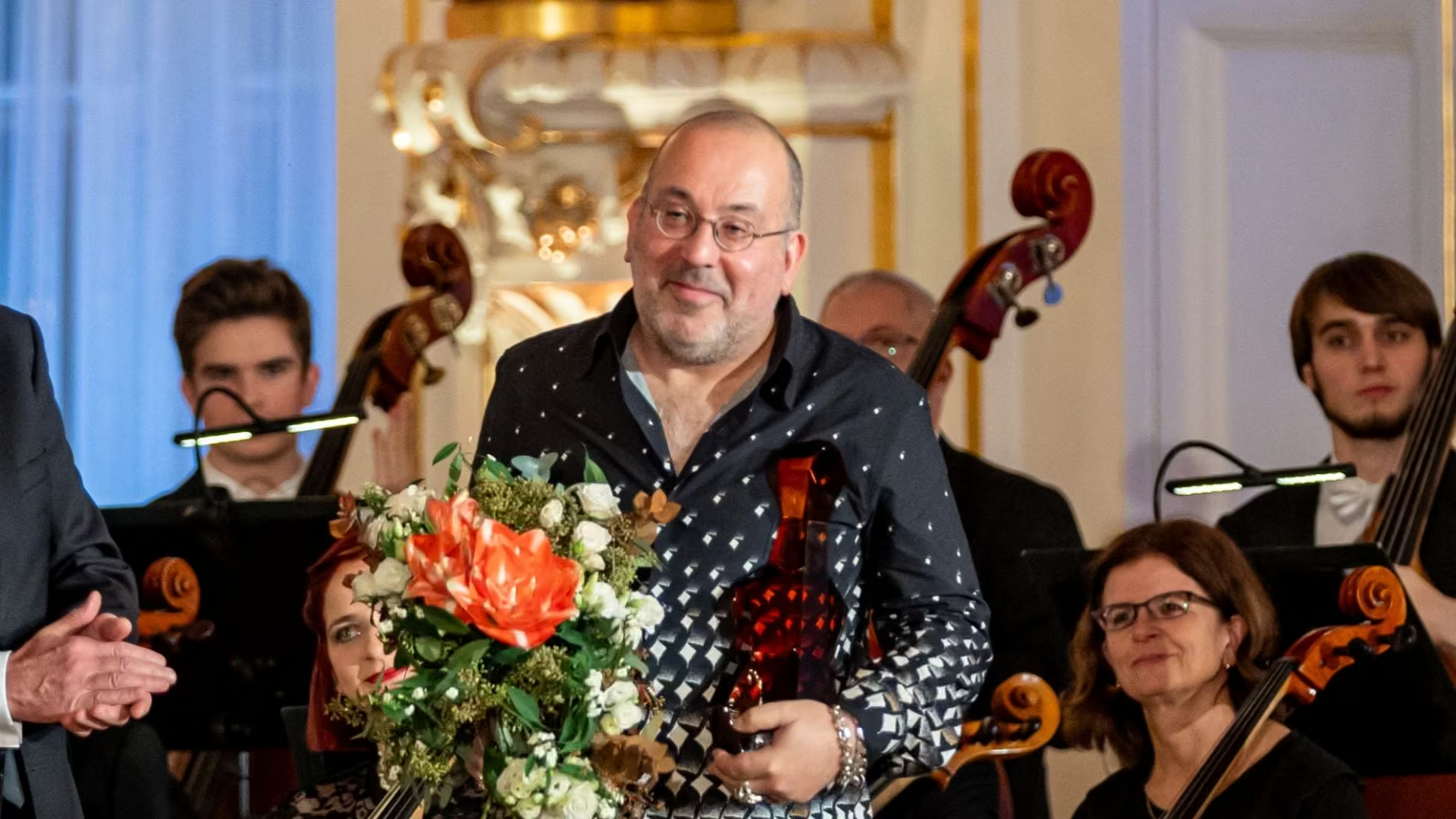
Barrie Kosky is widely regarded as one of the most influential figures in opera today. The Daily Telegraph has hailed him as a superstar and “the most important opera director of our time.”
Kosky was born in Australia in 1967 and was raised in a traditional Jewish household. As a teenager, he distanced himself from religion and has openly spoken about his rejection of Catholic ritual. Yet ritual – in a broader sense – remains central to his artistic approach. He has famously described himself as “a gay Jewish kangaroo” and affectionately identifies with Kermit the Frog as his alter ego.
In 2017, Kosky made history as the first Jewish director to work at the prestigious Bayreuth Festival. That same year, he directed Die Meistersinger von Nürnberg, Wagner’s nationalistic opera woven with visions of an ideal social order. It was the first time this opera had been staged at Bayreuth by someone outside the Wagner family, allowing Kosky to address the composer’s antisemitism directly, on the composer’s own stage.
Two years ago, his production of Káťa Kabanová at the Salzburg Festival – conducted by Jakub Hrůša – received widespread acclaim. Their collaboration earned the 2024 Opera Award from Gramophone magazine. At the Komische Oper in Berlin, Kosky has also staged Rusalka and two major operas by Leoš Janáček: The Cunning Little Vixen and From the House of the Dead.
The award for outstanding contribution to the arts and the promotion of Czech music is thus going to someone exceptionally deserving. Kosky is currently working on a new staging of Wagner’s Ring cycle for the Royal Opera House in Covent Garden – a striking turn for someone who once openly opposed Wagner’s work. The four operas are being conducted individually by Antonio Pappano. When Pappano steps down as Music Director, Jakub Hrůša will take over the full cycle as part of his new role at the helm of Covent Garden. Kosky’s career offers powerful proof that opera is far from obsolete. He has little patience for the claim that opera is a dying art form. On the contrary: the more society is overwhelmed by technology, he says, the more we crave authentic human rituals. For Kosky, opera is the ultimate antidote to artificial intelligence – a live orchestra in the pit, real voices on stage, no microphones or speakers. And that, he believes, is something people will never stop yearning for.
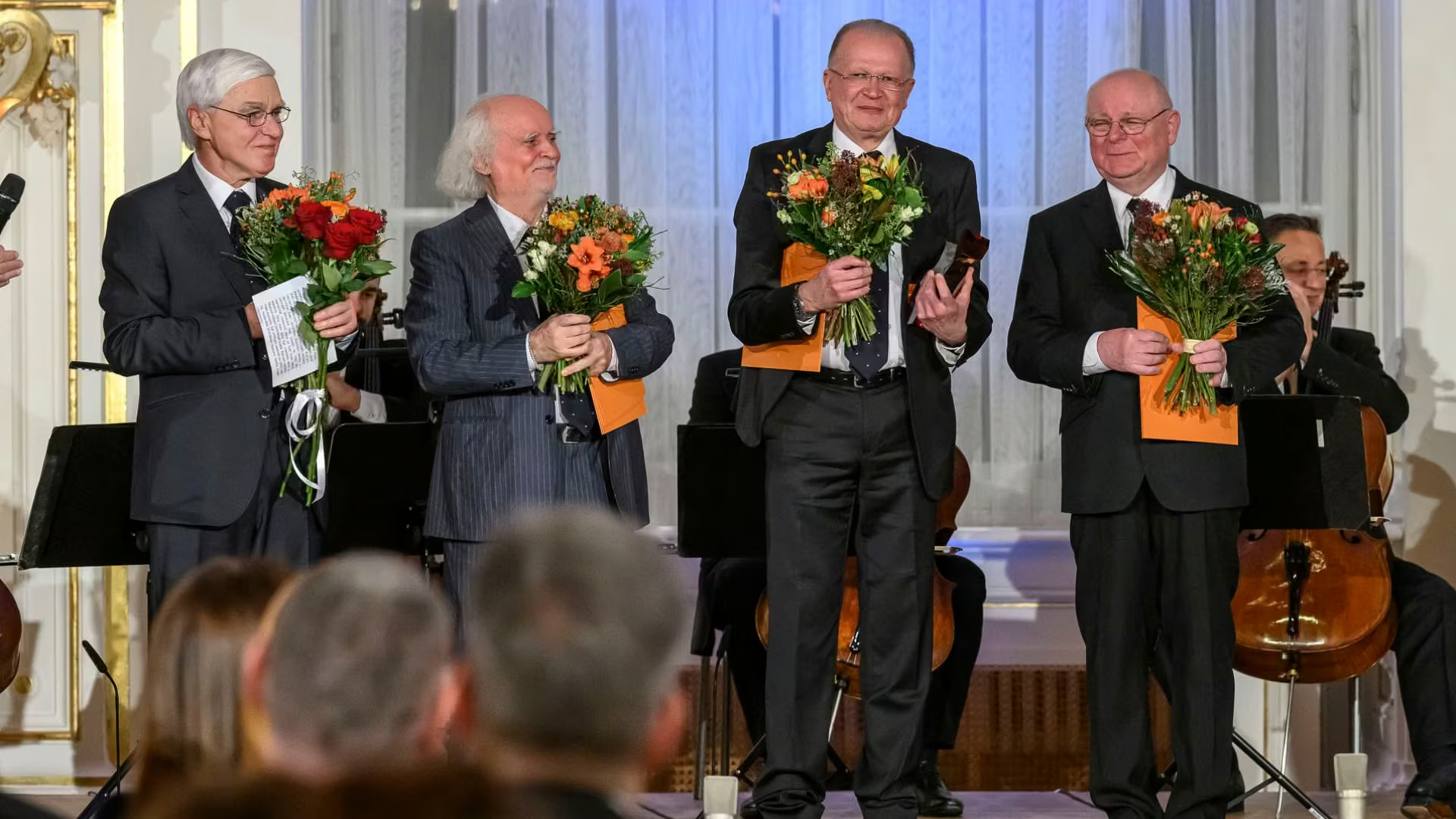
The legendary Panocha Quartet are one of the greatest representatives internationally of the Czech school of quartet playing. Over the years, they have made appearances in concert halls in practically every country of Europe, as well as in the USA, Canada, Mexico, Thailand, Iraq, Israel, Japan, Cuba, Australia, and New Zealand, in addition to their many concerts in this country.
They have performed repeatedly at international music festivals (Prague Spring, Edinburgh, Salzburg, Dubrovnik, Tel Aviv, Mondsee). They have made countless recordings, including the reference recording of Antonín Dvořák’s complete string quartets and quintets. Their exceptional artistry has earned them a number of important awards including both a Gold Disc and Platinum Disc from Supraphon, the Grand Prix de l’Académie Charles Cros in Chézy-sur-Marne, and a MIDEM Classical Award in Cannes.
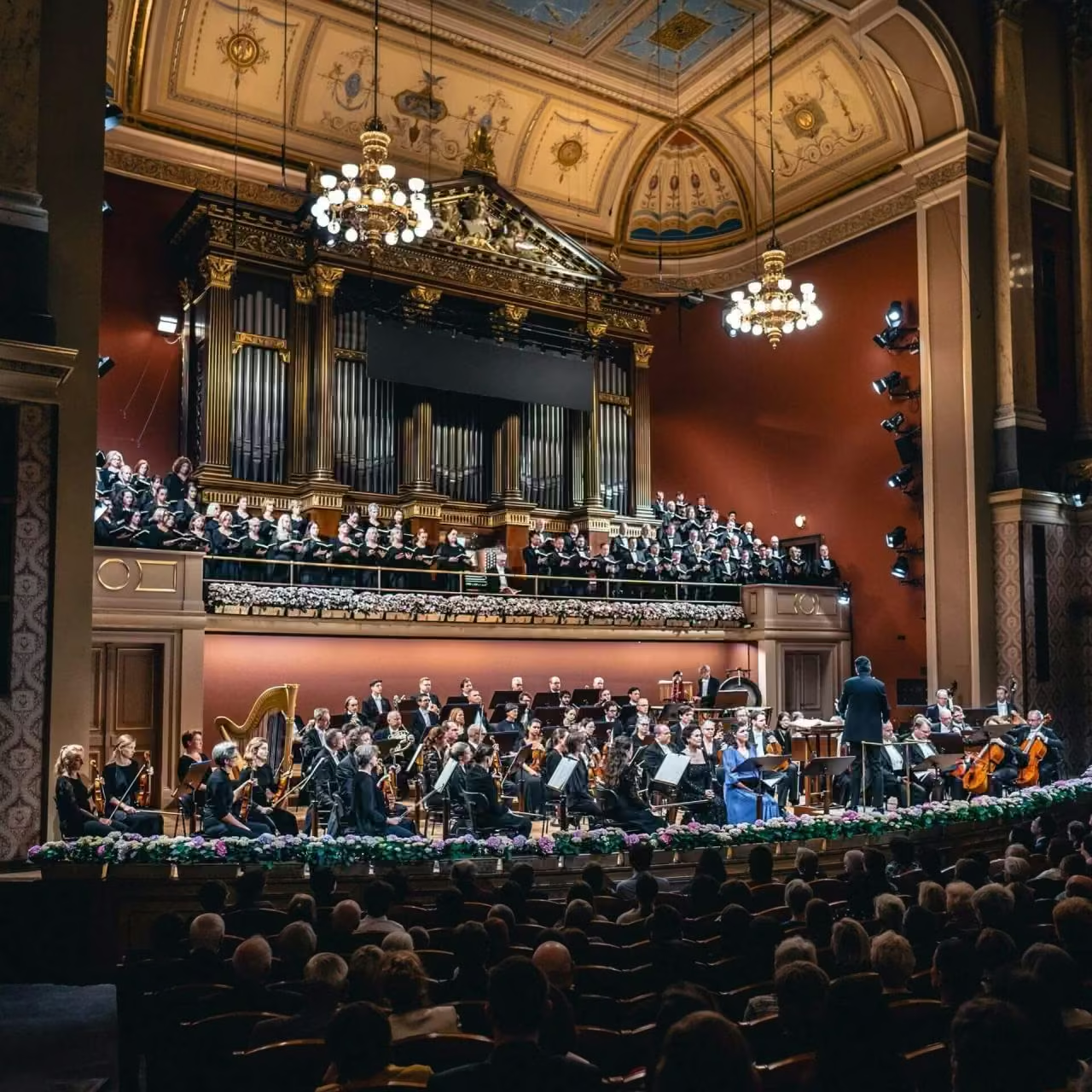
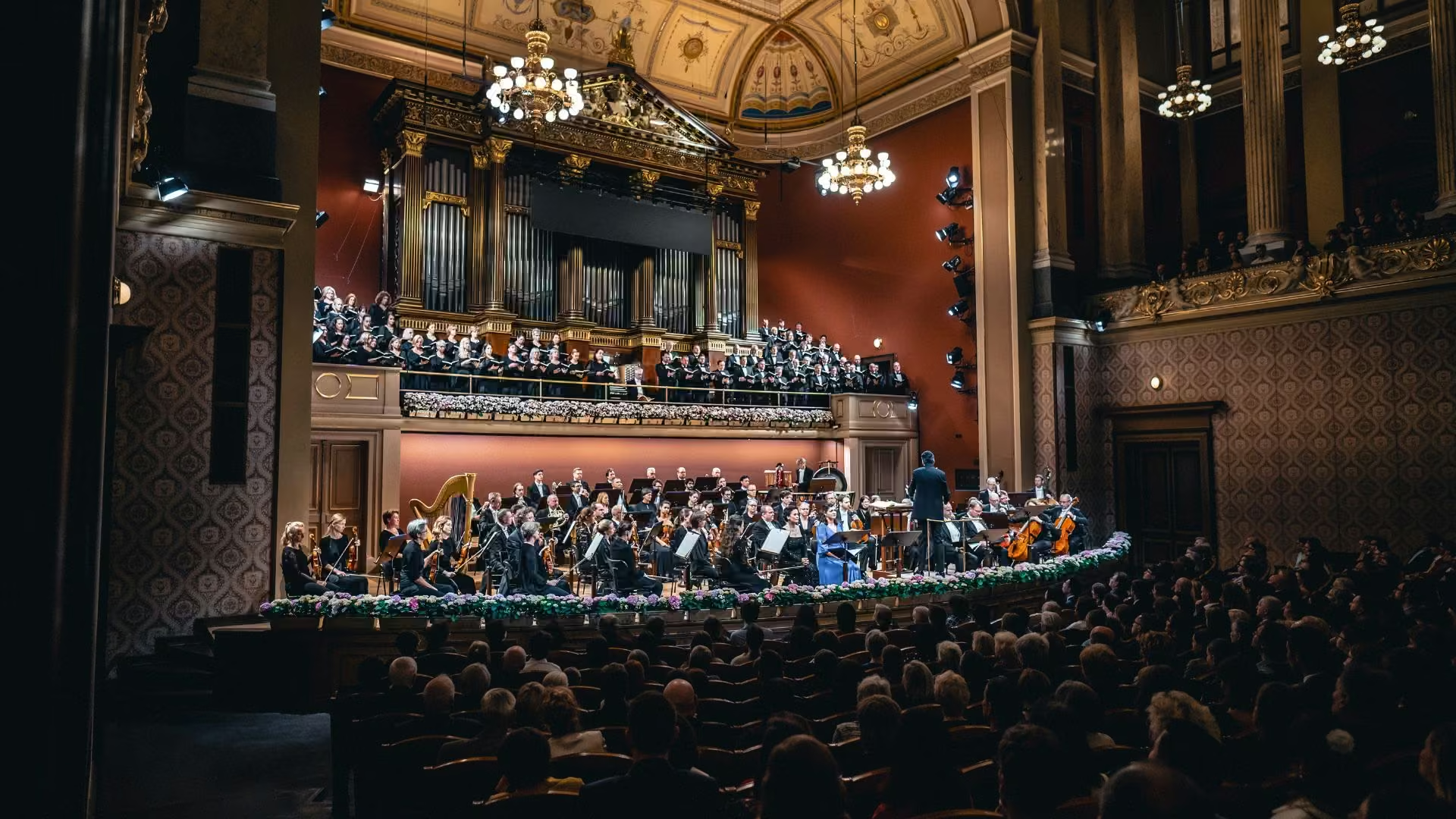
The Prague Philharmonic Choir (PPC) was founded in 1935 by choirmaster and teacher Jan Kühn. Now in its 91st season, it is the oldest professional choir in the Czech Republic. The choir is celebrated beyond Czech borders, especially for its interpretations of oratorios and cantatas. Lukáš Vasilek has served as Principal Conductor and Artistic Director since 2007, joined by Lukáš Kozubík as the choir’s Second Choirmaster.
Under Lukáš Vasilek’s leadership, the Prague Philharmonic Choir has established a reputation as a highly esteemed performing partner of leading international orchestras. At home, the ensemble collaborates regularly with the Czech Philharmonic and, for its own choral concerts, with the Prague Philharmonia. Internationally, the PPC has worked with ensembles such as the Berlin and Dresden Philharmonic Orchestras, Wiener Symphoniker, NDR Elbphilharmonie Orchestra, and the Hong Kong Philharmonic Orchestra.
The PPC has also gained extensive experience working with the world’s top conductors, including Semyon Bychkov, Jakub Hrůša, and Sir Simon Rattle. The choir regularly appears at the Czech Republic’s most renowned festivals, such as Smetana’s Litomyšl, Prague Spring, Dvořák Prague, and Days of Bohuslav Martinů. Since 2010, the PPC has served as Choir in Residence at the Bregenzer Festspiele.
In its 91st season, the Prague Philharmonic Choir will embark on further exciting collaborations with world-renowned conductors, including Zubin Mehta, Antonio Pappano, and Giovanni Antonini.
Alongside its performances, the PPC engages in numerous educational projects. Every season, it presents a cycle of educational concerts for children, catering to both school groups and families. These programs emphasize fun and active engagement with young listeners. The PPC Choral Academy in Honour of Soňa Červená offers singing students the opportunity to gain hands-on experience in a professional ensemble, participate in large-scale musical projects, and learn from collaborations with leading artists.
The choir’s artistic excellence is further demonstrated through its rich recording archive, which continues to expand each season. The PPC has appeared on releases from PENTATONE, Decca Classics, Sony Classical, and Supraphon. Its recordings have earned numerous international accolades, including awards from Gramophone, BBC Music Magazine, and the prestigious Diapason d’Or de l’Année. The PPC’s very first recording, made in 1952, featured Dvořák’s oratorio Stabat Mater conducted by Václav Talich. Its most recent release, Stravinsky, Janáček, Bartók: Village Stories, explores the magic of folk songs and traditional rituals in the music of three 20th-century masters.
The Prague Philharmonic Choir is a laureate of the 2018 Classic Prague Award for Best Vocal Concert, Czech Television’s Classical Music of the Year Award, and the 2022 Antonín Dvořák Prize for exceptional artistic achievements and the promotion of Czech music. The album Village Stories received the Choc de Classica award in May 2024.
source: Prague Philharmonic Choir
photo © Petr Chodura
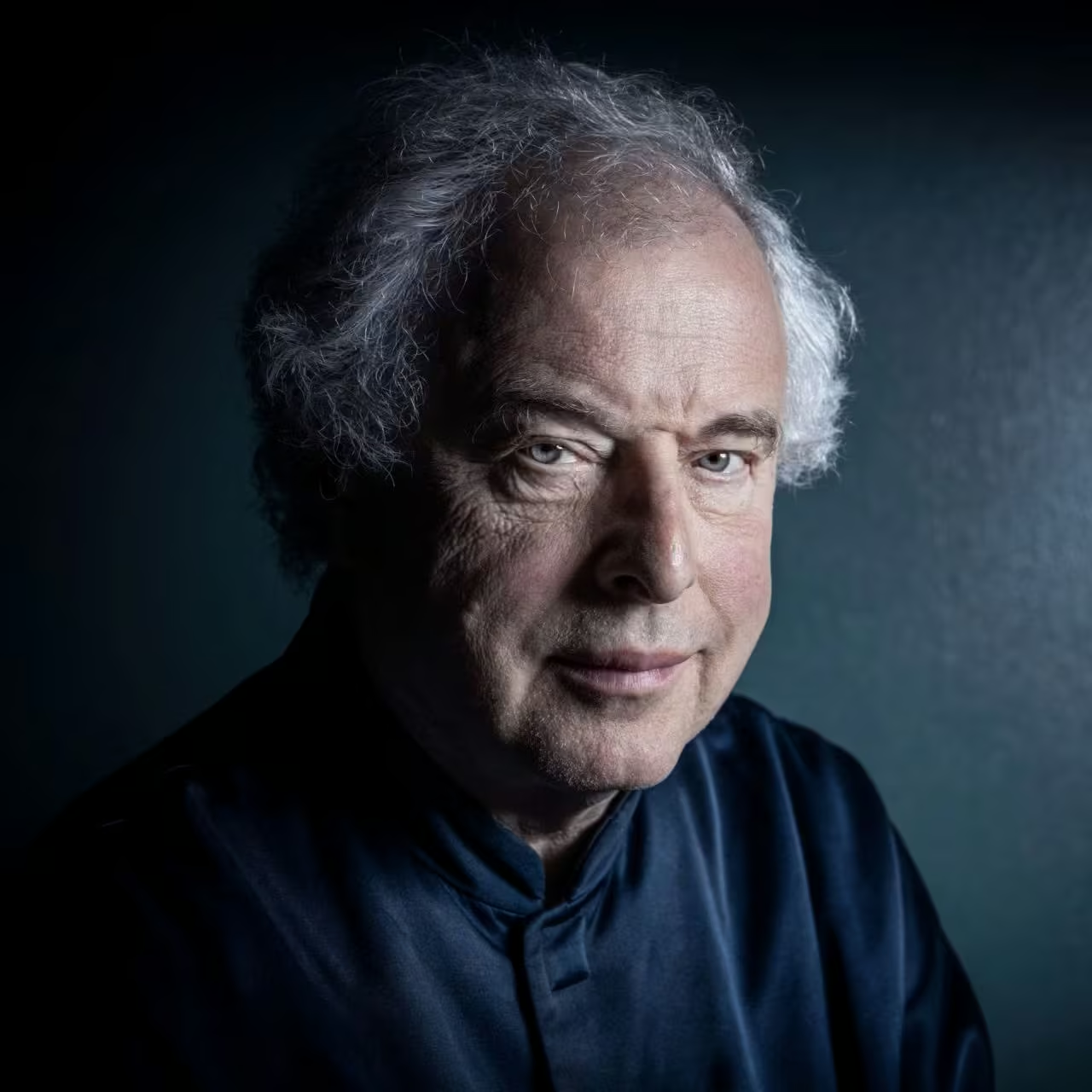
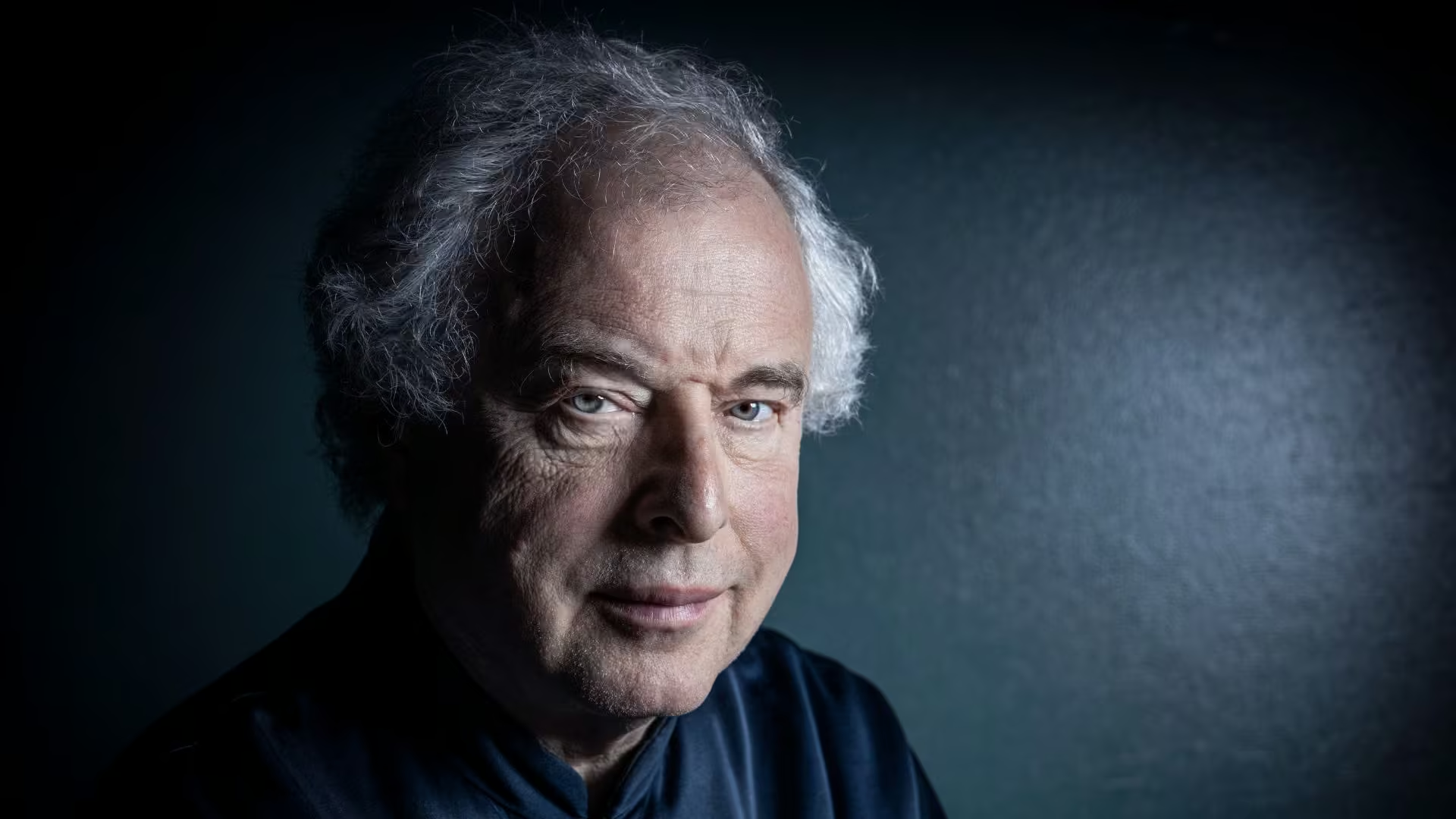
Sir András Schiff was born in Budapest in 1953. He received his first piano lessons at the age of five from Elisabeth Vadász. He later continued his studies at the Franz Liszt Academy in Budapest with Prof. Pál Kadosa, György Kurtág, and Ferenc Rados, as well as with George Malcolm in London.
Piano recitals have always been a central part of his artistic activities, particularly his cyclical performances of piano works by Bach, Haydn, Mozart, Beethoven, Schubert, Chopin, Schumann, and Bartók. Since the pandemic, he no longer announces the programs for his recitals in advance, instead selecting works on the evening of the concert to suit the instrument and the hall.
Sir András Schiff performs with most of the internationally important orchestras and conductors. He focuses on the performance of the piano concertos by Bach, Mozart, and Beethoven under his direction. In 1999, he founded Cappella Andrea Barca, a chamber orchestra composed of musician friends and soloists, with whom he has since worked closely as both conductor and soloist. He also enjoys a longstanding collaboration with the Chamber Orchestra of Europe. Since 1998, he has been the artistic director of the Omaggio a Palladio festival, held at the Teatro Olimpico in Vicenza with Cappella Andrea Barca.
In 2018, he accepted the invitation to become an Associate Artist of the Orchestra of the Age of Enlightenment, which met his growing interest in performing on historical keyboard instruments.
Sir András Schiff has been a passionate chamber musician since his youth. From 1989 to 1998, he directed the Musiktage Mondsee, a chamber music festival in Austria that gained significant international recognition. Together with Heinz Holliger, he was also the artistic director of the Ittinger Pfingstkonzerte at Kartause Ittingen, Switzerland, from 1995 to 2013.
Supporting young musicians is particularly close to his heart. He teaches piano and chamber music at the Kronberg Academy and the Barenboim-Said Academy and gives numerous masterclasses. In 2014, he founded the Building Bridges mentoring program, which provides long-term support for emerging pianists.
For 15 years, Sir András Schiff was an exclusive Decca artist; in celebration of his 70th birthday, the label released a box set containing all 78 albums he recorded for them. Since 1998, he has recorded exclusively for ECM, where his live recordings of Beethoven’s complete piano sonatas, performed at the Zurich Tonhalle, received the highest accolades. His album Geistervariationen, featuring compositions by Robert Schumann, won the 2012 International Classical Music Award in the category Solo Instrument Recording of the Year. A chamber music edition in collaboration with clarinetist and composer Jörg Widmann includes Brahms’s two clarinet sonatas, Op. 120, as well as Intermezzi for Piano, composed by Widmann and dedicated to Sir András Schiff. His most recent recordings include Brahms’s two piano concertos, performed on a historic Blüthner piano with the Orchestra of the Age of Enlightenment (2021), and a selection of J.S. Bach’s key works, played on a clavichord (2023).
In March 2017, his book Musik kommt aus der Stille (Music Comes Out of Silence) was published by Bärenreiter and Henschel. The book, which includes essays and conversations with Martin Meyer, explores Schiff’s artistic philosophy, playing techniques, interpretative methods, and professional experiences as a pianist and conductor. It has been translated into several languages and republished in 2024.
In the spring of 2011, Schiff made headlines when he publicly spoke out against alarming political developments in Hungary. In response to the insults and attacks he received from Hungarian nationalists, he decided to stop performing in his home country.
Sir András Schiff has received numerous international prizes and distinctions. In 2006, he was honoured with an honorary membership of the Beethoven-Haus Bonn for his outstanding achievements as a Beethoven interpreter. He has been the recipient of the Robert Schumann Prize of the City of Zwickau and the Order Pour le Mérite for Sciences and Arts since 2011. In 2012, he was awarded the Grand Cross of Merit with Star of the Federal Republic of Germany, the Wigmore Hall Medal in London for his 30 years of musical activity, and the Golden Mozart Medal of the International Mozarteum Foundation. In the same year, he was also appointed Special Supernumerary Fellow of Balliol College (Oxford, UK) and received the Royal Philharmonic Society's highest honour, the Gold Medal, in London. He received honorary doctorates from the University of Leeds in 2014 and the Royal College of Music in 2018. In 2013, he was knighted by Queen Elizabeth II, receiving the title Knight Bachelor for his services to music. In 2021, he was awarded the Antonín Dvořák Prize in Prague for his many years of promoting Czech composers through his numerous recordings and concert activities worldwide. In 2022, he received the Bach Medal of the City of Leipzig as one of the most important Bach interpreters of our time.
He has been an honorary citizen of the city of Vicenza since December 2014 and an honorary member of the Accademia Olimpica di Vicenza since 2016, from which he received the Lauro Olimpico in 2023 for his extraordinary contribution to the enhancement of Vicenza's artistic and cultural heritage. In March 2024, he was awarded the Una vita nella musica prize by the Teatro La Fenice in Venice. In January 2012, he was awarded the Golden Mozart Medal of the International Mozarteum Foundation. He has been an honorary member of the Wiener Konzerthaus since the same year.
In August 2023, at his 66th appearance at the Salzburg Festival, he was honoured with the Festival Pin with Rubies as an “essential artist who has shaped Festival history.” In June 2024, Sir András Schiff was awarded the Austrian Cross of Honour for Science and Art, First Class, and received the Bösendorfer Ring, which had previously been awarded to Wilhelm Backhaus and Paul Badura-Skoda.
source: Künstleragentur Dr. Raab & Dr. Böhm
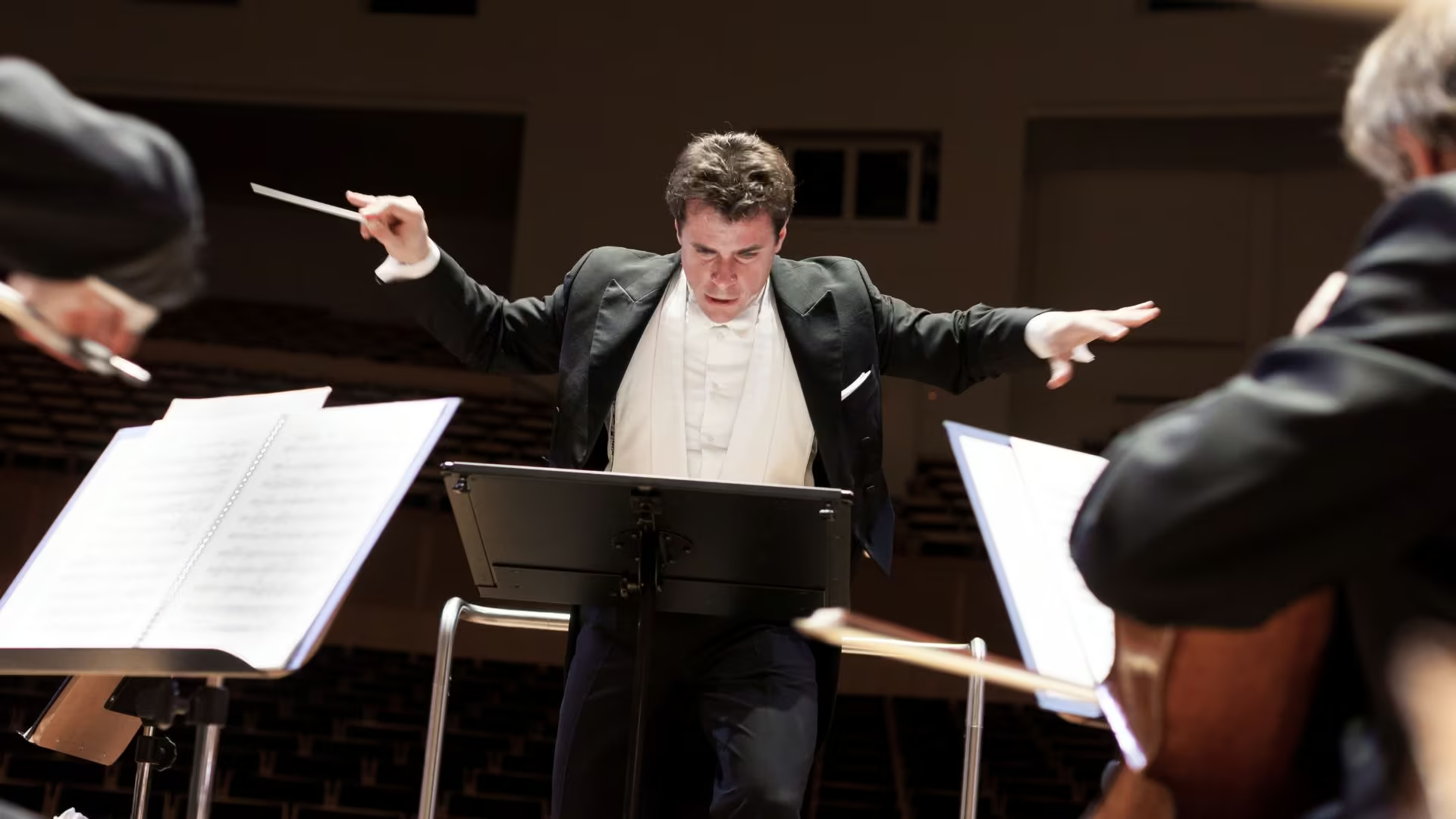
Internationally acclaimed Czech conductor Jakub Hrůša is Chief Conductor of the Bamberg Symphony, Music Director of The Royal Opera, Covent Garden (from 2025), and Chief Conductor and Music Director Designate of the Czech Philharmonic (from 2028).
He is a frequent guest with many of the world’s greatest orchestras, enjoying close relationships and performing regularly with the Vienna Philharmonic, Berlin Philharmonic, Bavarian Radio Symphony, Munich Philharmonic, Leipzig Gewandhaus Orchestra, Staatskapelle Dresden, Tonhalle Orchester Zürich, Lucerne Festival Orchestra, Royal Concertgebouw Orchestra, Orchestre de Paris, Orchestre Philharmonique de Radio France, NHK Symphony and the Mahler Chamber Orchestra – and in the US with The Cleveland Orchestra, New York Philharmonic, Chicago Symphony Orchestra, and Boston Symphony Orchestra.
As a conductor of opera, he has led productions for the Lyric Opera of Chicago (Jenůfa), Salzburg Festival (Kát’a Kabanová with the Vienna Philharmonic), Vienna State Opera (The Makropulos Case), Royal Opera House, Covent Garden (Carmen and Lohengrin), Opéra National de Paris (Rusalka), and Zurich Opera (The Makropulos Case). He has also been a regular guest with Glyndebourne Festival, conducting Vanessa, The Cunning Little Vixen, A Midsummer Night’s Dream, Carmen, The Turn of the Screw, Don Giovanni and La bohème, and served as Music Director of Glyndebourne On Tour for three years.
His relationships with leading vocal and instrumental soloists have included collaborations in recent seasons with Behzod Abduraimov, Piotr Anderszewski, Leif Ove Andsnes, Emanuel Ax, Lisa Batiashvili, Joshua Bell, Yefim Bronfman, Rudolf Buchbinder, Renaud Capuçon, Gautier Capuçon, Isabelle Faust, Bernarda Fink, Julia Fischer, Sol Gabetta, Véronique Gens, Christian Gerhaher, Kirill Gerstein, Karen Gomyo, Hélène Grimaud, Augustin Hadelich, Hilary Hahn, Barbara Hannigan, Alina Ibragimova, Steven Isserlis, Janine Jansen, Sheku Kanneh-Mason, Leonidas Kavakos, Evgeny Kissin, Patricia Kopatchinskaja, Lang Lang, Igor Levit, Karita Mattila, Albrecht Mayer, Anne-Sophie Mutter, Stephanie d’Oustrac, Emmanuel Pahud, Beatrice Rana, Kian Soltani, Josef Špaček, Nikolaj Szeps-Znaider, Antoine Tamestit, Jean-Yves Thibaudet, Daniil Trifonov, Mitsuko Uchida, Klaus Florian Vogt, Lukáš Vondráček, Yuja Wang, Alisa Weilerstein, and Frank Peter Zimmermann.
As a recording artist, Jakub Hrusa has received numerous awards and nominations. He was a double winner at the 2024 Gramophone Awards in both the Concerto and Opera categories, for his recordings of Britten’s Violin Concerto with Isabelle Faust and Bavarian Radio Symphony Orchestra, and Kát’a Kabanová with the Vienna Philharmonic at Salzburg Festival. With Bamberg Symphony, he received the ICMA Prize for Symphonic Music in both 2022 and 2023, for his recordings of Rott’s Symphony No. 1 and Bruckner’s Symphony No. 4. He was also the 2023 Opus Klassik Conductor of the Year. He was awarded the Preis der Deutschen Schallplattenkritik for his recording of Mahler’s Symphony No. 4, and in 2021 his recording of Martinů and Bartók violin concertos with Frank Peter Zimmermann was nominated for BBC Music Magazine and Gramophone awards, and his disc of the Dvořák Violin Concerto with the Bavarian Radio Symphony and Augustin Hadelich was nominated for a Grammy ® Award. His recordings of Dvořák and Martinů Piano Concertos with Ivo Kahánek and the Bamberg Symphony (Supraphon), and Vanessa from Glyndebourne (Opus Arte) both won BBC Music Magazine Awards in 2020. Other recent releases include Strauss songs with Bamberg Symphony and Kateřina Kněžíková (Supraphon), Dvořák and Brahms Symphonies with Bamberg Symphony (Tudor), Suk’s Asrael Symphony with the Bavarian Radio Symphony (BR Klassik), and Dvořák’s Requiem and Te Deum with the Czech Philharmonic (Decca).
Jakub Hrůša studied conducting at the Academy of Performing Arts in Prague, where his teachers included Jiří Bělohlávek. He is an Honorary Member of the Royal Academy of Music in London, and in 2024 received the Silver Medal of the President of the Czech Senate, its highest award. He was the inaugural recipient of the Sir Charles Mackerras Prize, and has also been awarded the Bavarian Culture Prize, the Czech Academy of Classical Music’s Antonín Dvořák Prize, and – together with Bamberg Symphony – the Bavarian State Prize for Music.
source: Jakub Hrůša
photo © Lenka Hatasová
photo © Andreas Herzau
A bright, lyrical soprano voice with a tinge of Slavonic sadness that rises to the heights with incredible lightness – that is how one might typically describe the voice and singing of Gabriela Beňačková, whose vocal career is one of the most brilliant to have emerged from Slovakia when it was still part of a country shared with the Czech people.
Around the world, Ms. Beňačková is the definitive performer of the role of Mařenka in The Bartered Bride, of major female roles in the operas of Leoš Janáček, and of the title role in Dvořák’s Rusalka. Her recording of The Bartered Bride under the baton of Zdeněk Košler is regarded as the key to the modern interpretation of Bedřich Smetana’s most popular opera. Besides Beňačková and the Slovak tenor Peter Dvorský singing the role of Jeník, the recording also features the bass Richard Novák and the Czech Philharmonic, two subsequent winners of the Antonín Dvořák Prize in 2016 and 2018.
Gabriela Beňačková was born on 25 March 1947 in Bratislava, and she devoted herself to music from her childhood. She sang in the Czechoslovak Radio Children’s Choir in Bratislava, and later she studied singing at the conservatoires in Bratislava and Žilina and at the Academy of Performing Arts in Bratislava. She became a member of the opera ensemble at the National Theatre in Prague in 1975. She soon worked her way upwards and became a leading member of the ensemble, but in parallel to her successes at home, she was also on the fact track to a big career abroad.
Ms. Beňačková became an ensemble member at the Bavarian State Opera and the Vienna State Opera, where one of her major roles was Maddalena in the opera Andrea Chénier. Plácido Domingo sang the title role, and Ms. Beňačková made an outstanding vocal pairing with him. Together, they also created the roles of Otello and Desdemona in Giuseppe Verdi’s opera, which they performed many times at the Metropolitan Opera, where Ms. Beňačková also gave remarkable performances of Káťa Kabanová. She later recorded this Janáček opera under the baton of Charles Mackerras. At the Metropolitan Opera, the Vienna State Opera, and other important theatres, Ms. Beňačková has made her mark as a moving performer of the title part in Dvořák’s Rusalka. She has been recorded twice in the role, once with the Czech Philharmonic and once in Vienna. Václav Neumann conducted on both recordings, and on the first of them, Beňačková again joined forces with Richard Novák in the role of the Water Goblin. Ms. Beňačková also appeared in Neumann’s complete set of recordings of the symphonies of Gustav Mahler. She has sung the soprano parts in Dvořák’s Requiem and Stabat Mater and has made recordings under the baton of Wolfgang Sawalisch.
Ms. Beňačková has been appreciated not only in the Czech and Slovak repertoire; she has been simply outstanding singing lyric roles. She has sung Mimi in Puccini’s La bohème and Margeurite in Gounod’s Faust and Boito’s Mefistofele. Her partners were the world’s top singers of the 1970s through the ’90s.
In about 1997 she began to withdraw from her life as a performer, and it seemed that her career as a singer had definitively ended, but in 2012 she appeared at the Salzburg Festival as the Countess de la Roche in Bernd Alois Zimmermann’s opera Die Soldaten. In 2018 she surprisingly played the role of Kabanicha in Janáček’s Káťa Kabanová – the public at the Teatro San Carlo in Naples saw Ms. Beňačková as Káťa’s tyrannical mother-in-law. The album of songs by Dvořák, Janáček, and Martinů, which she recorded in 1994 with the pianist Rudolf Firkušný, was nominated for a Grammy.
At present, she is the president of the Gabriela Beňačková International Vocal Competition. She has earned the title of Kammersängerin with the Bavarian State Opera and Vienna State Opera, and she has been awarded the Medal of Merit and the Order of the White Double Cross. She has won the Antonín Dvořák Prize as an outstanding artist who is still active.
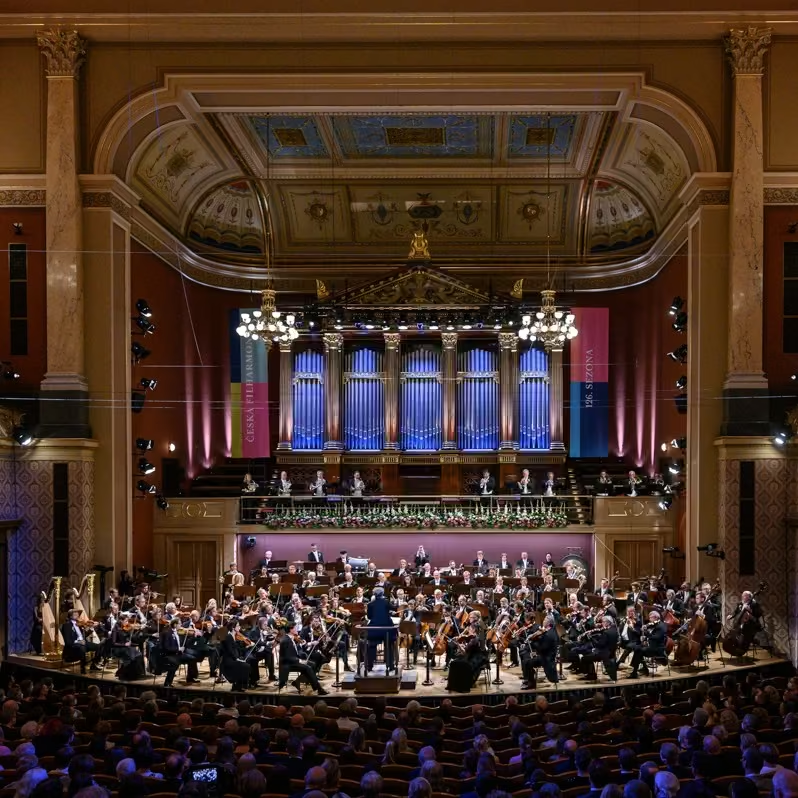
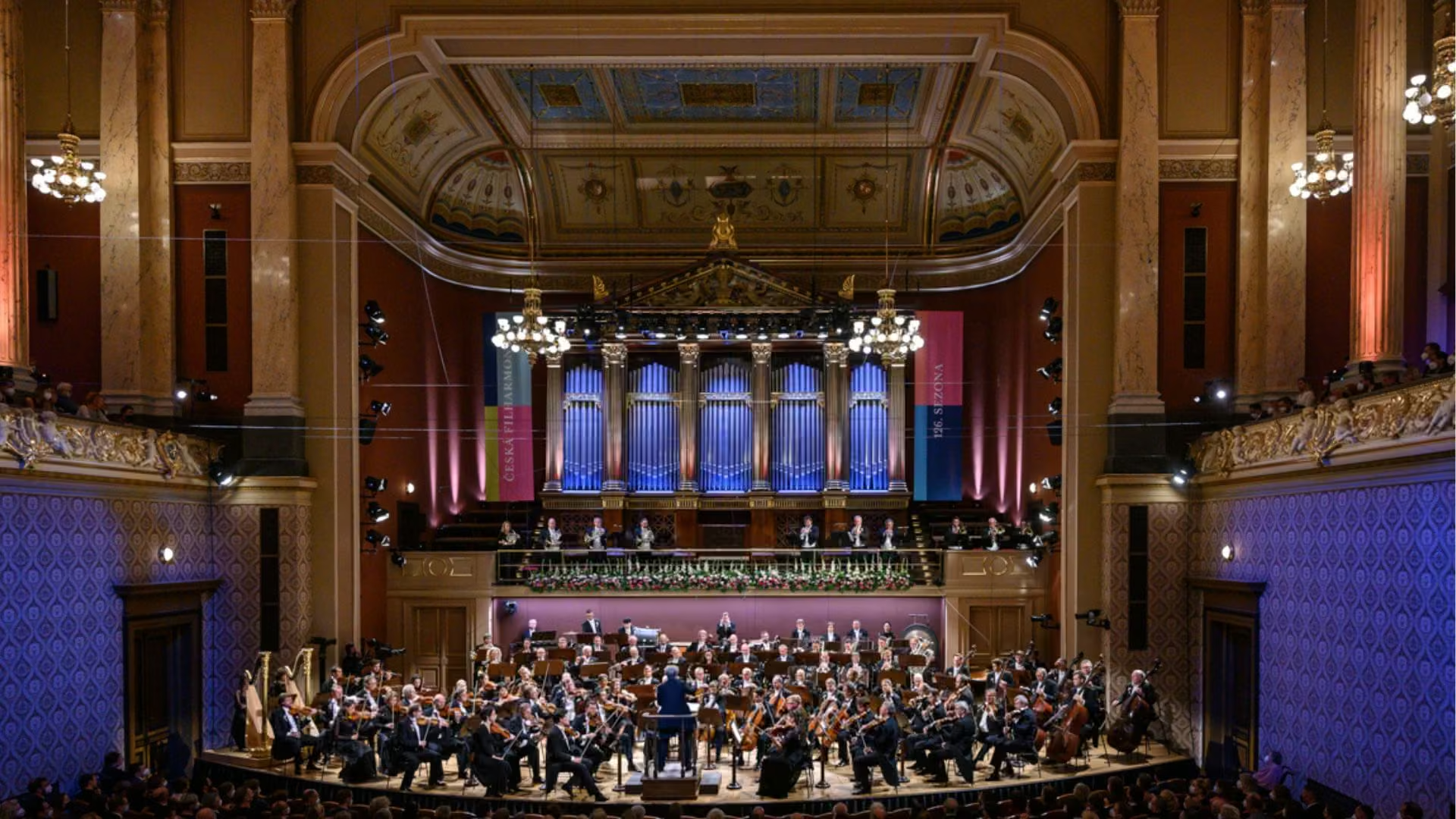
Named Gramophone’s Orchestra of the Year in 2024, the Czech Philharmonic is recognised as one of the world’s leading orchestras and remains the Czech Republic’s key cultural ambassador. Now in its 131st season, the orchestra combines a deep-rooted musical tradition with an international artistic outlook, expanding its profile through tours, residencies and recordings.
During the 2024 Year of Czech Music, the Czech Philharmonic and its Chief Conductor and Music Director Semyon Bychkov gave a three-day residency at New York’s Carnegie Hall. That same year saw the release of their recording of Smetana’s Má vlast (My Country), which went onto win the 2025 BBC Music Magazine Orchestral Award. In addition to Czech music, the orchestra’s long-standing relationship with composers such as Brahms, Tchaikovsky and Mahler has resulted in a series of benchmark recordings, including The Tchaikovsky Project (2019) and the first new cycle of Mahler symphonies in more than 40 years, released in 2026. The next release with Bychkov features Shostakovich’s Symphony Nos. 5 and 7.
The 131st season opens in Prague with Shostakovich’s Violin Concerto No. 1 featuring Artist-in-Residence Janine Jansen, alongside Dvořák’s Symphony No. 7. Touring highlights include the orchestra’s first visit in over 50 years to Sweden and Finland, a return to Lucerne Festival, and residencies in London, Vienna and Hamburg. At home, the Czech Philharmonic performs at the Rudolfinum in Prague and at leading Czech festivals including Dvořák Prague, Prague Spring, Smetana Litomyšl, and for the first time, Janáček Brno.
Repertoire this season with Bychkov includes Má vlast; works by Mussorgsky, Ravel, Adams, Strauss, Glanert and Britten; and a major focus on Rachmaninoff, presented both in Prague and on tour. Beethoven’s Ninth Symphony, performed with the Prague Philharmonic Choir, will mark the 200th anniversary of the composer’s death in 2027.
Principal Guest Conductors Simon Rattle and Jakub Hrůša both return this season. With Rattle, the orchestra presents music by Barber, Shostakovich, Debussy, Szymanowski and the Czech premiere of Composer-in-Residence Thomas Adès’s Aquifer. With Hrůša – appointed last year as the orchestra’s next Chief Conductor and Music Director (Renáta Kellnerová Chair) from the 2028/2029 season – they perform works by Strauss, Beethoven, Suk and a world premiere by Martin Smolka.
Guest conductors this season include Vasily Petrenko, Herbert Blomstedt, Elim Chan, Maxim Emilyanchev, and Daniel Harding, who closes the subscription season with the Accademia Nazionale di Santa Cecilia. Guest soloists include Yuja Wang, Behzod Abduraimov, Mao Fujita, Yunchan Lim, Seong-Jin Cho, Karen Gomyo, Radek Baborák and Kirill Gerstein.
The Czech Philharmonic’s distinguished history reflects the Czech Republic’s complex political past and its central European location. An early champion of the music of Martinů and Janáček, the Czech Philharmonic gave its first concert in 1896 with an all-Dvořák programme conducted by the composer itself.
Alongside its commitment to championing Czech composers, the orchestra’s belief in the power of music to transform lives remains a defining principle. The Czech Philharmonic Youth Orchestra, Orchestral Academy, and Jiří Bělohlávek Prize for young musicians, form part of the orchestra’s education strategy which engages with more than 400 schools. An inspirational music and song programme led by Ida Kelarová continues to support social inclusion by giving voice to Romany communities through music.
source: Česká filharmonie
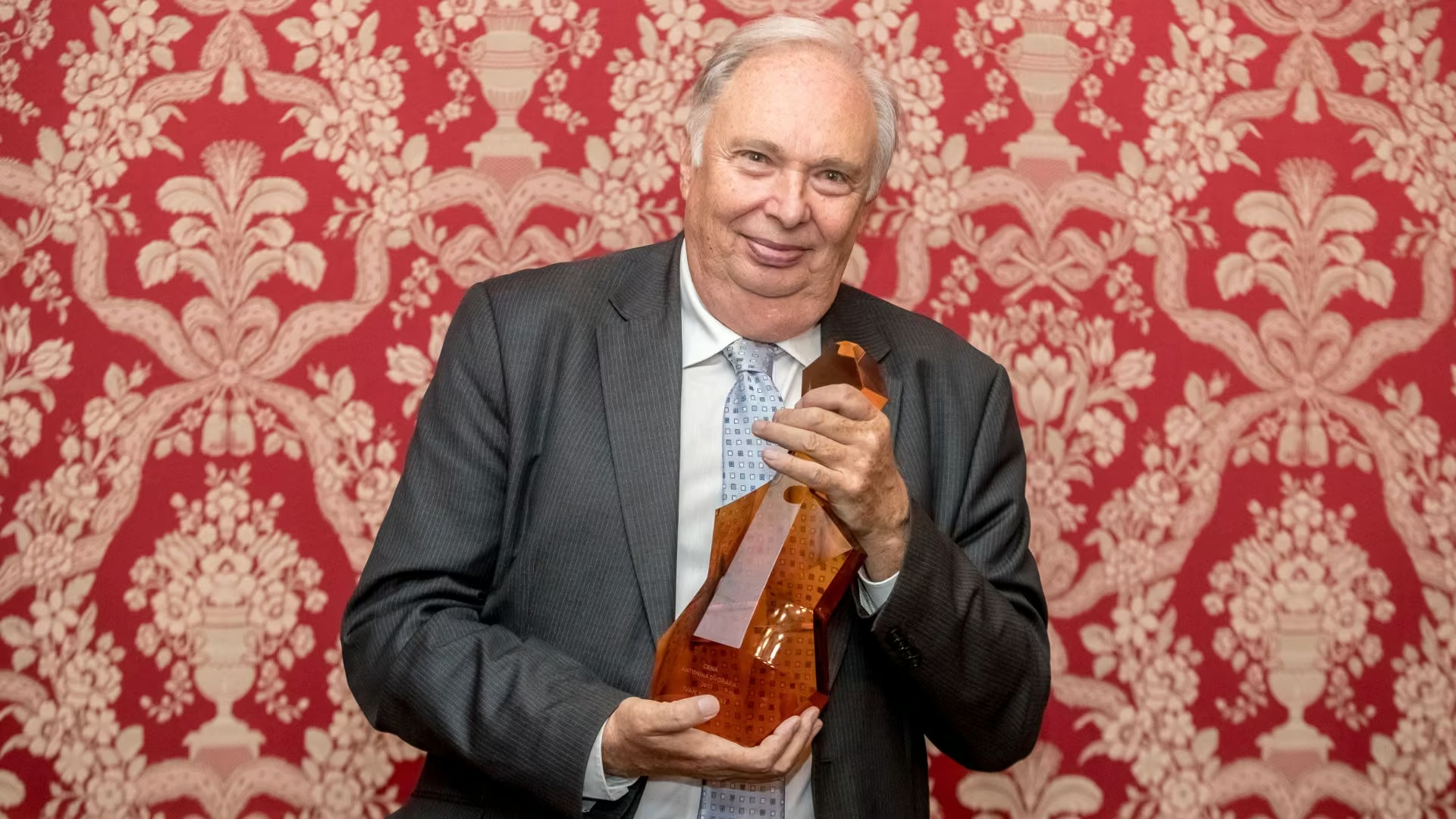
The pianist Ivan Klánský is emotionally systematic, to put it briefly. His playing naturally combines a systematic approach with powerfully radiant emotion. Now seventy years old, Mr. Klánský regards the balance of these two elements as very important: to him, the ability to formulate emotion comprehensibly is fundamental both for the artist and for the teacher. And he also sees this balance in his most accomplished pupils Ivo Kahánek and Martin Kasík.
Klánský studied piano at the Prague Conservatory under the wonderful pianist Valentina Kameníková – recordings document her artistry, and stories are being told to this day about her harsh teaching methods, but Klánský did not allow himself to be dissuaded. He worked in parallel under František Rauch, and when he finished his studies with the two teachers, he was ready for his future career.
He articipated successfully at competitions in Bolzano (1967), Naples (1968), Leipzig (1968), Barcelona (1970), and Warsaw (1970). At the International Chopin Piano Competition, he became the first and still the only Czech to reach the finals. Chopin would remain the love of his life, and in 1992 Klánský became the chairman of the Fryderyk Chopin Society.
Ivan Klánský’s solo repertoire consists mainly of Bach, Mozart, and Beethoven, and of the Romantics, he plays mainly Chopin and Schumann. He has also recorded the complete piano works of Bedřich Smetana, released on six CDs. Dvořák holds a special place in Mr. Klánský’s repertoire. It is rather unusual for a pianist to become a laureate of the Antonín Dvořák Prize. Ivan Klánský himself commented that Dvořák is not a typical piano composer, but he emphasised Dvořák’s chamber music in particular: “Of Dvořák’s music, his chamber works with piano are dearest to me. There are the four piano trios, the two piano quartets, and the two piano quintets, and I adore the Slavonic Dances, which Dvořák originally composed for piano four hands. I play them with my son Lukáš, and we’ve even recorded them on a CD. Dvořák was capable of using the piano to create things of beauty, although he did not write much solo piano music. He wrote a lovely piano concerto, but you couldn’t put together a full recital of just his solo pieces. But his chamber music is all the more beautiful, and those pieces are among my favourites in the entire repertoire.”
Ivan Klánský is currently the dean of the faculty of music at the Academy of Performing Arts in Prague, and he is still intensively engaged in giving concerts – both as a soloist and with the famed Guarneri Trio Prague, of which he is a member. He became a laureate of the Antonín Dvořák Prize in 2017.
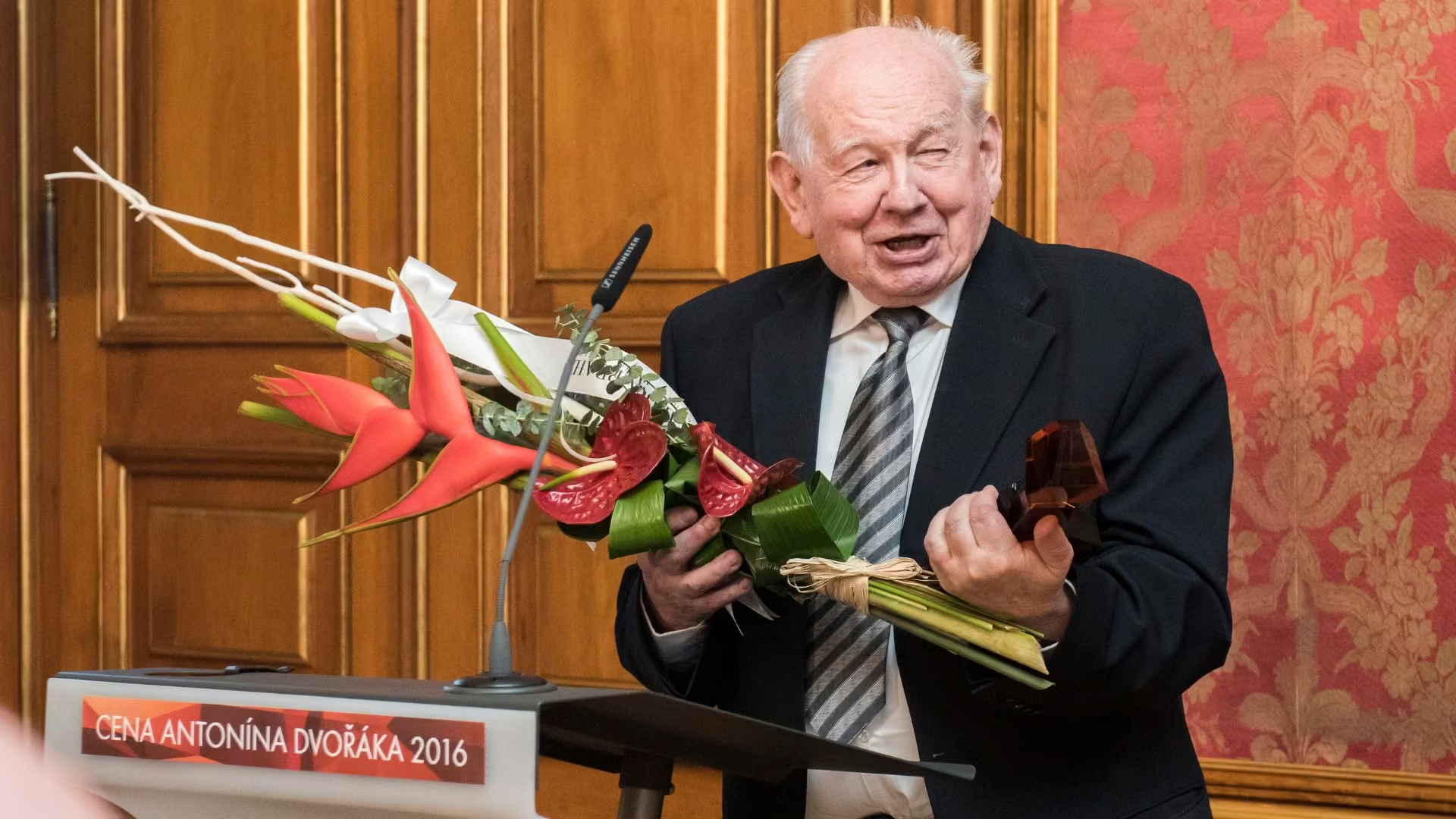
„Receiving the Antonín Dvořák Prize is the most beautiful thing that could have happened to me,“
said the bass Richard Novák in an attempt to describe his feelings.
The year was 2016, and the singer was celebrating his 85th birthday – not quietly at home, but on the concert stage. After all, his career was far from over. At his birthday celebration, Richard Novák joked that he didn’t need to exercise his voice anymore – just his memory.
At the Smetana’s Litomyšl Festival, he gave the world premiere of the cycle Evening Songs in an arrangement for harp, and he also sang at the gala concert that concluded the festival. Richard Novák commemorated his eightieth birthday in Brno – the city in the south of Moravia where he spent most of his life. It was a magnificent celebration: on his birthday, 2 October, he sang the role of the pilgrim Ivan in Dvořák’s oratorio Saint Ludmila.
A month later, he gave a recital with a full evening of lieder – Brahms and Loewe for the first half, then songs by Czech composers of the twentieth century after intermission. Both evenings were thrilling, but Saint Ludmila was perhaps more in keeping with the mood of celebration. The performance of Dvořák’s festive oratorio was by no means a mere excuse to allow a worthy old man one more appearance on stage. It was a dignified celebration of a major milestone in the great singer’s life.
At the same time, it was a powerful reminder that singers can safeguard the length of their careers only by treating their voices responsibly and by having perfect technique. Paradoxically, Richard Novák is basically an amateur as a singer; after having only taken some private lessons, he was selftaught.
At the Brno Conservatory he studied composition, and while he composed almost no music of his own, he had a great deal of understanding for the music of his contemporaries. A large number of composers turned to Mr. Novák when their new works did not meet with comprehension from other singers. Later on, they would come to him directly.
Richard Novák often sang world premieres that perhaps no one else would have performed. Among the composers to write music for him were Zbyněk Vostřák, Josef Berg, and his uncle Jan Novák – an important Czech composer who emigrated from communist Czechoslovakia. Richard Novák kept detailed records of his appearances – he gave over 3,000 operatic performances alone.
He also made a number of recordings, foremost among which are the works of Leoš Janáček and Antonín Dvořák. He has recorded Janáček’s Glagolitic Mass twice – with Riccardo Chailly for the Decca label and with Charles Mackerras for Supraphon. He still enjoys recalling some of the moments from his career of 64 years. Like singing Dvořák’s cantata The Spectre’s Bride in the 1980s at the opera in Munich with Wolfgang Sawallisch. Or his participation in the first recording of the oratorio Saint Ludmila in 1964.
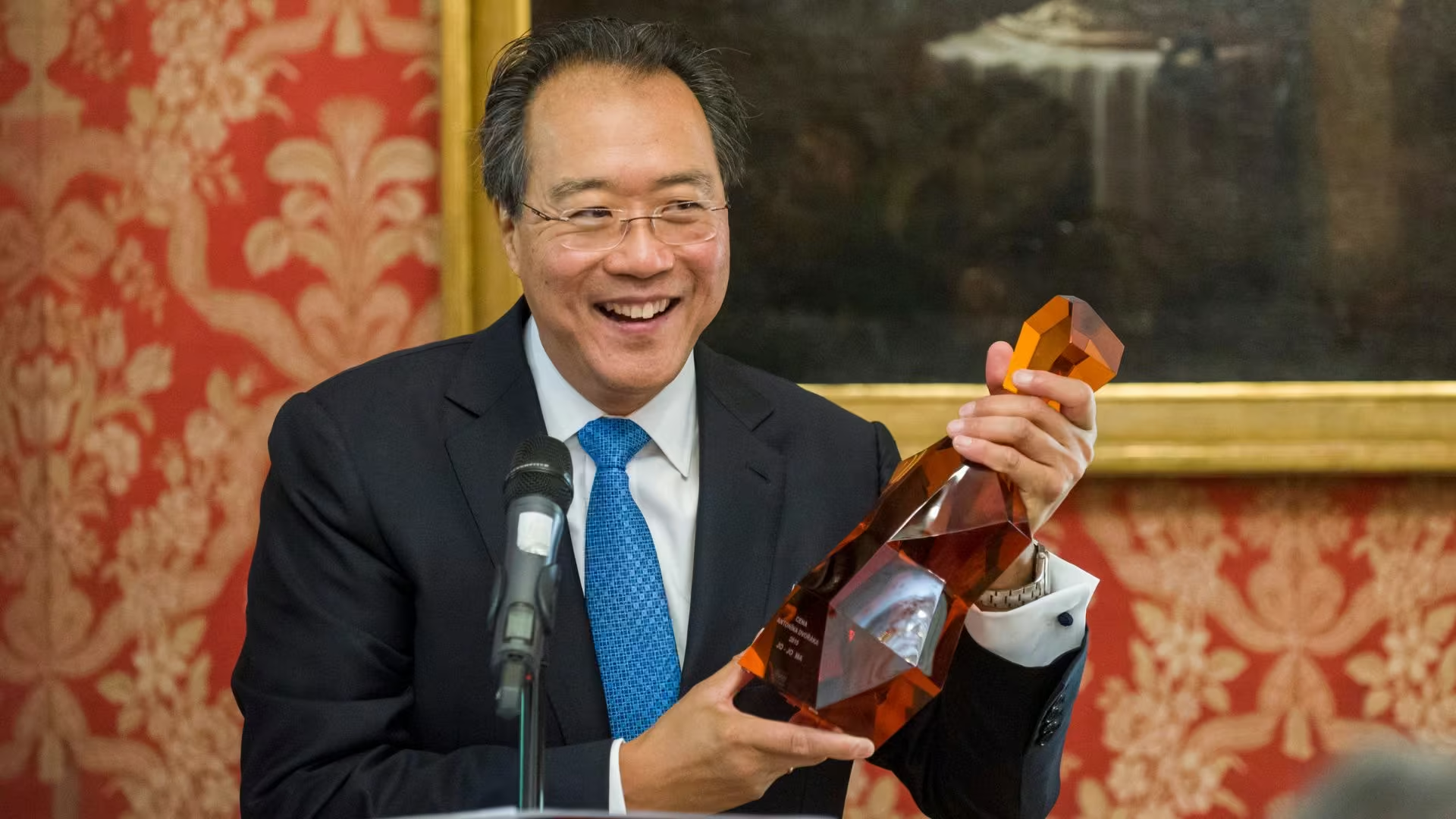
Born to Chinese parents in France, Yo-Yo Ma attended school in New York and studied at the Julliard School and Harvard. He is known all around the world.
Today, the cellist Yo-Yo Ma is one of the most famous figures of the music world, which he does not divide into classical and popular – genres are meaningless to him. He plays Dvořák’s Cello Concerto with the same naturalness as American bluegrass, Chinese folk music, or the Argentine tango. He moves us as a musician and as a person – to him, music is a means of communication and of understanding between peoples.
Since 2006, Yo-Yo Ma has been a United Nations Messenger of Peace. When Yo-Yo Ma received the Antonín Dvořák Prize in 2015, he said the following: “Dvořák didn’t compose music for the sake of music as such or for the sake of art; he wrote it for life. That’s how it seems to me.” So Dvořák’s Cello Concerto suddenly ceases to be just an opportunity to shine as a soloist in a popular, beautiful composition. Yo-Yo Ma has laid claim to the ideological foundations upon which Dvořák erected his masterpieces.
Yo-Yo Ma is more than just a soloist – regardless of his being a top-calibre musician. He is also an ambassador of the arts, which receive less and less time and resources in a world that focuses on performance and profits. His aim is for schools to devote just as much attention to arts education as to technical and scientific fields. Success in that effort might mean more to Yo-Yo Ma than all of the awards he has received, whether the National Medal of Arts, the Presidential Medal of Freedom, the Polar Music Prize, or any of his 18 Grammy Awards. More than just a musician, Yo-Yo Ma is also engaged as a citizen: he played at the first reading of the names of the victims of the attack on the World Trade Center and at the interfaith worship service for victims of the Boston Marathon bombing. He was an advisor to President Barrack Obama, and in March 2016 he was appointed as Artistic Advisor at Large to the Kennedy Center.
Thanks to his popularity, Yo-Yo Ma even appeared in the episode Puffless, Mr. Burns of the comedy series The Simpsons. Yo-Yo Ma first appeared in Prague in the spring of 1989: with the conductor Václav Neumann and the Czech Philharmonic he played Dvořák’s Cello Concerto. He played the same concerto in Prague twenty-six years later at the Dvořák Prague Festival. Conducting the Czech Philharmonic was Jiří Bělohlávek, whom Yo-Yo Ma succeeded as the next laureate of the Antonín Dvořák Prize.
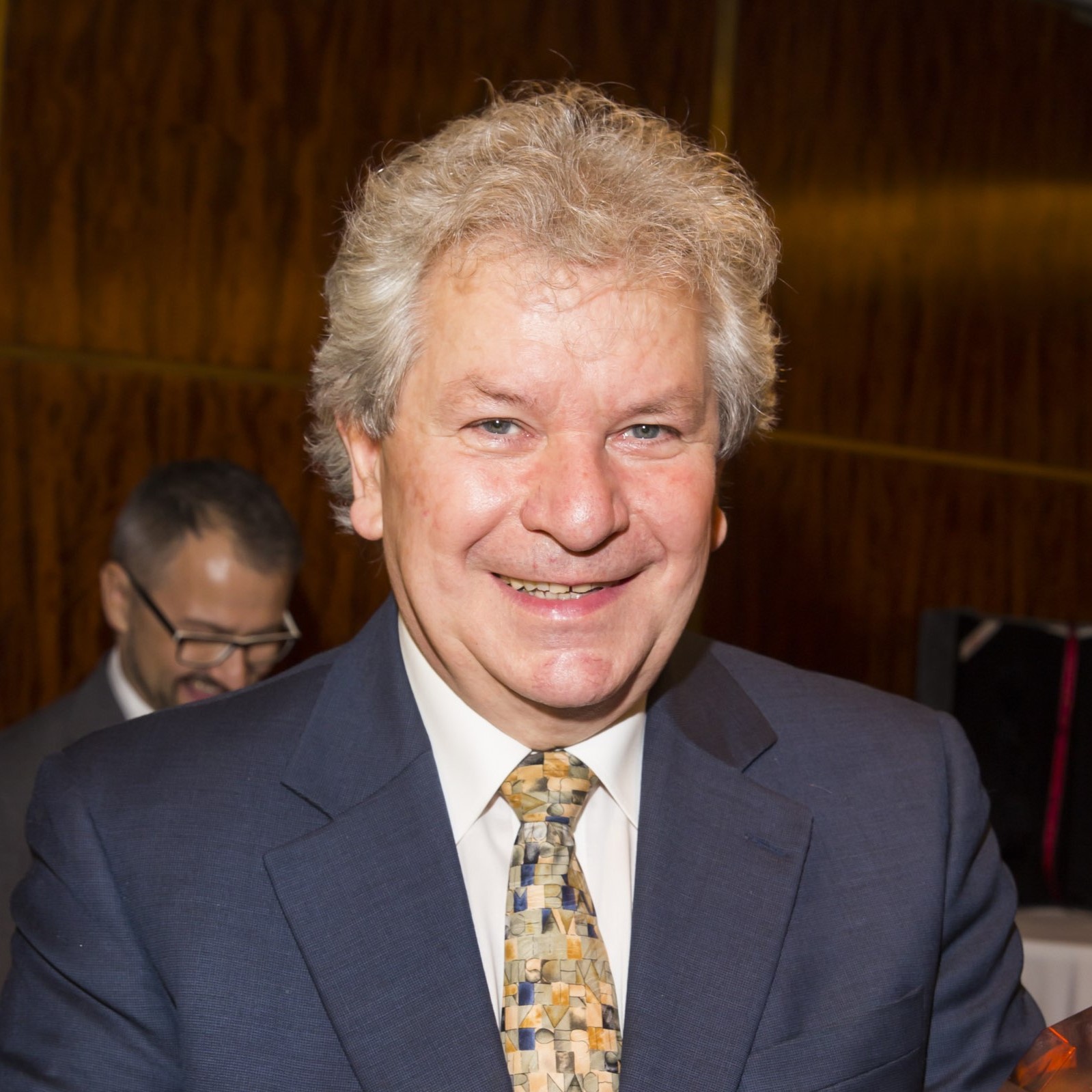
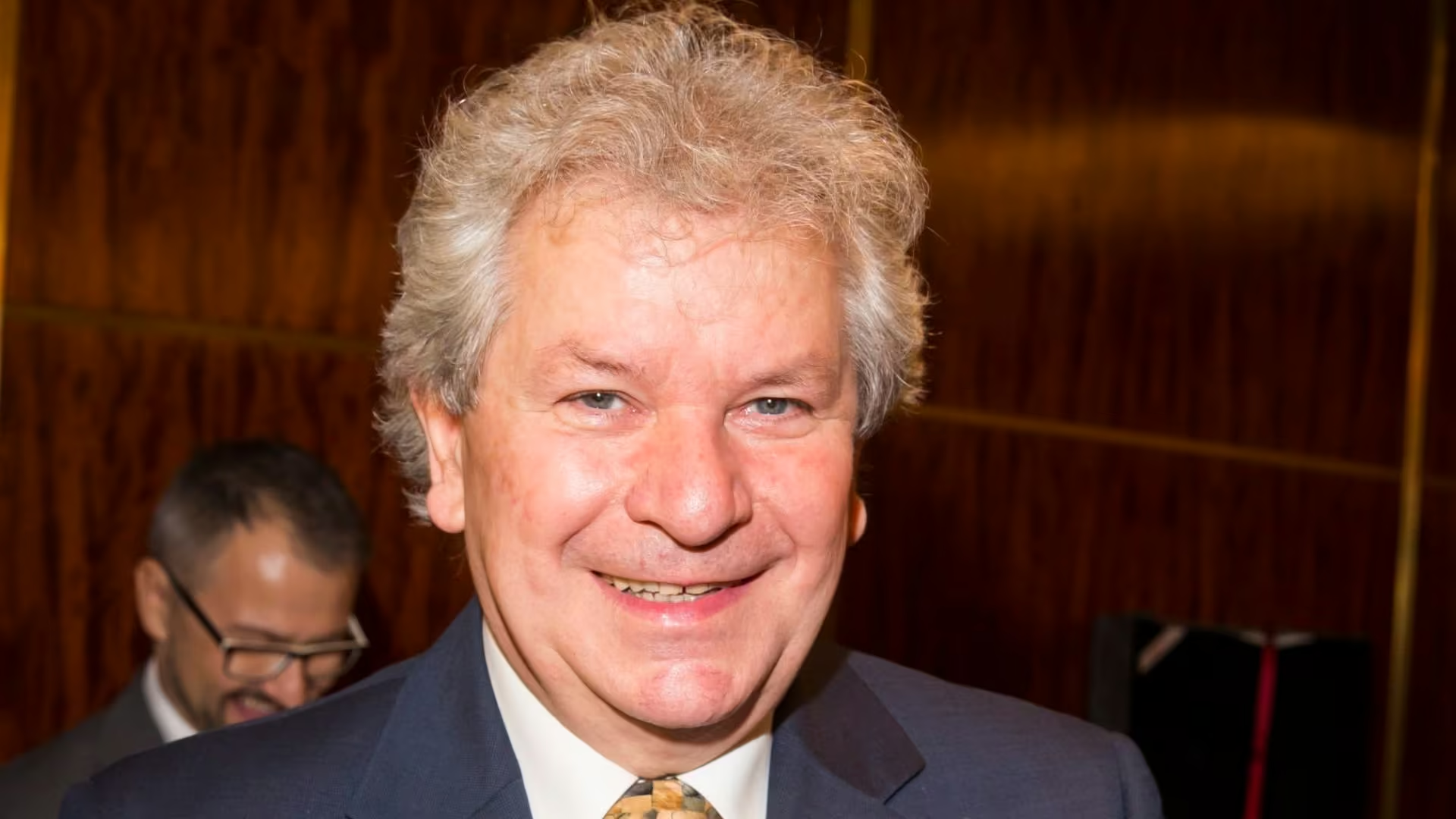
The conductor Jiří Bělohlávek was an ambassador of Czech music, although no one ever officially conferred such a title on him. The Antonín Dvořák Prize was rightly his before he received it in 2014, and perhaps even before the prize was established. Dvořák’s works were among those that Jiří Bělohlávek took with him everywhere he went, and he tended to give them priority. And it did not matter at all whether he happened to be the chief conductor of the Czech Philharmonic or of the BBC Symphony Orchestra at the time, or whether he was conducting at the Metropolitan Opera, the Vienna State Opera, the Glyndebourne Festival, or the National Theatre in Prague.
Mr. Bělohlávek was a meditative lyricist who put together functional wholes from subtly refined details. And those wholes were cohesive and impressive, as anyone can ascertain from hearing the complete set of Antonín Dvořák’s symphonies, which he recorded with the Czech Philharmonic for the Decca label. The process of recording the complete set of symphonies was captured in a documentary film by the Canadian director Barbara Willis Sweete, whose directing credits also include 31 broadcasts from the series The Metropolitan Opera HD Live. Her documentary Sketches of Dvořák brought the great Czech composer and American culture together in yet another way, and Jiří Bělohlávek has one of the major roles in the film.
Like Arturo Toscanini, Bělohlávek had originally been a cellist. He studied conducting at the Prague Conservatory and the Academy of Performing Arts, and he received training and great creative inspiration from a master, the legendary conductor Sergiu Celibidache. “He taught me – or actually showed me – how I did nothing. How I was not able to do anything, that I did not know how to study, how superficially I viewed the conductor’s role, and how laughable and superficial my penetration of the score was,” said Bělohlávek recalling Celibidache’s influence, and he added “It wasn’t a very pleasant thing to find out, but it led me to make a transformation. I began working in an absolutely different way.”
Jiří Bělohlávek served two terms as the chief conductor of the Czech Philharmonic. The first was from 1990 to 1992, then he left after disagreements with the orchestra. His return in 2012 was an anticipated and welcome event, and the present executive director of the Czech Philharmonic David Mareček regards it as one of his greatest successes. Under Mr. Bělohlávek’s artistic leadership, the Czech Philharmonic won back its worldwide renown. It made recordings for the Warner Classics, Decca, and Deutsche Grammophon labels.
Maestro Bělohlávek was a Commander of the Order of the British Empire and the recipient of many other awards. Jiří Bělohlávek received the Antonín Dvořák Prize in 2014 before a concert with the Czech Philharmonic at New York’s Carnegie Hall.
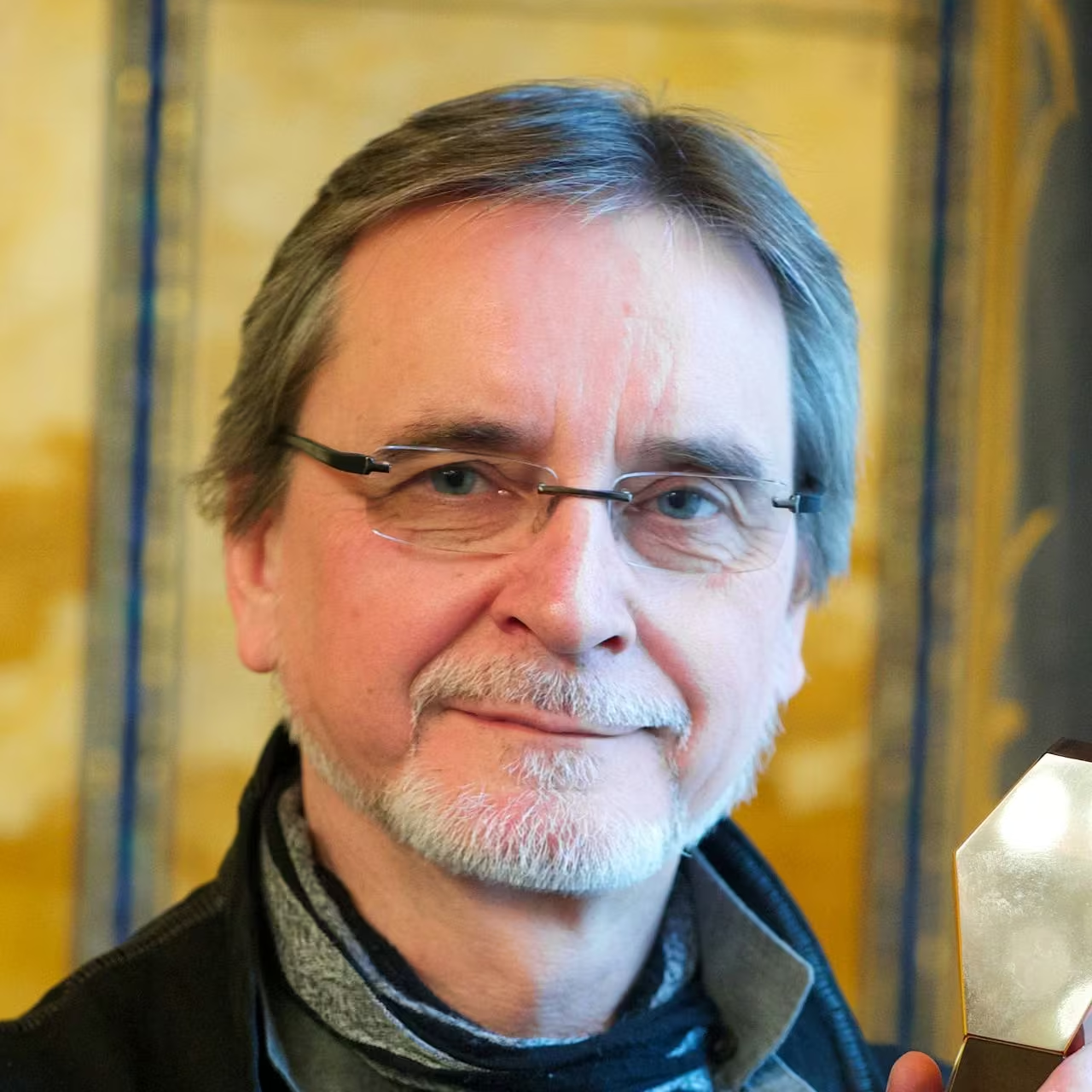
Forgotten Land, Falling Angels, Petite Mort – if the choreographer and dancer Jiří Kylián had created nothing apart from those three productions, his contribution to theatre of movement would nonetheless be normous. The Antonín Dvořák Prize, which he received in 2013, was the climax of a long series of awards that he has earned throughout a career that he is still continuing successfully.
Jiří Kylián began dancing at the age of nine in Prague. He continued with dance at the conservatory, but already in 1967 he managed to earn a scholarship to the Royal Ballet School in London. His next stop was at the Stuttgart Ballet in Germany, then under the leadership of John Cranko.
Ultimately, the Dutch Dance Theatre – Nederlands Dans Theater – was to become his home stage and the most important centre of his activities. The theatre, with its focus on contemporary dance, was founded in 1959, and it gradually earned a respected position. By the early 1970s, however, growing disputes between the artistic staff and management had left the theatre in a state of uncertainty, and the quality of performances had become uneven. It was with the arrival of Jiří Kylián that this situation, which certainly had been unpleasant for everyone, came to an end. As a guest choreographer, Mr. Kylián’s first creations for the Nederlands Dans Theater were the performances Viewers, Stoolgame, and La Cathédrale Engloutie.
The collaboration proved to be successful, and in 1975 Jiří Kylián became the ensemble’s artistic director together with Hans Knill. Besides his outstanding theatrical work, at the Nederlands Dans Theater Mr. Kylián also founded the group NDT II for young dancers and the group NDT III for dancers over the age of forty.
Mr. Kylián’s best-known choreographies are mentioned right at the beginning. Forgotten Land (1981) tells of people, events, and reminiscences that have disappeared somewhere in the depths of time. It is musical choreography based on the Sinfonia da Requiem by Benjamin Britten; another source of inspiration was the painting Dance of Life by Edvard Munch. In Falling Angels, Mr. Kylián creates constant mutual communication between eight dancers who drive ahead to the pulsating music of Steve Reich for percussion instruments. Petite Mort was created for the Salzburg Festival for the 200th anniversary of Mozart’s death. Six men, six women, and rapiers (foils) dance to the music of Wolfgang Amadeus Mozart.
Since his first work Paradox in 1970, Jiří Kyliána has created hundreds of choreographies, and the list of awards and honours Mr. Kylián has so far received is also long. He is a knight of France’s Ordre national de la Légion d’honneur, he earned the Golden Lion for Lifetime Achievement at La Biennale di Venezia, and the Queen of the Netherlands has conferred on him the Medal of the Order of the House of Orange for Arts and Science… The list goes on and on. Jiří Kylián received the Antonín Dvořák Prize as one of the most distinguished artists of the worldwide dance scene.
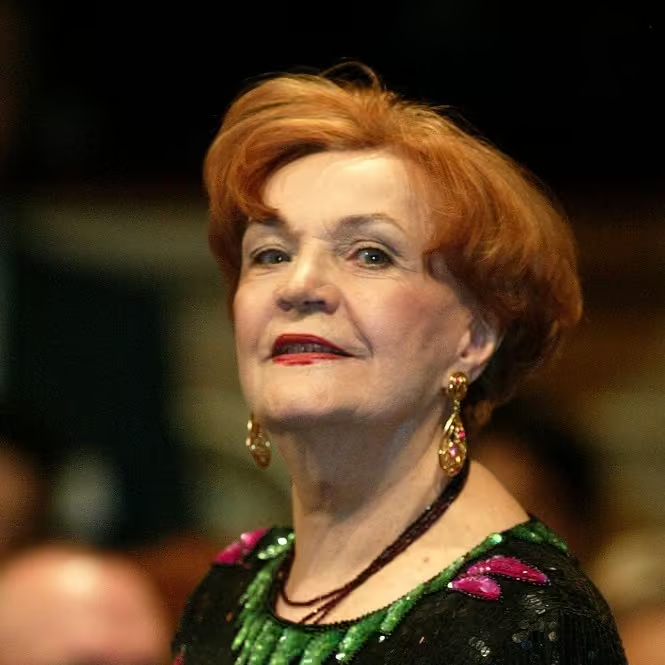
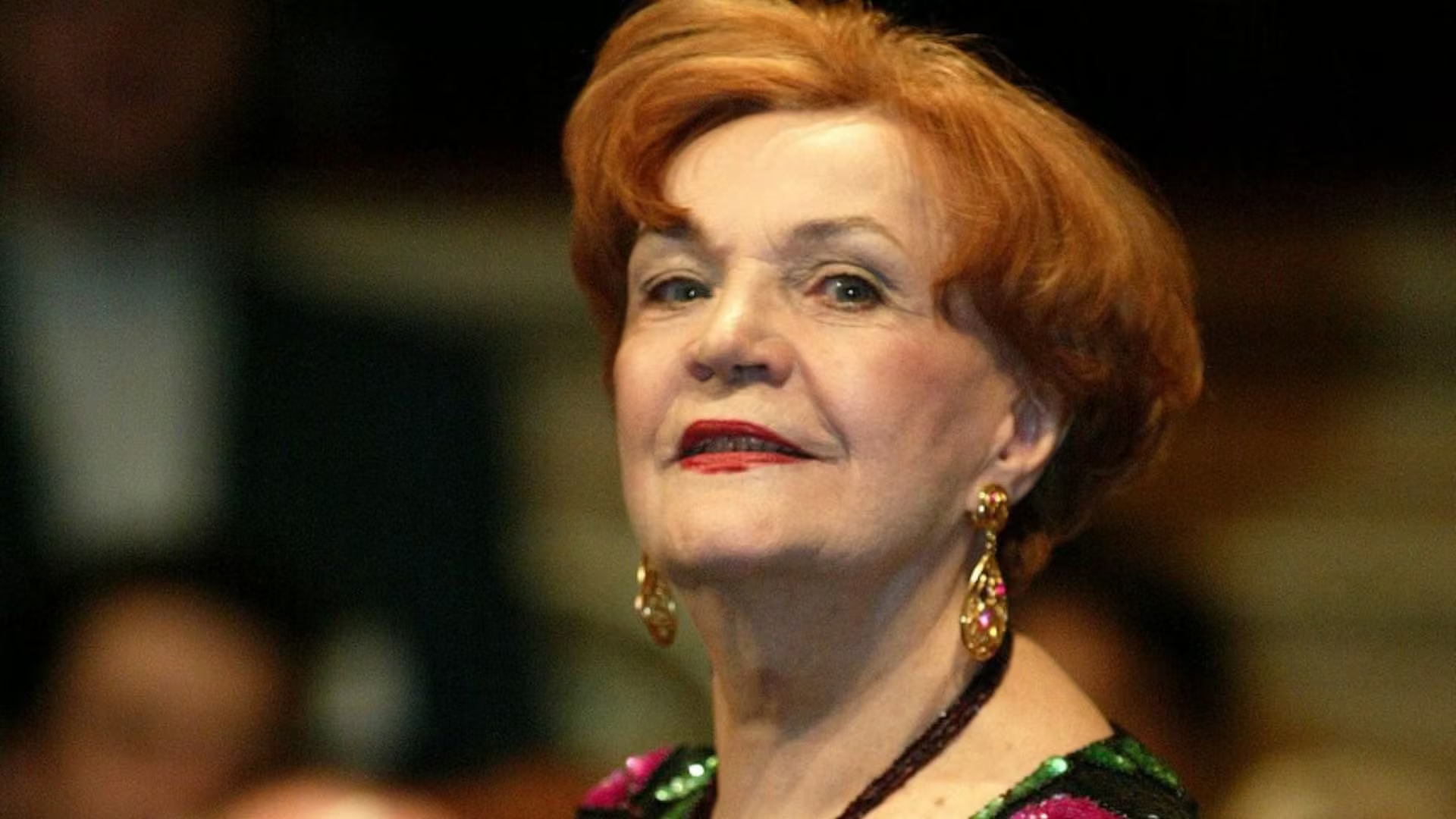
Ludmila Dvořáková was an outstanding dramatic soprano, and even her name associates her with Antonín Dvořák. Her given name reminds us of Dvořák’s monumental oratorio Saint Ludmila, and her surname reminds us of the composer himself.
Ms. Dvořáková made her reputation as a heroine in the operas of Richard Wagner and Richard Strauss, singing at the Metropolitan Opera in both the old and the new building, but her repertoire also included Leoš Janáček and Czech opera in general – something no Czech singer can avoid.
Dvořáková began her career in 1949 in Ostrava, then an industrial city on the border between Moravia and Silesia. Ostrava’s typical features were coal mines and steel mills – it might have reminded some people of Buffalo, New York. Smoking blast furnaces might not seem to create the ideal environment for the art of singing, but Ostrava’s opera was – and still is – of very high quality.
Ludmila Dvořáková’s talent was recognised by the conductor Rudolf Vašata, who later became her husband. He heard her sing Mařenka in The Bartered Bride, and he quickly understood that there was¨far more heroism, passion, and nobility in her voice that was required for the role of the sweet girl Mařenka in Bedřich Smetana’s opera. He cast Dvořáková in the title role of Janáček’s Káťa Kabanová, starting her on a path at the summit of which stood a great soprano heroine. Ludmila Dvořáková was to become a true “Hochdramatischer Sopran”. Her voice was not only big, but also beautiful and perfectly controlled.
Ludmila Dvořáková became a soloist at the National Theatre in Prague. She made guest appearances at the Vienna State Opera, but opera theatres in Germany soon noticed her artistry as well. In 1960 Dvořáková began singing at the Berlin State Opera, where one of her roles was that of the Foreign Princess in Dvořák’s Rusalka.
From East Berlin, it was just a short step to the world’s biggest stages in the West – she even managed to work on the other side of the Iron Curtain with the permission of the authorities, so she was not forced to emigrate from communist Czechoslovakia. Her Ortrud in Lohengrin so captivated Wagner’s grandson Wieland that he immediately invited her to the festival in Bayreuth. At the theatre dedicated to the operas of Richard Wagner, she sang not only Ortrud, but also Brünnhilde, Venus in Tannhäuser, and Kundry in Parsifal. A Wagnerian soprano can hardly attain loftier goals.
In 1966 Ludmila Dvořáková sang at the Metropolitan Opera for the first time, making appearances while the company was still in its old building. She sang the title role in Beethoven’s Fidelio, and the critics were just as enthusiastic as the public. At the Met, Ms. Dvořáková sang roles including Isolde, Ortrud, and Strauss’s Elektra – her fach was clear. At London’s Covent Garden she sang all of the big female roles in Der Ring des Nibelungen under the baton of Georg Solti, so she appeared in all four evenings of the production. But she also sang Dvořák’s Biblical Songs in London.
Ludmila Dvořáková’s death was like a Wagnerian tragedy – she died in a fire at her home. She left behind more memories than recordings – she did not like making recordings. In 2002 she won the Thalia Prize for lifetime achievement, and she won the Antonín Dvořák Prize ten years later.
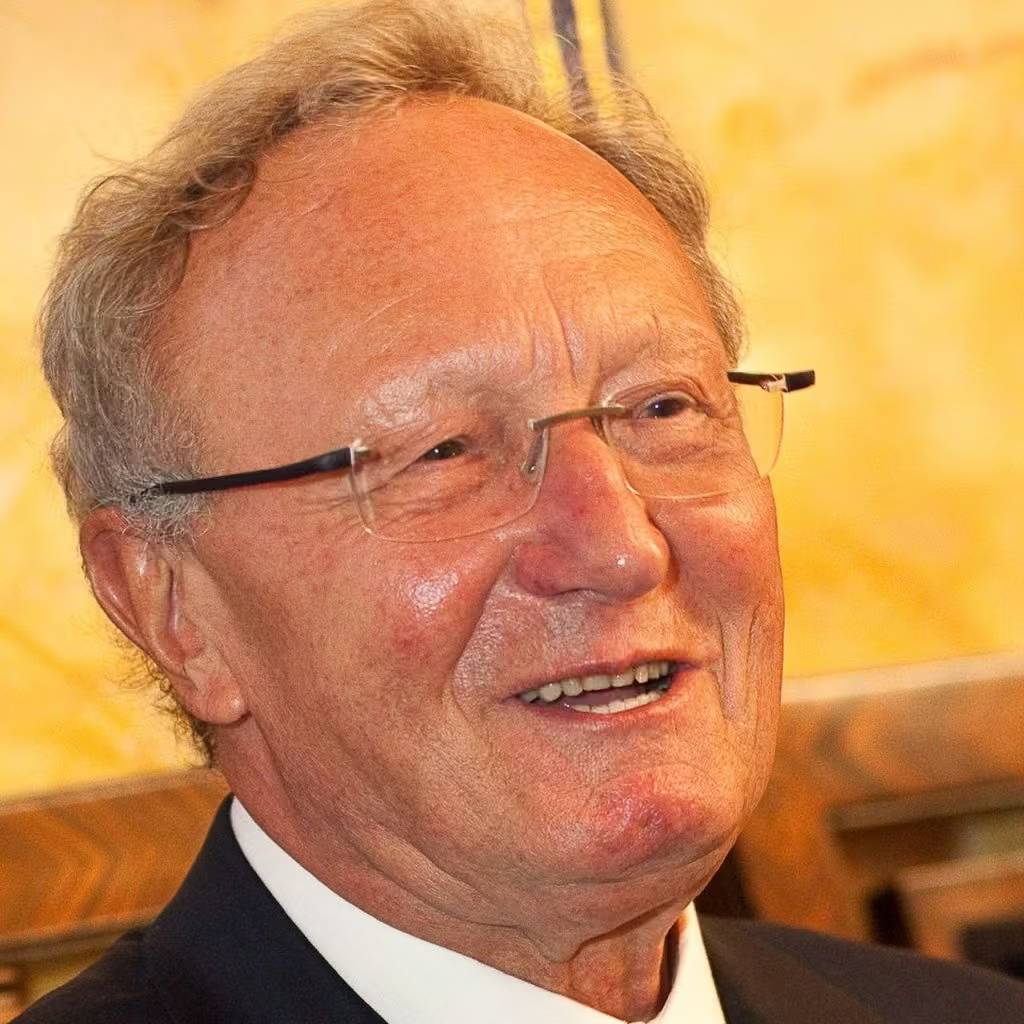
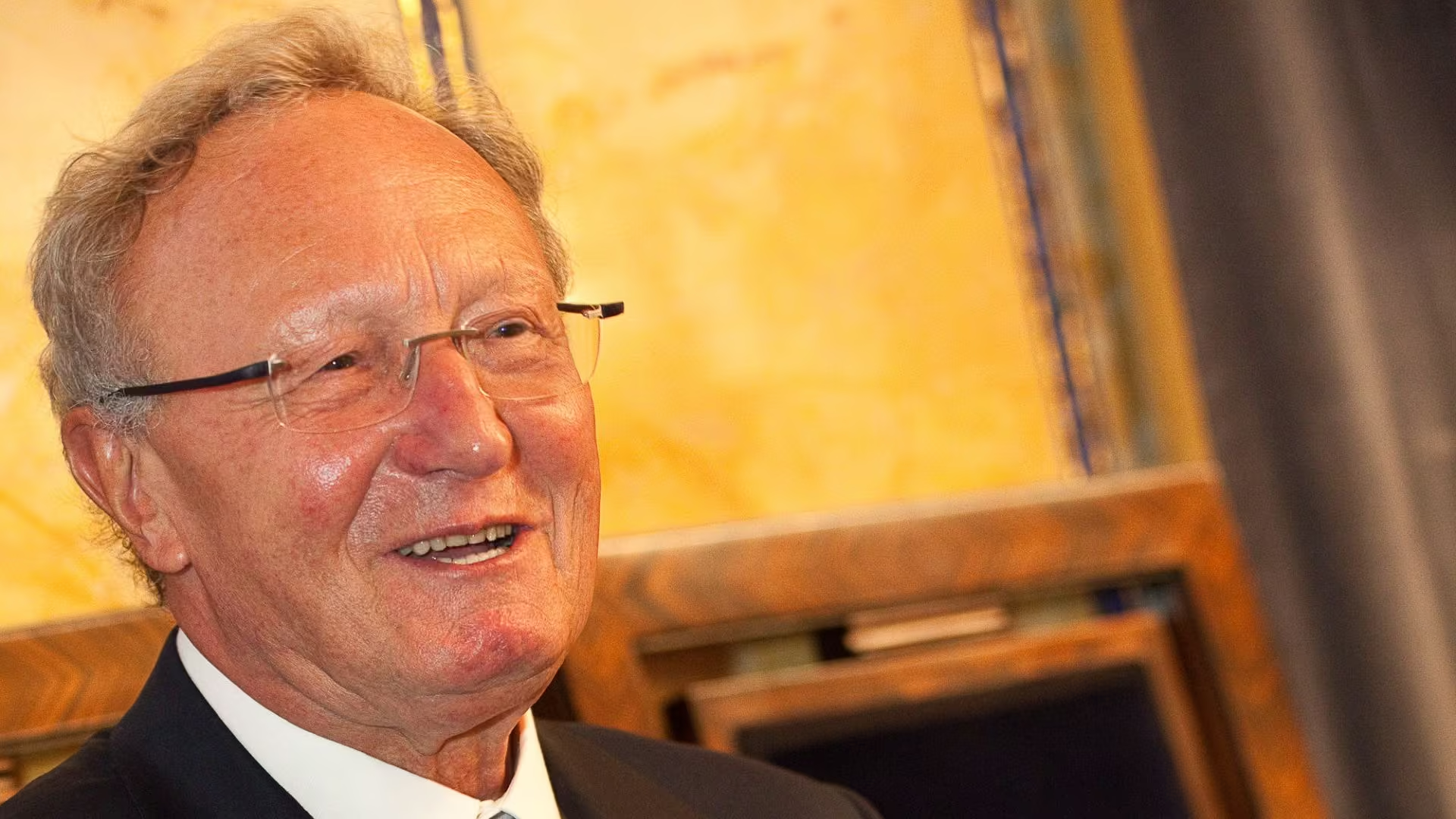
The artistic career of the conductor Jiří Kout took him from the west-Bohemian city Pilsen all the way to New York. From the post of conductor of a small regional theatre, he worked his way up over many years to the Metropolitan Opera as a specialist in the works of Richard Wagner, Richard Strauss, and Leoš Janáček. Inconspicuous, precise, original – Jiří Kout is all of these things. And also modest and funny.
“If there had been an announcement of a competition for the Antonín Dvořák Prize, I wouldn’t have had the courage to apply. With Ivan Moravec and Josef Suk, the organisers have set the bar very high, and today I have managed to slip under it a bit,”
Jiří Kout commented when he received the award from the Academy of Classical Music.
Jiří Kout’s life and career were affected by the political landscape of socialist Czechoslovakia. When Soviet troops occupied the country in August 1968, he openly expressed his opposition to what was being called “fraternal assistance”. Because of this, the following year he lost his job at the Pilsen Opera, where he had conducted, among other things, a ballet production of Dvořák’s Slovanic Dances.
In 1972 Kout began working at the National Theatre in Prague as a rehearsal pianist, and he gradually returned to conducting. Over time, he began to receive offers of work from Germany. He started guest conducting at the Deutsche Oper am Rhein in Düsseldorf, and in 1978 he accepted a fulltime position there. In those days, that meant emigrating from Czechoslovakia, and at the time that seemed to mean his department would be permanent. He could never complain of a lack of work as a conductor, and with his orientation towards the German repertoire, he earned success at Germany’s leading theatres.
He worked at the Bavarian State Opera and the Vienna State Opera and was the chief music director in Saarbrücken. Later, he conducted in Leipzig, and at the same time he was the chief conductor at the Deutsche Oper Berlin. He worked in Berlin and Leipzig until the late 1990s, and at the Deutsche Oper Berlin, together with the stage director Götz Fridrich he was responsible for an outstanding era in the theatre’s history.
At the Metropolitan Opera, Jiří Kout has conducted Strauss’s Rosenkavalier, which he has also conducted at the National Theatre in Prague. Six years after the fall of the communist regime, he began working there again in 1995, and besides Rosenkavalier he conducted excellent productions of Strauss’s Elektra, Wagner’s Tristan und Isolde, and Janáček’s Jenůfa.
Among the best things Jiří Kout has done in opera have been his interpretations of the operas of Dvořák’s admirer and friend Leoš Janáček. He has conducted Janáček’s operas at the Met, in Los Angeles and San Francisco, at Covent Garden, and at the Glyndebourne Festival. On his returns to the Czech Republic, he has also conducted the Czech Philharmonic and the Prague Symphony Orchestra. To this day, he is the Prague Symphony Orchestra’s Conductor Emeritus.
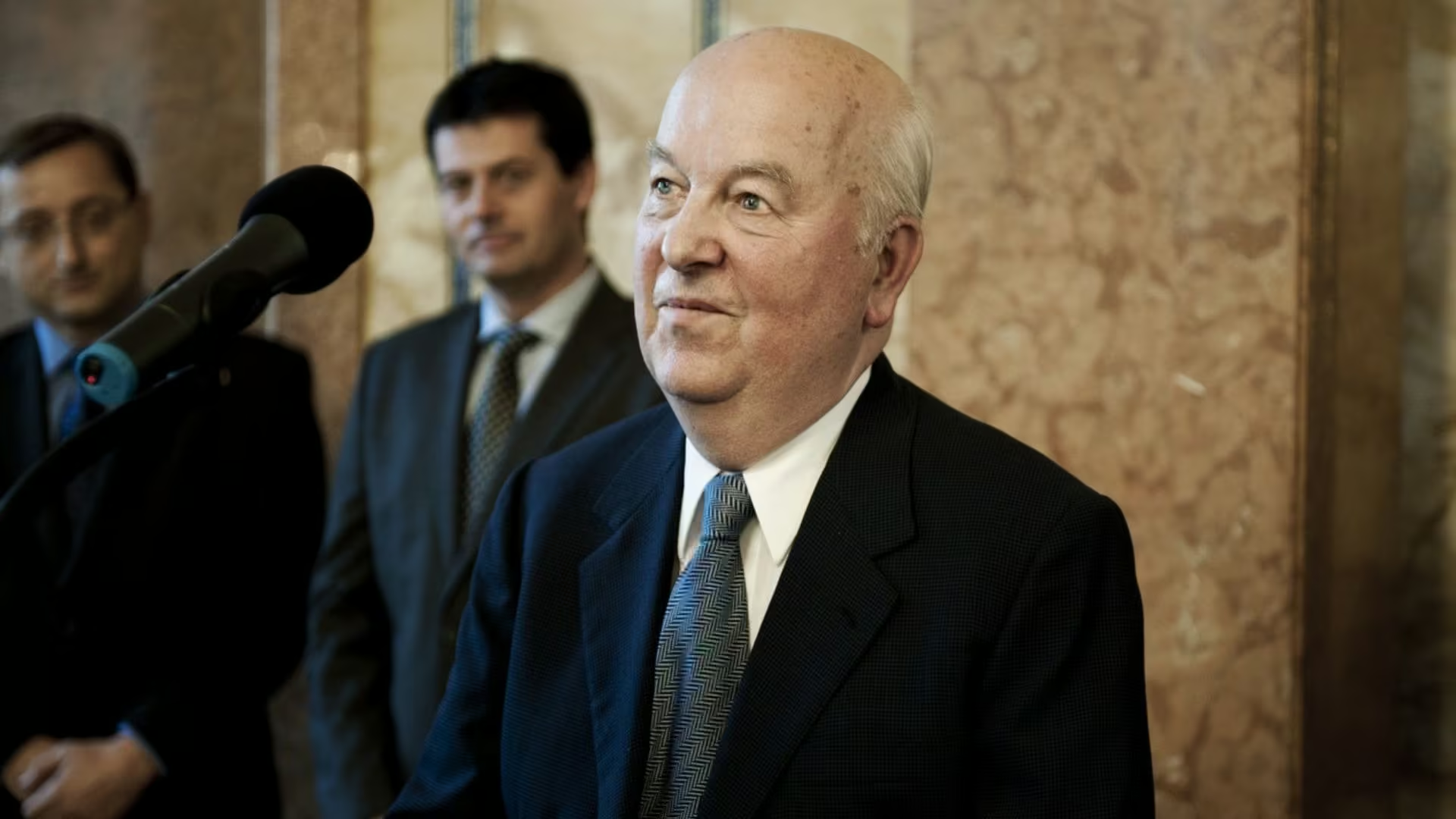
„I’m particularly interested in pianists who are radically different to myself,“
the superb Czech pianist Ivan Moravec once declared in an interview.
In that same interview, he also said “I will recall to my dying day two recitals given here in Prague by Michelangeli.” Those two sentences could be taken as a summary of Moravec’s approach to the piano and to music. Michelangeli was a great source of inspiration for Ivan Moravec: through not only the Prague recitals mentioned above, but also their personal encounters at Michelangeli’s master classes and the thorough study of his recordings.
The pursuit of diametrically opposite approaches to the piano was something characteristic of Moravec’s constant refinement of his own original style. He also became the only Czech pianist included by the Philips Records label in its series Great Pianists of the 20th Century.
Ivan Moravec began studying piano in Prague, which was also his birthplace. His first teacher was Ilona Štěpánová-Kurzová. It was opera, however, that first drew him to music, and he enjoyed listening to the recordings of Enrico Caruso.
His career as a pianist was nearly ruined by an injury to is cervical spine, but he managed not only to overcome the handicap, but even to put it to use by developing his own special playing technique consisting in the use of the weight of his whole arm and the gentle creation of tones with the tips of his fingers.
Despite his talent, Ivan Moravec had difficulty making a name for himself at home in Czechoslovakia, and it was his success in the United Kingdom and America that launched his worldwide career. His London debut came in 1962, and two years later – like the violinist Josef Suk and the pianist Rudolf Firkušný – he received an invitation from the conductor George Szell to make a guest appearance with the Cleveland Orchestra.
In 1966 Moravec made his Carnegie Hall debut. In America he also began his systematic recording activities for the Connoisseur Society. Among Mr. Moravec’s best recordings are his 1982 recital of works by Claude Debussy for the Vox label and his recital of the music of Leoš Janáček for the Nonesuch label from the following year. The Supraphon label, which had formerly not wished to record him, finally awarded him with a platinum disc for 250,000 recordings sold.
He was noted for his quiet, contemplative playing, and among his favourite composers were Mozart, Chopin, Schumann, Brahms, and Ravel. Antonín Dvořák is represented among Moravec’s recordings, naturally. He recorded Dvořák’s Piano Concerto in G Minor with the Czech Philharmonic and Jiří Bělohlávek, and with the mezzo-soprano Věra Soukupová he recorded the Biblical Songs.
Ivan Moravec became a laureate of the Antonín Dvořák Prize in 2010. He was able to add this honour to a list including a Grand Prix du Disque, a Cannes Classical Award for lifetime achievement, and many other prizes.
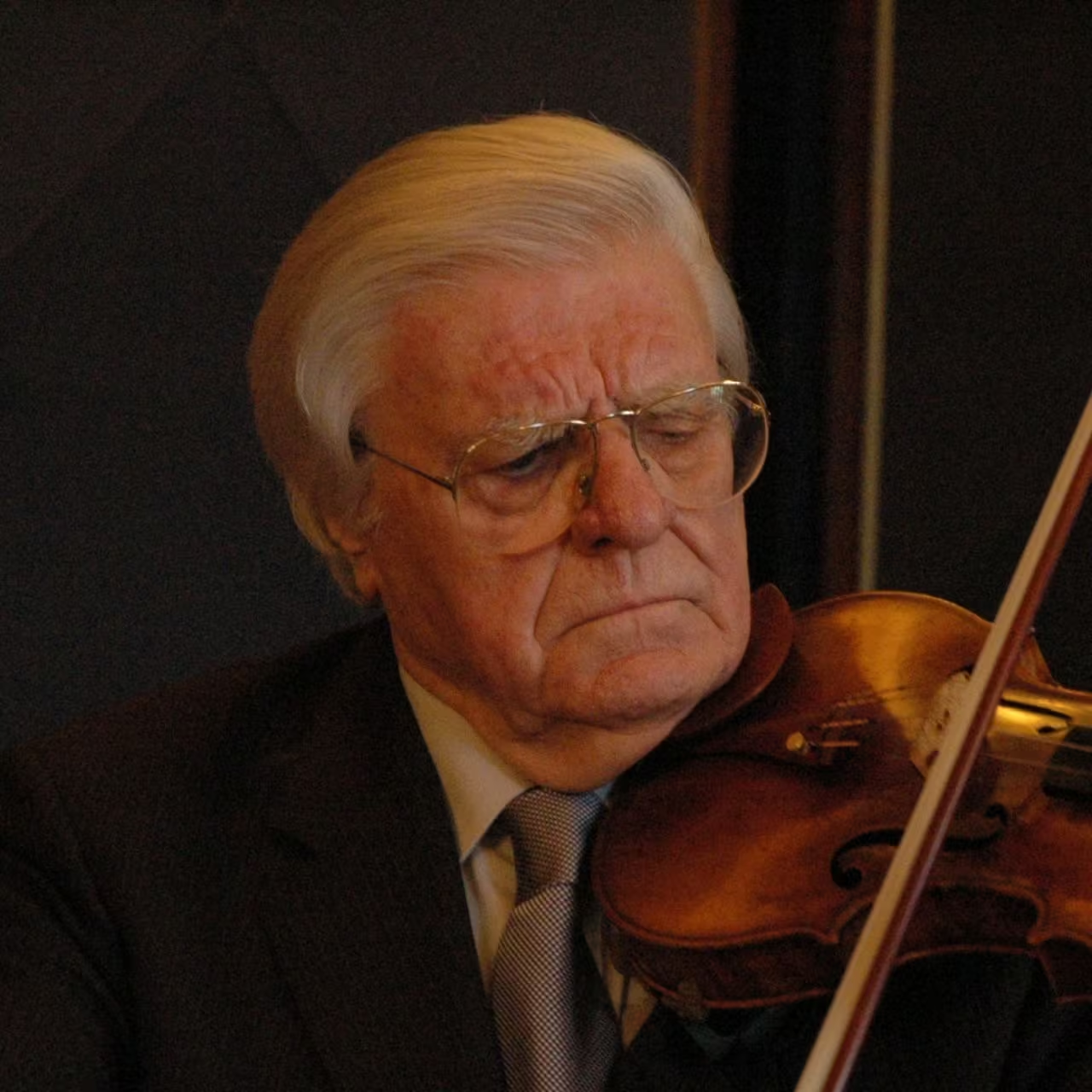
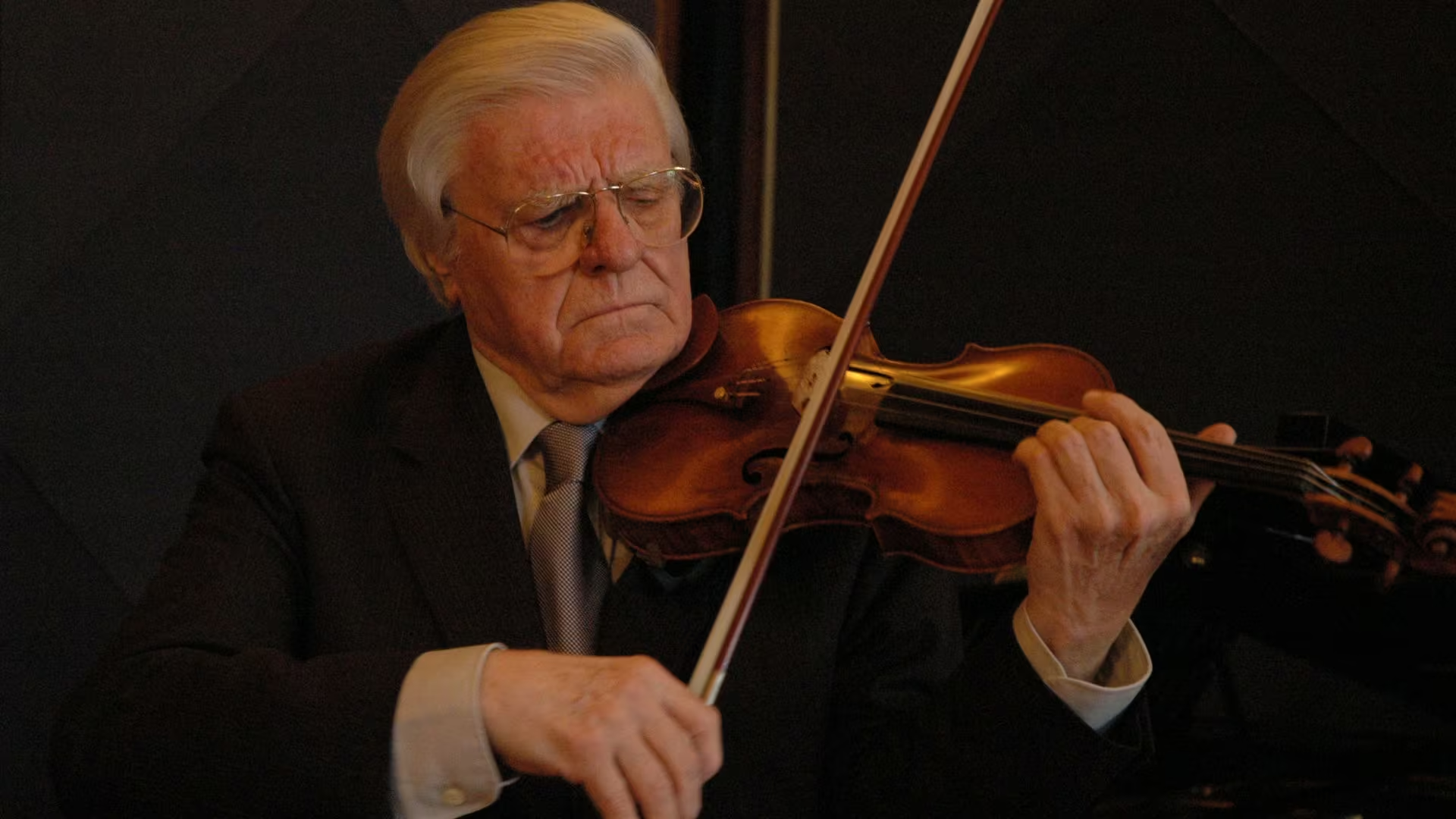
The-great grandson of Antonín Dvořák and the grandson of the composer Josef Suk, the violinist, violist, and conductor Josef Suk not only inherited a great deal of talent, but also developed it. He soon became a respected musician from a great line, and he never betrayed his talent or his name.
“Josef Suk is universally acknowledged as the greatest living representative of the Czech violin school. His playing possesses an individual character with an immediately recognisable tone that has placed him among top international artists.”
The music critic Patrick Lambert wrote these words of appreciation about Josef Suk in the journal Gramophone in an article that appeared in August 2004, when Josef Suk was seventy-five years old.
Five years later, he celebrated his eightieth birthday and became the first laureate of the Antonín Dvořák Prize. That, of course, was not the first prize he ever received: in 2002 he became a knight of France’s Legion of Honour, and three years earlier the Czech president Václav Havel had conferred on him the Medal of Merit. From 1977 he held the title of National Artist. Above all, it was music that dazzled the world in Suk’s hands.
“I admired him greatly,” Lambert continued in his confession. “It was he who introduced me to the world of great violinists with the highest violin culture. He was a colleague of Kubelík, Kreisler and Heifetz, and their recordings were for me at that time my daily bread.” For Josef Suk, music was his daily bread, and he was incapable of interpretations of anything but the highest quality.
He was the last pupil of the violin virtuoso Jaroslav Kocián, who in turn had studied under Otakar Ševčík. Suk was not only a continuation of the line of a great composer, but also a successor to the greatest masters of the Czech school of violin playing.
He played a Stradivarius, but he also played an instrument built by the Czech violin maker Přemysl Špidlen.
The conductor George Szell invited the twenty-five-year-old Josef Suk to the USA – that is greater proof of talent and quality than all of his musical awards. It was not easy to satisfy the nearly superhuman demands that Szell made on musicians. It was with Szell and the Cleveland Orchestra that Josef Suk launched his international career.
Josef Suk excelled as a soloist and a performer of chamber music. Naturally, he devoted himself to the music of his great-grandfather Antonín Dvořák and of his grandfather Josef Suk, but he was also an exemplary interpreter of Bach, Mozart, and Beethoven. Suk’s playing was characterised by a full, singing tone and perfect stylistic purity.
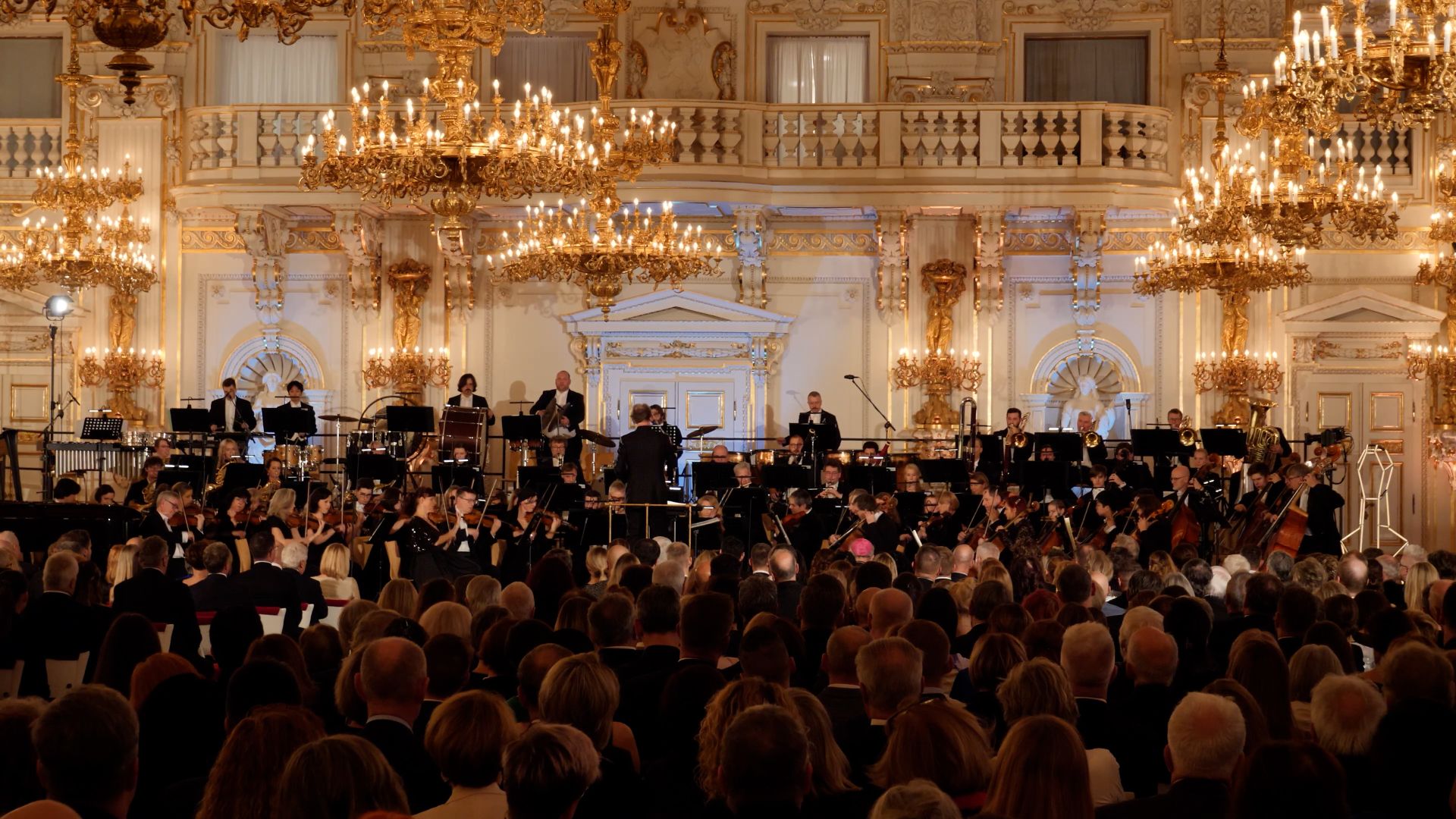
Festive concert featuring the presentation of the Antonín Dvořák Award for 2025
Council of Academicians
Expert Council
The laureates of the Antonín Dvořák Award are selected by an international Council of Academicians, with a membership chosen to advance the Award's international reach. Alongside internationally renowned figures of the Czech music scene and a representative of the organising Academy of Classical Music, the Council includes distinguished personalities representing leading foreign cultural institutions and ensembles. In its new composition, the Council builds on the work of members of the Council of Academicians of the Antonín Dvořák Award who served from 2009 to 2025.
Members
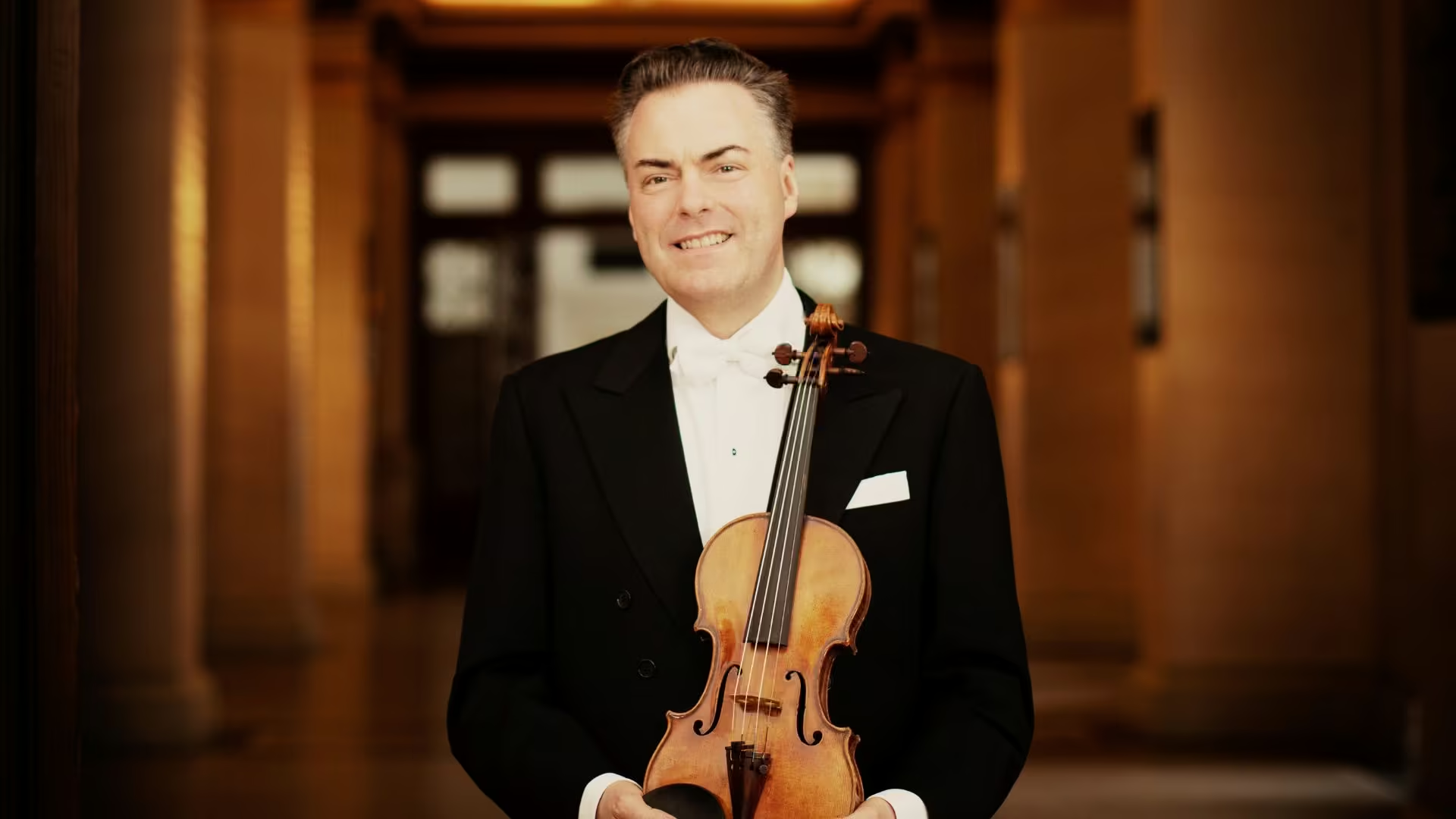
First violinist and section leader Daniel Froschauer was born in Vienna, Austria. He began his musical career as a member of the Vienna Boys Choir. His studies on the violin led him to the Juilliard School of Music in New York where he was a student of Dorothy DeLay and Masao Kawasaki. He completed his studies with Pinchas Zukerman, with Professor Alfred Staar and Professor Alfred Altenburger in Vienna. In 1993, he made his debut in the Brahmssaal of the Vienna Musikverein with an evening of sonatas.
Froschauer has been a member of the Vienna State Opera Orchestra since 1995 and joined the Association of the Vienna Philharmonic in 1998. He has performed in both orchestras as a first violinist, since 2004 as a section leader. In 2005, he became a member of the Vienna Hofmusikkapelle.
Daniel Froschauer has appeared as a soloist with, among others, the Mozarteum Orchestra Salzburg, the Japan Philharmonic, the West German Radio Orchestra, the New York Symphonic Ensemble, the Reno Philharmonic, the Northwest German Philharmonie, and the New York Virtuosi Strings Chamber Orchestra. He is a member of the Küchl Quartet, the Ensemble Wien and the Vienna Ring Ensemble. As a particular distinction he received the Young Artist Award from Musical America in New York in 1990 and he was also a prize winner at the Concours International Pierre Lantier in Paris in 1997.
Daniel Froschauer has also dedicated himself to numerous charitable projects such as the organization and performance of concerts and workshops for the Vienna Philharmonic and Suntory Music Aid Fund - a relief fund for people in Japan who suffered hardship as a result of the natural catastrophes in Japan (Fukushima). He also appeared in concerts in the series Music and Medicine - a research project which studies the effects of classical music on cancer patients - as well as concerts at the CS Hospiz Rennweg.
Daniel Froschauer plays the violin "Ex Benvenuti, ex Halphen" by Antonio Stradivari from the year 1727, on loan from the Angelika Prokopp Foundation.
source: Daniel Froschauer
photo © Julia Wesely
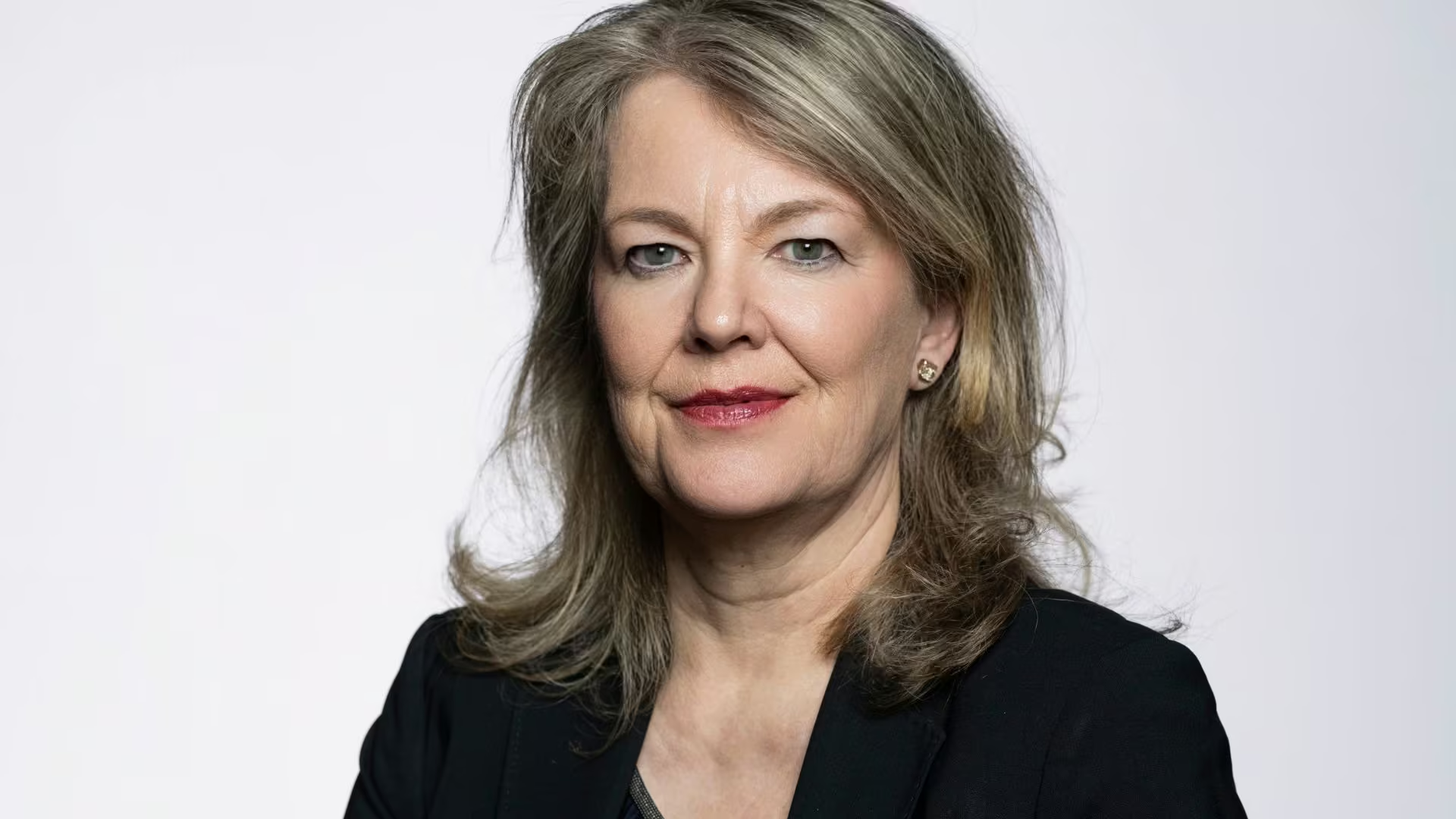
Ilona Schmiel, born in Hanover in 1967, studied School Music, Singing, Classical Philology and Cultural Management in Berlin and Oslo. Her first professional positions were at the Donaueschingen Music Festival and the Olympic Cultural Festival in Lillehammer. She also worked as Project Manager for the worldwide opera tours of the Arena di Verona and as a guest lecturer at the Hanns Eisler Academy of Music in Berlin.
In 1998, she became Germany's youngest Artistic Director, taking over the Management and Artistic Direction of the Bremen Concert Hall «Die Glocke», a position she held until 2002. From 2004 to 2013, she was Artistic and Executive Director of the Beethovenfest Bonn. Under her leadership, the Beethovenfest Bonn was awarded the European Cultural Brand 2012. In January 2017, she received the Order of Merit of the State of North Rhine-Westphalia for her commitment to the Beethovenfest Bonn.
Since the 2014/15 season, she has been Artistic and Executive Director of the Tonhalle-Gesellschaft Zürich AG and is responsible for all events and tours of the Tonhalle-Orchestrer Zürich with its Music Director Paavo Järvi, as well as various other concert series and the operation of the Tonhalle Zürich. The Tonhalle-Gesellschaft Zürich AG was also responsible for the construction of the interim venue «Tonhalle Maag» and used this multi-award-winning concert hall from 2017 until the reopening of the renovated Tonhalle in September 2021.
In 2018, Ilona Schmiel was awarded the Junge Ohren Prize for her programmatic and structural pioneering work in music education as an essential component of the cultural institutions she has directed. She was also a member of the jury of the German Federal Cultural Foundation from 2005 to 2007 and has been a member of the jury of the Ernst von Siemens Music Foundation since 2007, becoming its chair in January 2025. From 2009 to 2023, she was chair of the board of trustees of the Deutsche Kammerphilharmonie Bremen.
Since 2010, she has been a guest lecturer at the Munich University of Music and Performing Arts and the Free University of Berlin, and since 2012, she has been a member of the board of the Beethoven Haus Bonn (until June 2025) and a member of the University Council of the University of Bonn.
From 2014 to 2022, Ilona Schmiel was a member of the University Council of the Munich University of Music and Dance. She is also a member of the board of trustees of the Concours Géza-Anda Zurich and the Zurich Singakademie, a member of the board of collegium novum zürich, a board member of the IAMA International Artist Managers' Association (2022 to 2024) and an advisory board member of the Zurich University of the Arts. Since 2023, she has been advising Ina Brandes, Minister of Culture and Science of the State of North Rhine-Westphalia, on issues relating to the future direction of art and music colleges.
As a mentor, she passes on her knowledge and is juror at numerous international competitions, as well as a patron of Superar Suisse, among others.
source: Ilona Schmiel
photo © Priska Ketterer
Internationally acclaimed Czech conductor Jakub Hrůša is Chief Conductor of the Bamberg Symphony, Music Director of The Royal Opera, Covent Garden (from 2025), and Chief Conductor and Music Director Designate of the Czech Philharmonic (from 2028).
He is a frequent guest with many of the world’s greatest orchestras, enjoying close relationships and performing regularly with the Vienna Philharmonic, Berlin Philharmonic, Bavarian Radio Symphony, Munich Philharmonic, Leipzig Gewandhaus Orchestra, Staatskapelle Dresden, Tonhalle Orchester Zürich, Lucerne Festival Orchestra, Royal Concertgebouw Orchestra, Orchestre de Paris, Orchestre Philharmonique de Radio France, NHK Symphony and the Mahler Chamber Orchestra – and in the US with The Cleveland Orchestra, New York Philharmonic, Chicago Symphony Orchestra, and Boston Symphony Orchestra.
As a conductor of opera, he has led productions for the Lyric Opera of Chicago (Jenůfa), Salzburg Festival (Kát’a Kabanová with the Vienna Philharmonic), Vienna State Opera (The Makropulos Case), Royal Opera House, Covent Garden (Carmen and Lohengrin), Opéra National de Paris (Rusalka), and Zurich Opera (The Makropulos Case). He has also been a regular guest with Glyndebourne Festival, conducting Vanessa, The Cunning Little Vixen, A Midsummer Night’s Dream, Carmen, The Turn of the Screw, Don Giovanni and La bohème, and served as Music Director of Glyndebourne On Tour for three years.
His relationships with leading vocal and instrumental soloists have included collaborations in recent seasons with Behzod Abduraimov, Piotr Anderszewski, Leif Ove Andsnes, Emanuel Ax, Lisa Batiashvili, Joshua Bell, Yefim Bronfman, Rudolf Buchbinder, Renaud Capuçon, Gautier Capuçon, Isabelle Faust, Bernarda Fink, Julia Fischer, Sol Gabetta, Véronique Gens, Christian Gerhaher, Kirill Gerstein, Karen Gomyo, Hélène Grimaud, Augustin Hadelich, Hilary Hahn, Barbara Hannigan, Alina Ibragimova, Steven Isserlis, Janine Jansen, Sheku Kanneh-Mason, Leonidas Kavakos, Evgeny Kissin, Patricia Kopatchinskaja, Lang Lang, Igor Levit, Karita Mattila, Albrecht Mayer, Anne-Sophie Mutter, Stephanie d’Oustrac, Emmanuel Pahud, Beatrice Rana, Kian Soltani, Josef Špaček, Nikolaj Szeps-Znaider, Antoine Tamestit, Jean-Yves Thibaudet, Daniil Trifonov, Mitsuko Uchida, Klaus Florian Vogt, Lukáš Vondráček, Yuja Wang, Alisa Weilerstein, and Frank Peter Zimmermann.
As a recording artist, Jakub Hrusa has received numerous awards and nominations. He was a double winner at the 2024 Gramophone Awards in both the Concerto and Opera categories, for his recordings of Britten’s Violin Concerto with Isabelle Faust and Bavarian Radio Symphony Orchestra, and Kát’a Kabanová with the Vienna Philharmonic at Salzburg Festival. With Bamberg Symphony, he received the ICMA Prize for Symphonic Music in both 2022 and 2023, for his recordings of Rott’s Symphony No. 1 and Bruckner’s Symphony No. 4. He was also the 2023 Opus Klassik Conductor of the Year. He was awarded the Preis der Deutschen Schallplattenkritik for his recording of Mahler’s Symphony No. 4, and in 2021 his recording of Martinů and Bartók violin concertos with Frank Peter Zimmermann was nominated for BBC Music Magazine and Gramophone awards, and his disc of the Dvořák Violin Concerto with the Bavarian Radio Symphony and Augustin Hadelich was nominated for a Grammy ® Award. His recordings of Dvořák and Martinů Piano Concertos with Ivo Kahánek and the Bamberg Symphony (Supraphon), and Vanessa from Glyndebourne (Opus Arte) both won BBC Music Magazine Awards in 2020. Other recent releases include Strauss songs with Bamberg Symphony and Kateřina Kněžíková (Supraphon), Dvořák and Brahms Symphonies with Bamberg Symphony (Tudor), Suk’s Asrael Symphony with the Bavarian Radio Symphony (BR Klassik), and Dvořák’s Requiem and Te Deum with the Czech Philharmonic (Decca).
Jakub Hrůša studied conducting at the Academy of Performing Arts in Prague, where his teachers included Jiří Bělohlávek. He is an Honorary Member of the Royal Academy of Music in London, and in 2024 received the Silver Medal of the President of the Czech Senate, its highest award. He was the inaugural recipient of the Sir Charles Mackerras Prize, and has also been awarded the Bavarian Culture Prize, the Czech Academy of Classical Music’s Antonín Dvořák Prize, and – together with Bamberg Symphony – the Bavarian State Prize for Music.
source: Jakub Hrůša
photo © Lenka Hatasová
photo © Andreas Herzau
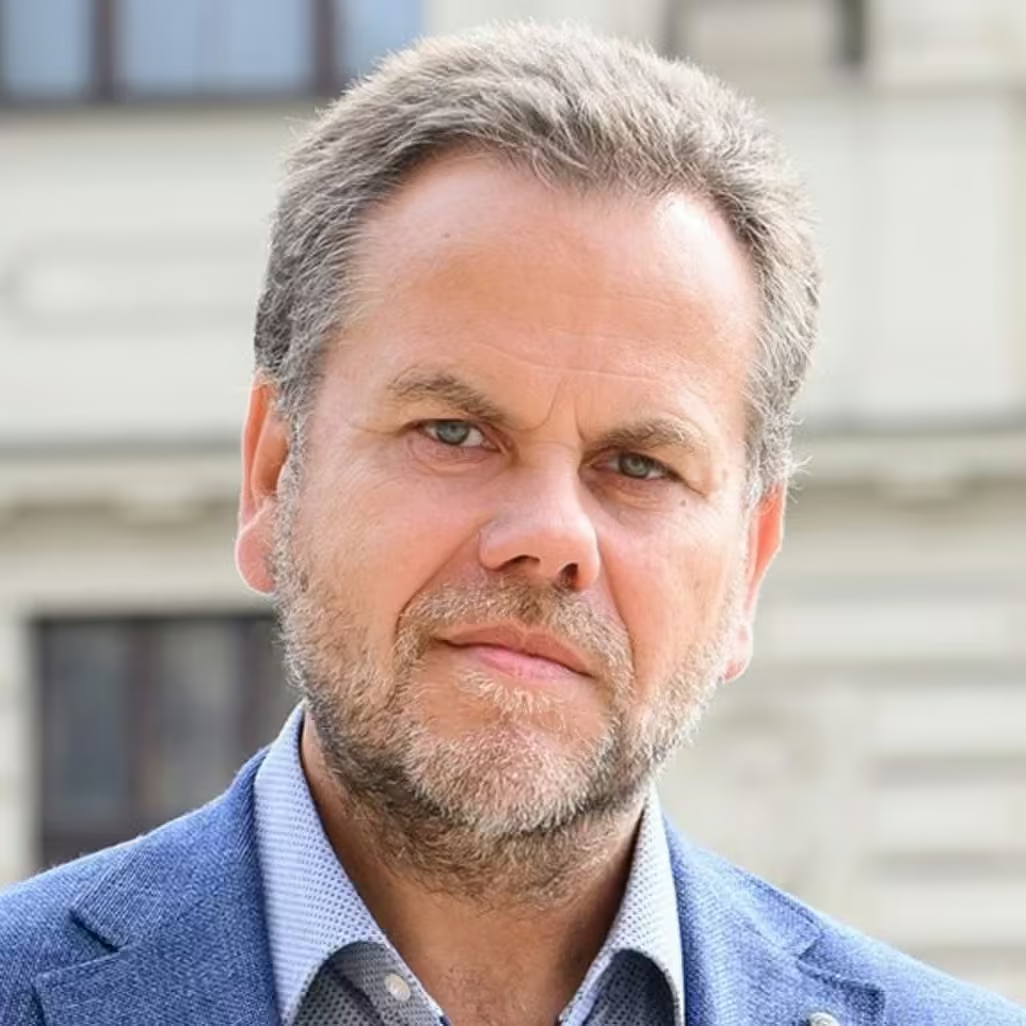
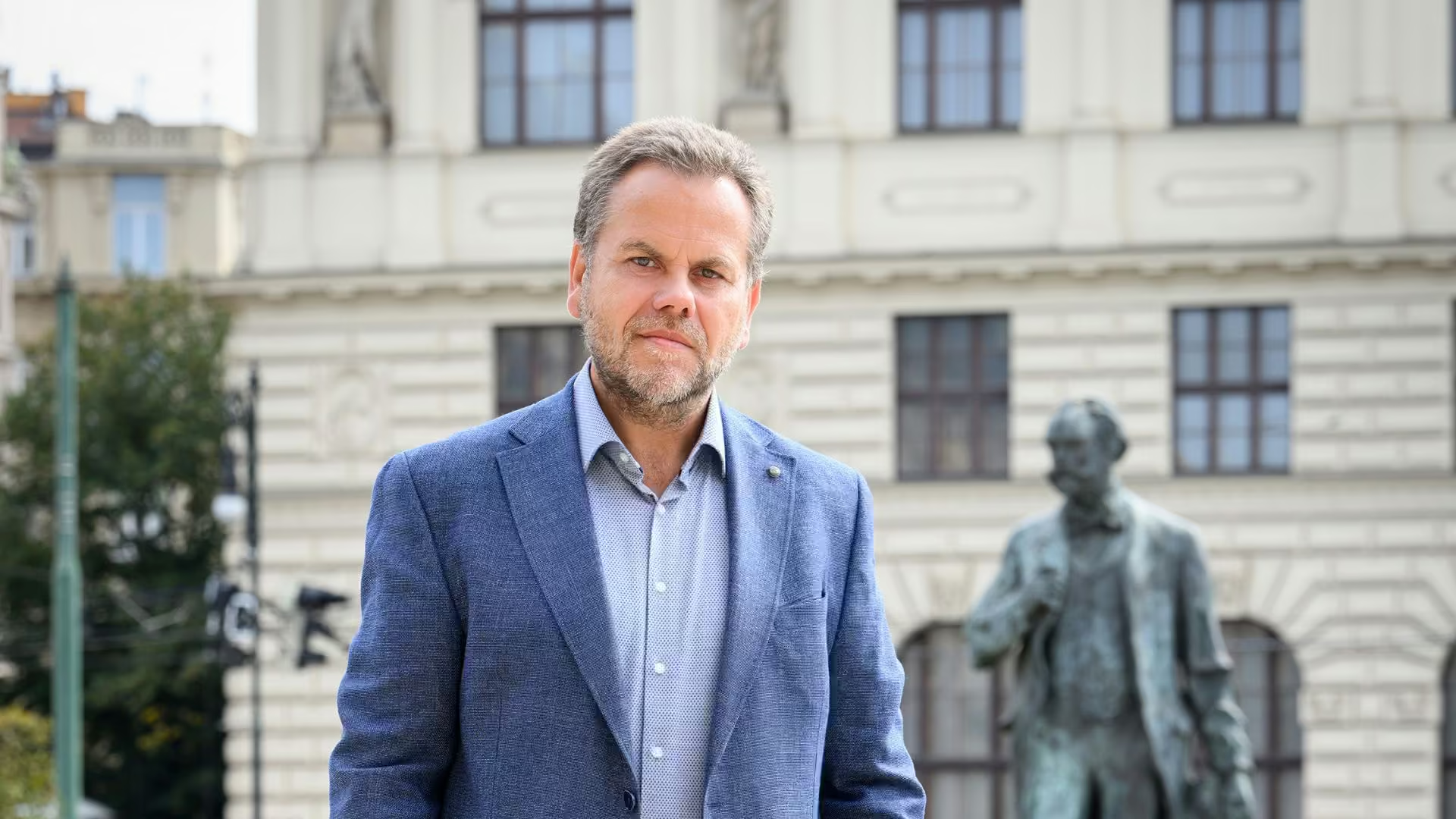
Jan Simon (1966) began playing the piano at the age of seven under the guidance of his father, composer and conductor Ladislav Simon. After graduating from the Prague Conservatoire in the class of Valentina Kameníková, he pursued further studies at the Music and Dance Faculty of the Academy of Performing Arts in Prague under Ivan Moravec. He went on to study with pianist Homer Francesch in Zurich for one year, and then undertook a two-year course of study at Die Musikhochschule Lübeck under Professor James Tocco. After completing his studies, Simon began teaching there.
Simon’s notable success in international competitions such as the Prague Spring Competition, Chopin Competition in Mallorca and recognition at the William Kapell Competition in the USA culminated with a bronze medal at the Queen Elisabeth Competition in Brussels in 1991.
Simon has performed regularly with acclaimed orchestras including the BBC Symphony Orchestra London, Israel Philharmonic, Czech Philharmonic, Baltimore Symphony, Malmö Symphony, Tchaikovsky Symphony Orchestra, Beethoven Bonn Orchestra, Czech Radio Symphony Orchestra, Moscow Soloists, Slovak Philharmonic Orchestra, Prague Philharmonia, Prague Symphony Orchestra and others. He has collaborated with conductors Jiří Bělohlávek, Marc Soustrot, Vladimír Válek, Vasily Sinaisky, Vladimir Fedoseyev, Tadeusz Strugala, Serge Baudo, Petr Altrichter, Ondrej Lenárd, David Robertson, Libor Pešek, Martin Turnovský, Ole Kristian Ruud, Gaetan Delogu and others. Simon has performed in concerts across Europe as well as in Egypt, Japan, China, Taiwan, Mexico, Canada, the USA and Australia and on the stages at prominent festivals. He has appeared in a range of cities – Berlin, Munich, Frankfurt, Vienna, Salzburg, Copenhagen, Zaragoza, Madrid, Jerusalem, Udine, Belgrade, Zagreb, Frankfurt, Le Mans, Nancy, Bilbao, Bucharest, Belgrade, Seoul and Tokyo – and other significant concert venues. He has performed at Carnegie Hall in New York, where he played Ludwig van Beethoven’s Piano Concerto No. 3 in the Stern/Perelman Auditorium.
As a chamber player he has collaborated mainly with cellist Wolfgang Emanuel Schmidt and has appeared with Josef Suk, Václav Hudeček, Jiří Bárta and other instrumentalists. Simon has recorded over 20 albums for Supraphon, BMG Ariola, Radioservis and Clarton. In 1996, his recording of Schulhoff’s piano concertos earned him the Cannes Classical Award 95 at the MIDEM record industry fair in France (along with the Prague Radio Symphony Orchestra and Vladimír Válek).
His CD recordings of piano concertos by Fryderyk Chopin and Ludwig van Beethoven with Jiří Bělohlávek and the Prague Philharmonia are highly regarded by music critics.
In addition to his musical career, Simon served as director and manager of the Czech Radio Symphony Orchestra from 2001 to 2015, and later as director of INTERGRAM, a copyright protection organisation for performers and producers in the audio and audiovisual industry, until 2018. He has been the artistic director of the Academy of Classical Music and the artistic director of the Dvořák Prague International Music Festival since 2018.
source: jansimon.info
photo © Petra Hajská
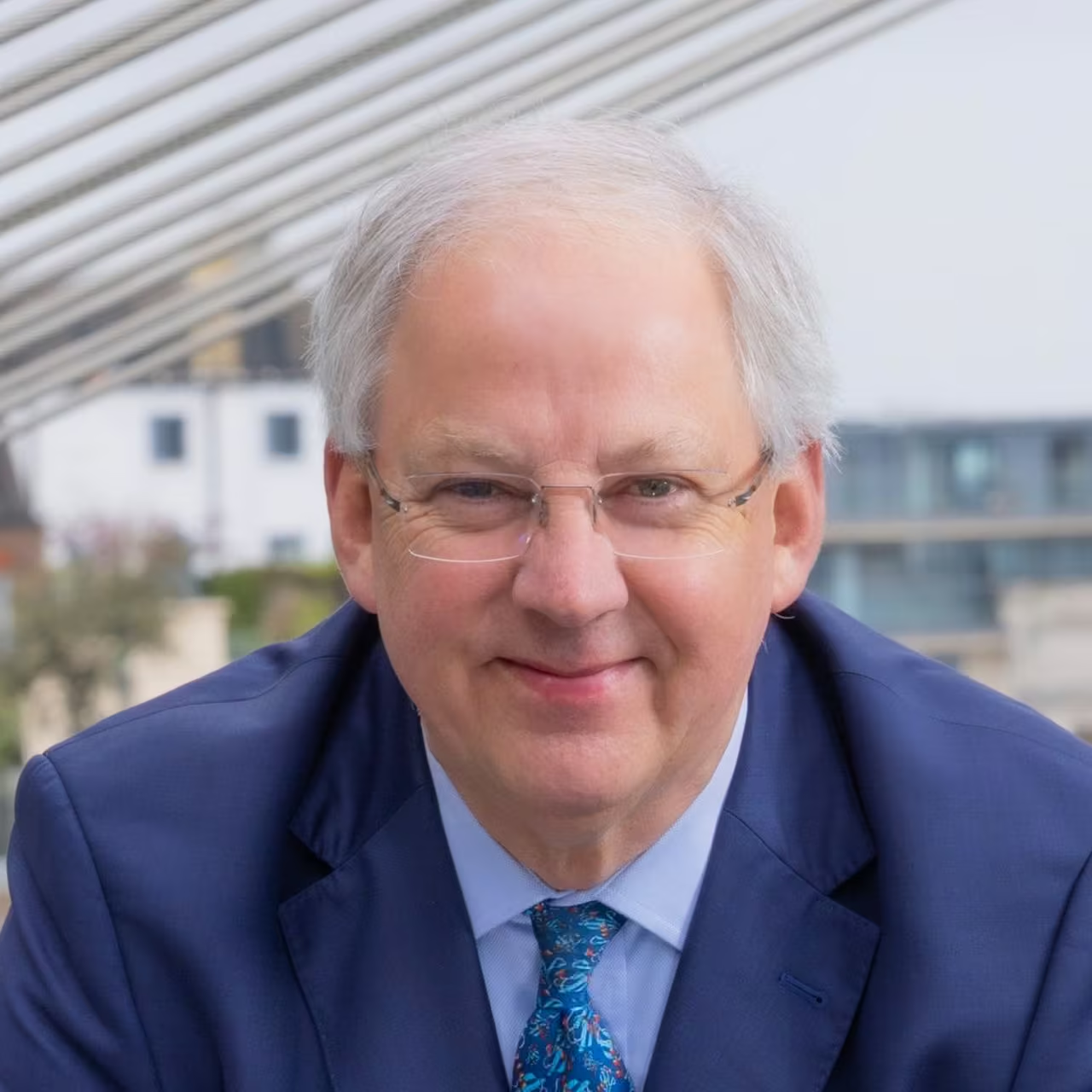
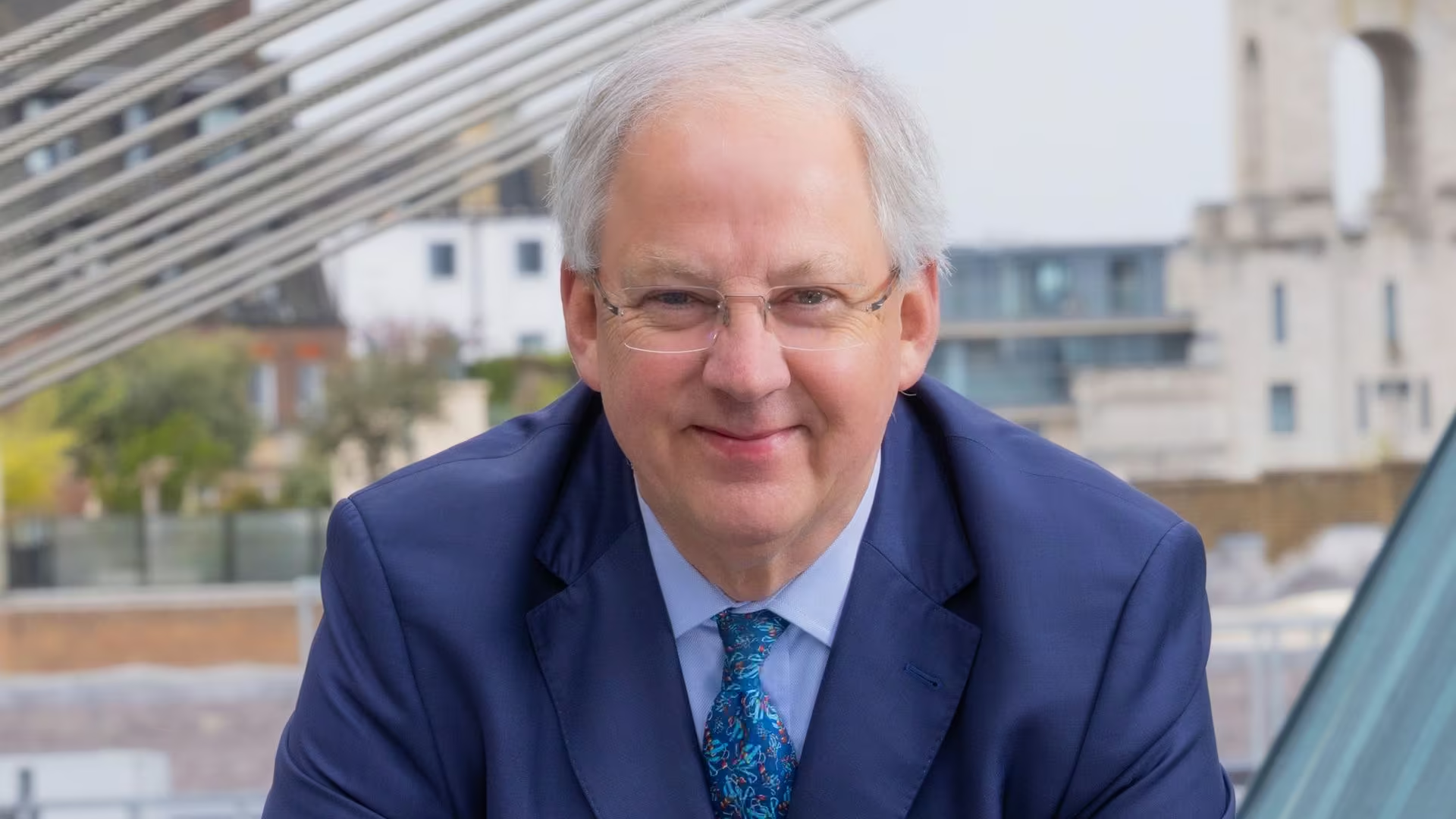
Jonathan Freeman-Attwood is the fourteenth Principal of the Royal Academy of Music. His commitment to education spans over thirty-five years, within which time he has also established himself as a recording producer, freelance trumpet player, writer and broadcaster. In the early years of his career, he was awarded the Healey Willan Memorial Scholarship at the University of Toronto, from which he graduated with First Class Honours, before embarking on research at Christ Church, University of Oxford.
As a trumpet soloist, Jonathan Freeman-Attwood has released fourteen solo albums, the majority of them with Linn, and they have attracted wide critical acclaim for their musical originality and effective re-imagining of the trumpet as a chamber instrument in reconstructions of works from around 1600 to the twentieth century. He is Series Editor for Resonata Music’s ‘The Re-Imagined Trumpet’ in which, amongst other pieces from his catalogue, newly configured sonatas by Schumann, Mendelssohn and Fauré have been published. In 2020, he created with composer Thomas Oehler a Sonata ‘after Richard Strauss’ for Boosey & Hawkes, recorded for Linn as part of Richard Strauss and the Viennese Trumpet and in 2025 he published and recorded a text for Edition Peters of the Bach Cello Suites for trumpet.
He has also produced over 250 commercial recordings for many of the world’s most prestigious independent labels. Productions have won major awards, including several Diapasons d’Or, Gramophone and BBC Music Awards (including Record of the Year in 2023), and numerous nominations over the last thirty years with artists and ensembles including Rachel Podger, The Cardinall’s Musick, Trevor Pinnock, Kristian Bezuidenhout, Lucy Crowe, Phantasm, La Nuova Musica, I Fagiolini, Orchestra of the Age of Enlightenment, Daniel-Ben Pienaar, and various leading cathedral choirs, including St Paul’s Cathedral.
From 1991 to 1995, Jonathan served as Dean of Undergraduate Studies at the Royal Academy of Music, then thirteen years as its Vice-Principal and Director of Studies. In 2001, he was conferred Professor of the University of London and in 2008 was appointed Principal at the Academy. For 30 years in senior posts, he has played a leading role in major campaigns to improve the Academy’s estate (including the Sainsbury Theatre and Burgess Recital Hall) as well as raising over a £100m during his period as Principal, much of it for scholarships and endowed professorial chairs. He has launched pioneering degree programmes and fostered major international relationships including in 2021 the Sir Elton John Global Exchange Programme with twelve major international conservatoires, including a twenty-five year collaboration with The Juilliard School in New York.
As an educator and scholar Jonathan continues to be active as a lecturer, critic, and contributor to journals (including Gramophone since 1992) and publications such as The New Grove Dictionary of Music and Musicians (2001, 2nd edition) and The Cambridge Companion of Recorded Music, as well as broadcasting regularly on BBC Radio 3. He is an established authority on Bach interpretation.
Jonathan is a trustee of Christ Church Cathedral, Oxford Music, the Associated Board of the Royal Schools of Music (ABRSM), the Countess of Munster Musical Trust, The British Library’s SAGA Trust and Garsington Opera, The British Library’s SAGA Trust and Garsington Opera (where he is Chair of the Artistic Advisory Committee) and served for nine years on the Young Classical Artists Trust (YCAT). He is also on the Advisory Board of the Academy of Ancient Music, is Patron of London Youth Choirs, holds fellowships at the Royal College of Music, Royal Northern College of Music and King’s College London, and was made a Distinguished Visiting Professor at Tokyo University of the Arts in 2017.
He was appointed CBE in the New Year’s Honours List of 2018.
source: Jonathan Freeman-Attwood
photo © Neil Emmerson
-andrej-grilc-001-m.avif)
-andrej-grilc-001.avif)
Praised for his remarkable range of colours, his confident and concentrated stage presence, his virtuosity and technical poise as well as the beauty of his tone Josef Špaček has gradually emerged as one of the leading violinists of his generation. His performances of a wide range of repertoire demonstrate his “astonishing articulation and athleticism” (The Scotsman) and “a richness and piquancy of timbre.” (The Telegraph).
Forthcoming highlights include debuts with the Pittsburgh Symphony Orchestra and Petr Popelka, London Philharmonic Orchestra and Edward Gardner, NHK Symphony Orchestra and Jakub Hrůša and Hong Kong Philharmonic Orchestra and Anja Bihlmaier, as well as returns to the Konzerthausorchester Berlin and Joanna Mallwitz, Bamberger Symphoniker and Aurel Dawidiuk, Symphoniker Hamburg and Adam Hickox, Deutsche Radio Philharmonie and Kevin John Edusei, Dutch Radio Philharmonic and Stephan Zilias, the Czech Philharmonic and Thomas Adès and George Enescu Philharmonic and Tomáš Netopil.
Recent highlights include highly successful debuts with the Chicago Symphony Orchestra and Jakub Hrůša (“his steely technique handling the angular bonhomie as surely as the passing lyrical strains. In the Andante, Špaček rendered the lovely main theme with a beguiling tenderness and sweetness of tone that recalled Suk, his illustrious predecessor.” - CCR), with the Atlanta Symphony Orchestra and Nathalie Stutzmann, the Gewandhausorchester Leipzig and Andrew Manze, the Orchestre National de Lille and Jan-Willem de Vriend, concerts with Sinfonia Varsovia and Marta Gardolińska in Warsaw and Brussels, a concerto and recital tour in China, as well as returns to the Dresdner Philharmonie and Kahchun Wong, the Berner Symphoniker and Anna Sułkowska-Migoń and the Macao Orchestra and Lio Kuokman, as well as a residency with the Residentie Orchestra The Hague with Anja Bihlmaier and Jun Märkl. He also returned to the Verbier Festival for a performance of the Barber concerto.
He equally enjoys giving recitals and playing chamber music and is a regular guest at festivals and in concert halls throughout Europe. He ist he artistic director and co-founder of the Troja chmber music festival Festival, in Prague.
With cellist Timotheos Gavriilidis-Petrin and pianist George Xiaoyuan Fu he forms the Trio Zimbalist. The trio regularly tours in the US and Europe. Their first CD release with piano trios of Weinberg, Auerbach and Dvořák received high accolades from the international press, including Gramophone Magazine’s Editor’s Choice in March 2024, describing the album as “miraculously fresh,” “imaginative,” and “inventive”.
In September 2023 Supraphon released Josef’s recording of Martinů’s Concerto for violin, piano and orchestra, violin sonata no. 3 and Five Short Pieces with pianist Miroslav Sekera and the Prague Radio Symphony Orchestra, conducted by Petr Popelka. The BBC Music Magazine commented that “Špaček and Sekera are virtuosic in the opening movement and searching in the Adagio. There’s a special piquancy in their Scherzo, and all these elements are combined in the finale, where Špaček’s violin tone has shining poise.”
Previous recordings for the Supraphon label are an album with cellist Tomáš Jamník, featuring works for violin and cello by Janáček, Martinů, Schulhoff and Klein; his highly praised recording of the violin concertos of Dvořák and Janáček, coupled with the Fantasy of Suk, with the Czech Philharmonic Orchestra conducted by Jiří Bělohlávek and a recital disc with works for violin and piano by Smetana, Janáček and Prokofiev with pianist Miroslav Sekera.
Josef Špaček studied with Itzhak Perlman at The Juilliard School in New York, Ida Kavafian and Jaime Laredo at the Curtis Institute of Music in Philadelphia, and with Jaroslav Foltýn at the Prague Conservatory.
After having served as concertmaster of the Czech Philharmonic Orchestra for nine seasons until the end of the 2019/20, he has devoted himself exclusively to his solo career. The orchestra has named him the Associate Artist in Residence.
Josef Špaček performs on the ca. 1732 “LeBrun; Bouthillard” Guarneri del Gesù violin, generously on loan from an anonymous sponsor.
source: agentura Makropulos
photo © Andrej Grilc
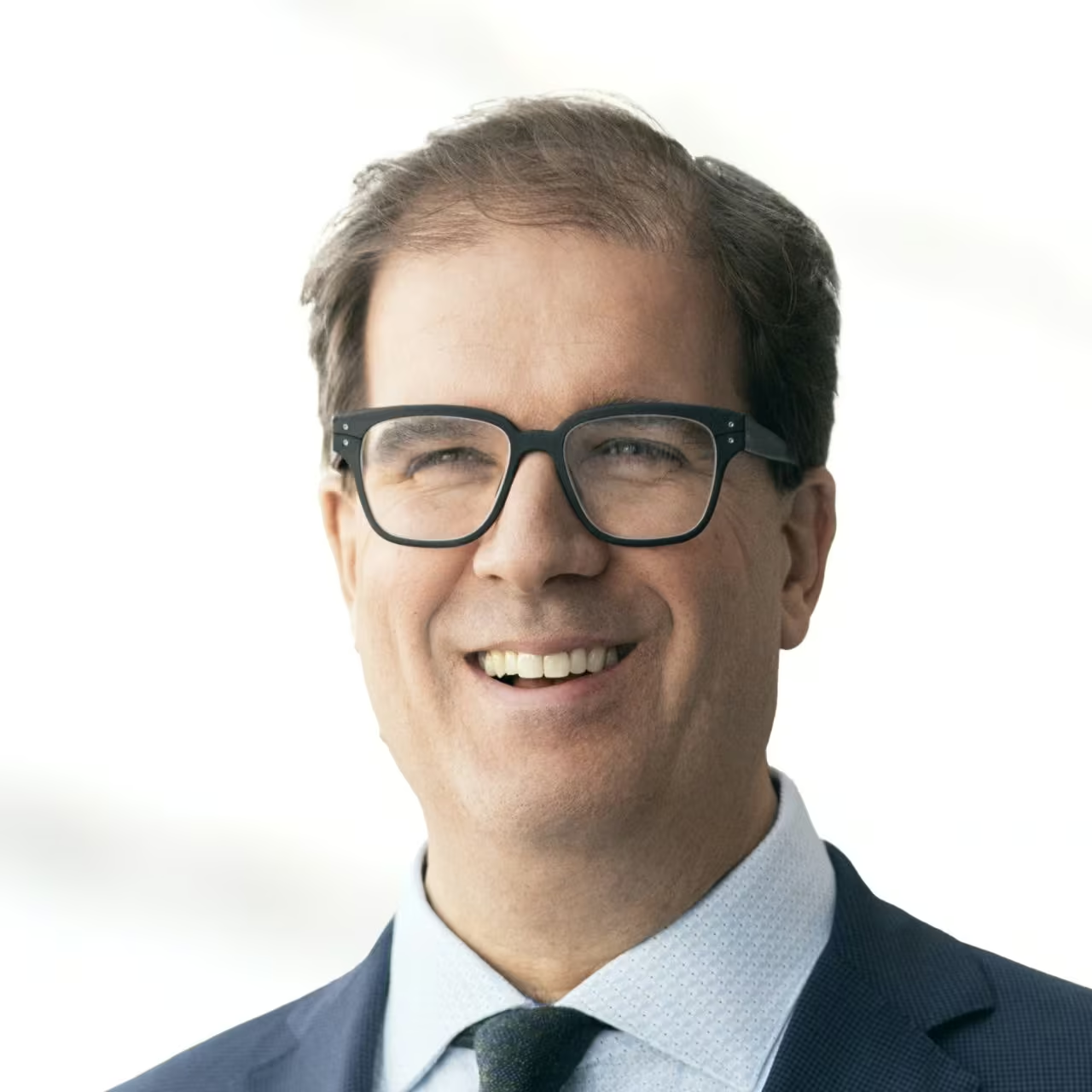
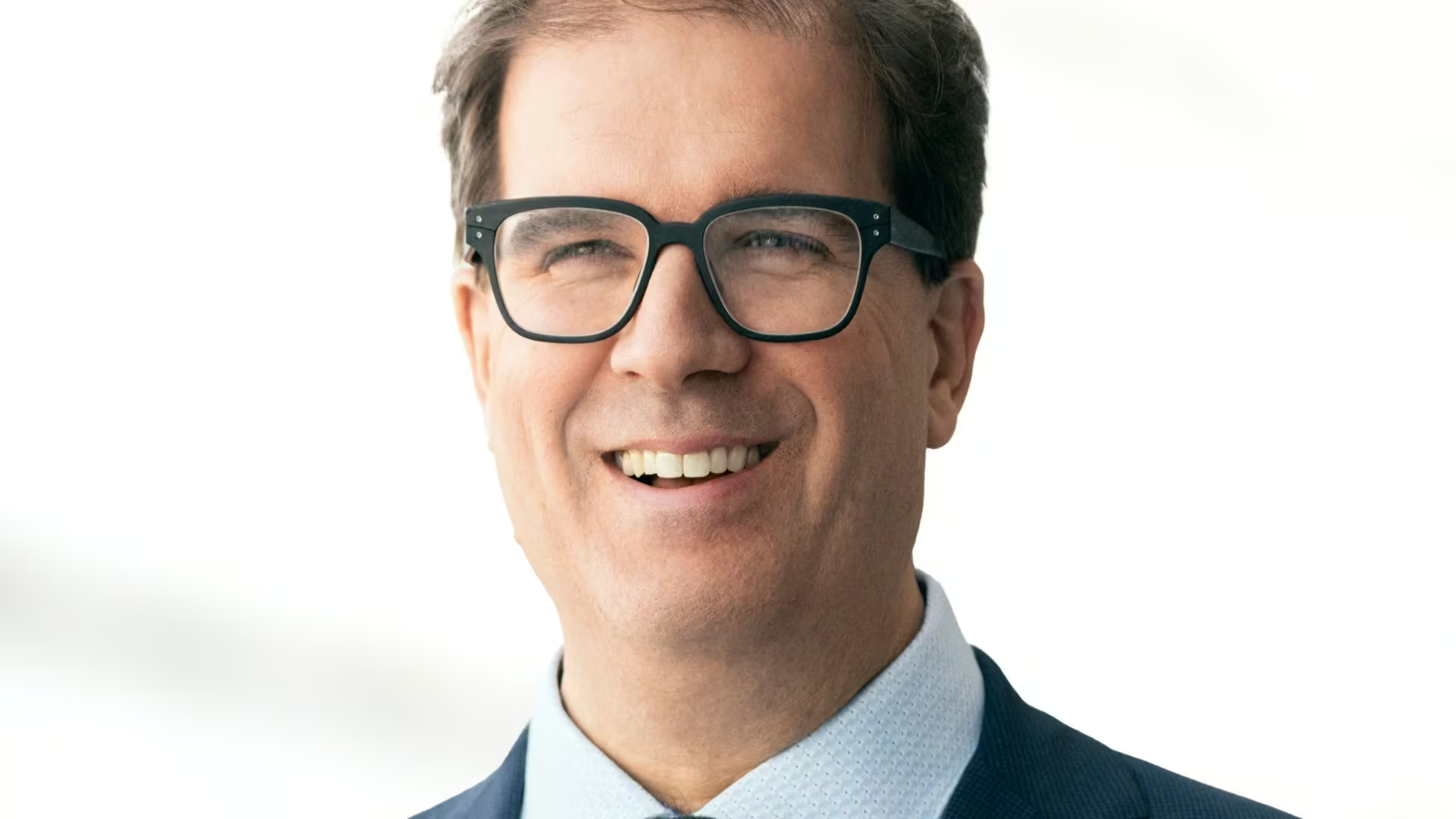
Matías Tarnopolsky became Linda and Mitch Hart President & CEO of the New York Philharmonic in January 2025, joining incoming Oscar L. Tang and H.M. Agnes Hsu-Tang Music & Artistic Director Designate Gustavo Dudamel to author a new chapter in the Orchestra’s rich history.
Tarnopolsky previously served in the same role at The Philadelphia Orchestra and Ensemble Arts, a visionary organization that shares the transformative power of the performing arts and arts education with the widest possible audience. Working with Music & Artistic Director Yannick Nézet-Séguin, Tarnopolsky positioned The Philadelphia Orchestra and Ensemble Arts to boldly lead the way in building a bright, inclusive future for the performing arts — as the center of cultural life in Philadelphia, and as a model for the nation. With The Philadelphia Orchestra and Nézet-Séguin as the centerpiece, the organization features vibrant, multi-genre programming performed at the highest level, animating stages across three buildings and attracting millions of visitors each year. Tarnopolsky forged a groundbreaking partnership between the world-renowned orchestra and Kimmel Center, Inc. The merger, the first major post-pandemic innovation in the arts nationally, laid the groundwork for the creation of Ensemble Arts Philadelphia, launched in 2024, as the organization’s presenting brand.
Tarnopolsky’s tenure in Philadelphia was marked by significant achievements, including three major awards in 2022: a Tony Award for the Kimmel Center’s role in producing the Stephen Sondheim Broadway musical Company, as well as a Grammy Award for Best Orchestral Performance and a Diapason d’or for The Philadelphia Orchestra and Nézet-Séguin for their Deutsche Grammophon recording of Florence Price’s First and Third Symphonies. Matías Tarnopolsky positioned the organization as a convener, contributing to Philadelphia’s diverse cultural and intellectual vibrancy. In 2024 he led the effort to rededicate Verizon Hall at the Kimmel Center for the Performing Arts as Marian Anderson Hall, the first major concert venue in the world named in honor of the trailblazing Black singer, civil rights icon, and Philadelphian.
By enriching programming with the work of BIPOC musicians, composers, and artists; expanding the traditional classical music canon; hosting free festivals with arts and culture organizations from across the region; launching the Digital Stage; amplifying the voices, stories, and causes of unique Philadelphia organizations and businesses through musical collaboration; creating opportunities for productive dialogue on social justice and the arts; and encouraging a change to the formal dress code for orchestra musicians, Tarnopolsky dismantled barriers to access, reaching ever broader and more diverse audiences.
With Tarnopolsky at the helm, The Philadelphia Orchestra received the largest financial contribution in its history, launched an innovative free ticket program for the School District of Philadelphia, and was named Gramophone magazine’s 2020 Orchestra of the Year. He also facilitated a flagship collaboration with the University of Pennsylvania by transferring the Orchestra’s archives to the Penn Libraries Kislak Center for Special Collections, providing broad research opportunities and access to more than a century of Philadelphia’s rich musical history.
In 2023 Tarnopolsky led Philadelphia Orchestra musicians on a special visit to China, commemorating the 50th anniversary of the ensemble’s historic 1973 tour to China, the first by an American orchestra. The visit took place against the backdrop of the November 2023 summit between Presidents Joseph R. Biden and Xi Jinping, and both leaders noted the orchestra’s achievements and commitment to cultural diplomacy in letters sent to The Philadelphia Orchestra. Tarnopolsky made international outreach a priority of the orchestra, one of the nation’s premier cultural ambassadors, and contributed a guest essay on this topic to The New York Times.
Driven by a lifelong passion for and innate knowledge of the arts, Matías Tarnopolsky has deep experience molding the artistic profiles of orchestras and cultural centers. Before his tenure in Philadelphia he served as executive and artistic director of Cal Performances at the University of California, Berkeley, the largest multidisciplinary university-based arts presenter and producer in the United States. This followed a series of key leadership roles at the New York Philharmonic, Chicago Symphony Orchestra, and BBC Symphony Orchestra. Born in Buenos Aires and raised in London, he received degrees in music and musicology from King’s College London. He serves on the Executive Committee of the Avery Fisher Artist Program, Advisory Council of the Tianjin Juilliard School, Pacific Harmony Foundation, Philadelphia Convention and Visitor’s Bureau, Chamber of Commerce for Greater Philadelphia, and Viñoly Foundation.
Tarnopolsky has been recognized with numerous awards, including the Chevalier de l’Ordre des Arts et des Lettres by the French Ministry of Culture. In 2022 he was awarded the William J. Clothier II Award from the Pan American Association of Philadelphia. The Philadelphia Business Journal recognized Tarnopolsky and the Orchestra with the 2021 Faces of Philanthropy award, and named him to its list of 2021 Most Admired CEOs. He was selected as one of the 100 most powerful people in Philadelphia for City & State Pennsylvania’s Philadelphia Power 100 list in December 2021.
source: Matías Tarnopolsky
photo © Todd Rosenberg
Programme
Gyermekeknek
Don’t Stop Me Now (feat. Hommage à Leoš Janáček)
Swing on Beethoven
The Cunning Little Vixen (suite)
Song to the Moon
Antonín Dvořák Award Ceremony
Humoresque
Noriet saule vakarā
Song for Peace
Prélude in E Minor, Op. 28, No. 4
Allegro Tangabile
Babarababa
Ciocârlia
Waltzing Matilda
Artists
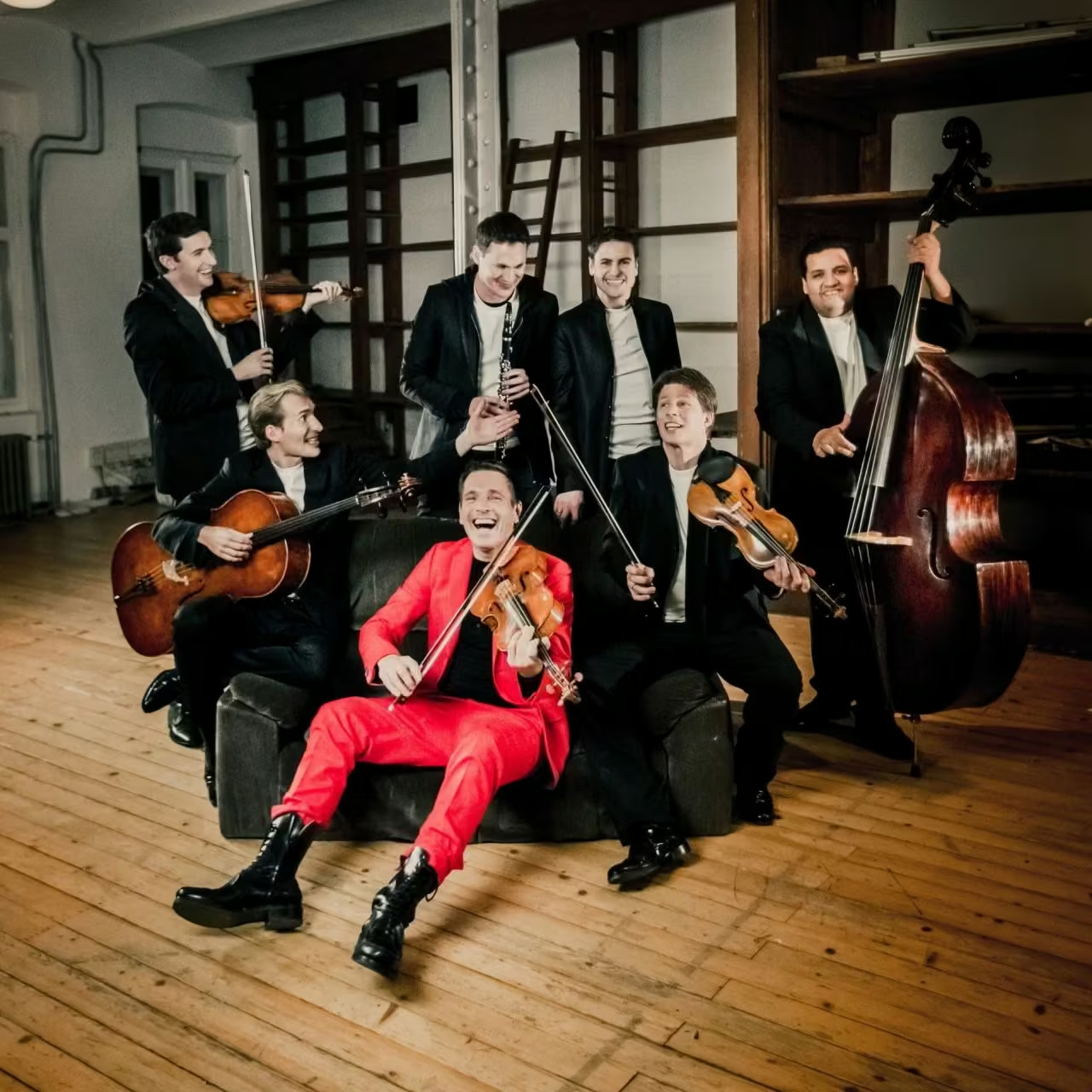
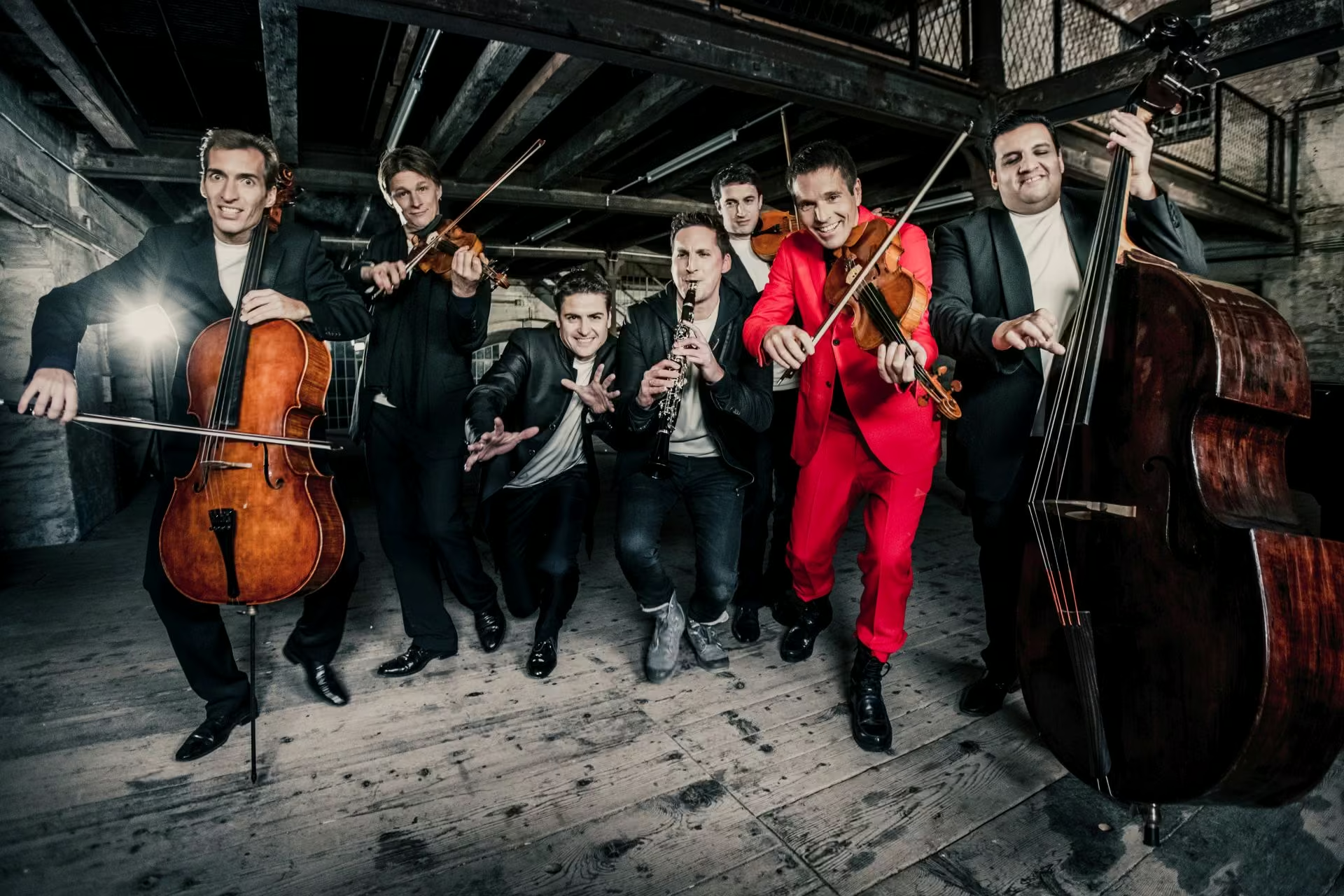
Founded by members of the Berliner and Wiener Philharmoniker, the Philharmonix play everything they have always wanted to play. Their trademark: brilliant arrangements, incomparable virtuosity, and, above all, unbridled joy in making music together, which spills over to the listener in a matter of seconds.
In their brilliant new adaptations, they work on pop, jazz, swing, folk music, klezmer, and famous melodies from big Hollywood films in addition to classical works. They bring out previously unheard, original aspects to all compositions - and skilfully combine things that otherwise do not belong together. So not everything is classical music; but everything has musical class.
Their music is influenced by the sound aesthetics and tradition of the top orchestras for which they also work: Thilo Fechner (viola), Daniel Ottensamer (clarinet), and Ödön Rácz (double bass) play with the Wiener Philharmoniker; Stephan Koncz (cello) and Noah Bendix-Balgley (violin) with the Berliner Philharmoniker. They are joined by the outstanding soloists Christoph Traxler (piano) and Sebastian Gürtler (violin), who, together with Stephan Koncz, is also the compositional head of the ensemble. Their aspiration:
"The mind must rejoice, the heart exult, and the leg must twitch."
The ensemble records exclusively for Deutsche Grammophon and released their two albums The Vienna Berlin Music Club Vol. I and The Vienna Berlin Music Club Vol. II in 2018 and 2019. In September 2022, the third album The Vienna Berlin Music Club Vol. III was released. "Classical Music without Borders"—rarely has a category name been more fitting than in the case of the Philharmonix, who were awarded the OPUS KLASSIK award in 2018 for their first recording. The classical music expertise demonstrated by all members does not prove to be a barrier, but rather an inspiring door opener to new listening experiences.
The Philharmonix appear regularly at the Wiener Konzerthaus. Here they have held a subscription cycle in the Great Hall for several seasons, as well as at the Berliner Philharmonie, Tonhalle Düsseldorf, Kulturpalast Dresden, Philharmonie Essen, Philharmonie Luxembourg, and the Elbphilharmonie in Hamburg.
Sebastian Gürtler - violin
Thilo Fechner - viola
Stephan Koncz - cello
Ödön Rácz - double bass
Daniel Ottensamer - clarinet
Christoph Traxler - piano
source: Konzertdirektion Schmid
Praised for his remarkable range of colours, his confident and concentrated stage presence, his virtuosity and technical poise as well as the beauty of his tone Josef Špaček has gradually emerged as one of the leading violinists of his generation. His performances of a wide range of repertoire demonstrate his “astonishing articulation and athleticism” (The Scotsman) and “a richness and piquancy of timbre.” (The Telegraph).
Forthcoming highlights include debuts with the Pittsburgh Symphony Orchestra and Petr Popelka, London Philharmonic Orchestra and Edward Gardner, NHK Symphony Orchestra and Jakub Hrůša and Hong Kong Philharmonic Orchestra and Anja Bihlmaier, as well as returns to the Konzerthausorchester Berlin and Joanna Mallwitz, Bamberger Symphoniker and Aurel Dawidiuk, Symphoniker Hamburg and Adam Hickox, Deutsche Radio Philharmonie and Kevin John Edusei, Dutch Radio Philharmonic and Stephan Zilias, the Czech Philharmonic and Thomas Adès and George Enescu Philharmonic and Tomáš Netopil.
Recent highlights include highly successful debuts with the Chicago Symphony Orchestra and Jakub Hrůša (“his steely technique handling the angular bonhomie as surely as the passing lyrical strains. In the Andante, Špaček rendered the lovely main theme with a beguiling tenderness and sweetness of tone that recalled Suk, his illustrious predecessor.” - CCR), with the Atlanta Symphony Orchestra and Nathalie Stutzmann, the Gewandhausorchester Leipzig and Andrew Manze, the Orchestre National de Lille and Jan-Willem de Vriend, concerts with Sinfonia Varsovia and Marta Gardolińska in Warsaw and Brussels, a concerto and recital tour in China, as well as returns to the Dresdner Philharmonie and Kahchun Wong, the Berner Symphoniker and Anna Sułkowska-Migoń and the Macao Orchestra and Lio Kuokman, as well as a residency with the Residentie Orchestra The Hague with Anja Bihlmaier and Jun Märkl. He also returned to the Verbier Festival for a performance of the Barber concerto.
He equally enjoys giving recitals and playing chamber music and is a regular guest at festivals and in concert halls throughout Europe. He ist he artistic director and co-founder of the Troja chmber music festival Festival, in Prague.
With cellist Timotheos Gavriilidis-Petrin and pianist George Xiaoyuan Fu he forms the Trio Zimbalist. The trio regularly tours in the US and Europe. Their first CD release with piano trios of Weinberg, Auerbach and Dvořák received high accolades from the international press, including Gramophone Magazine’s Editor’s Choice in March 2024, describing the album as “miraculously fresh,” “imaginative,” and “inventive”.
In September 2023 Supraphon released Josef’s recording of Martinů’s Concerto for violin, piano and orchestra, violin sonata no. 3 and Five Short Pieces with pianist Miroslav Sekera and the Prague Radio Symphony Orchestra, conducted by Petr Popelka. The BBC Music Magazine commented that “Špaček and Sekera are virtuosic in the opening movement and searching in the Adagio. There’s a special piquancy in their Scherzo, and all these elements are combined in the finale, where Špaček’s violin tone has shining poise.”
Previous recordings for the Supraphon label are an album with cellist Tomáš Jamník, featuring works for violin and cello by Janáček, Martinů, Schulhoff and Klein; his highly praised recording of the violin concertos of Dvořák and Janáček, coupled with the Fantasy of Suk, with the Czech Philharmonic Orchestra conducted by Jiří Bělohlávek and a recital disc with works for violin and piano by Smetana, Janáček and Prokofiev with pianist Miroslav Sekera.
Josef Špaček studied with Itzhak Perlman at The Juilliard School in New York, Ida Kavafian and Jaime Laredo at the Curtis Institute of Music in Philadelphia, and with Jaroslav Foltýn at the Prague Conservatory.
After having served as concertmaster of the Czech Philharmonic Orchestra for nine seasons until the end of the 2019/20, he has devoted himself exclusively to his solo career. The orchestra has named him the Associate Artist in Residence.
Josef Špaček performs on the ca. 1732 “LeBrun; Bouthillard” Guarneri del Gesù violin, generously on loan from an anonymous sponsor.
source: agentura Makropulos
photo © Andrej Grilc
About the Programme
Philharmonix weaves playfulness into classical music, sneaking a light-hearted spirit into what is traditionally a rather serious affair. When an ensemble as brilliant as Philharmonix takes the stage, it doesn’t matter whether they are performing original works or arrangements of classical music. A song by Sting, a Chopin prelude and an Australian folk tune all sound phenomenal.
Queen pays tribute to Janáček, The Cunning Little Vixen seems to listen to an arrangement of a song to the moon, Beethoven swings, and the passion of Argentine tango vibrates with the energy of the Romanian wilderness. Philharmonix concerts intertwine genres and continents as well as a cast of musicians from the Vienna and Berlin Philharmonic orchestras. On this occasion, they will be joined by the outstanding Czech violinist Josef Špaček.
Their collaborative performance will accompany the Antonín Dvořák Award ceremony, paying homage to a composer who viewed music as boundless and who, through it, won the hearts of audiences around the world. In a sense, this concert by Philharmonix and Josef Špaček brings the whole world together to salute Dvořák in return.
Thank you to the following partners





The Spanish Hall
The Spanish Hall is the largest ceremonial space of the Prague Castle and is located in the northern wing of the New Royal Palace. It was built at the beginning of the 17th century during the reign of Rudolf II, and its rich stucco decoration is one of the most advanced manifestations of Mannerism in Bohemia before the outbreak of the Thirty Years' War.