
simon.pauly-022026-2-d.avif)
Date
23/9/2026
Location
Rudolfinum, Dvořák Hall
Time
8 pm
Doors Closed
7.55 pm
End of Concert
approx. 9.50 pm
Dress Code
black tie
Programme Series

Programme
Bohuslav Martinů
Sergei Prokofiev
Antonín Dvořák
Igor Stravinsky
Artists
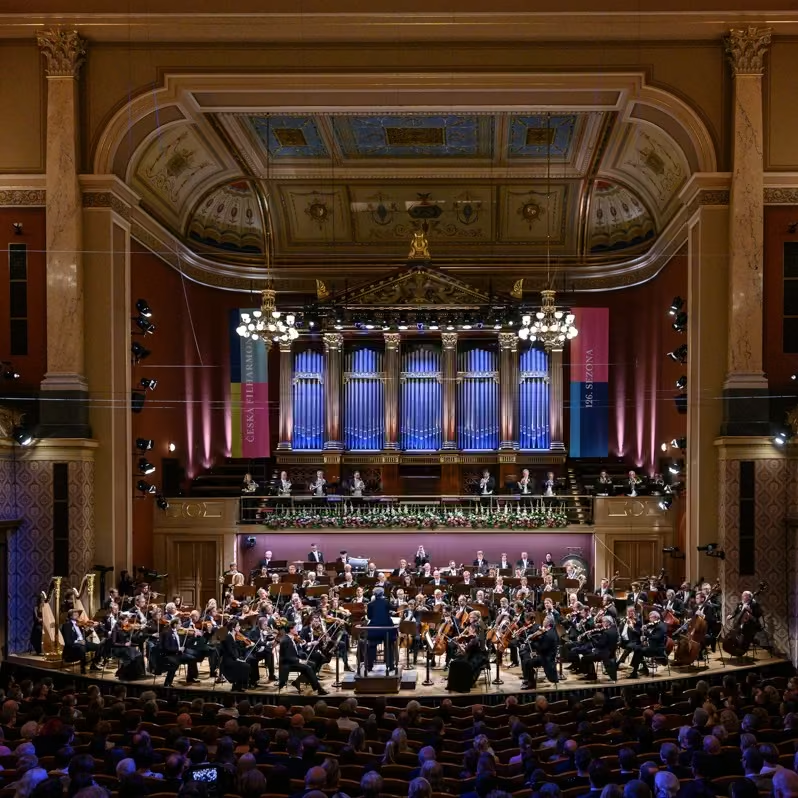
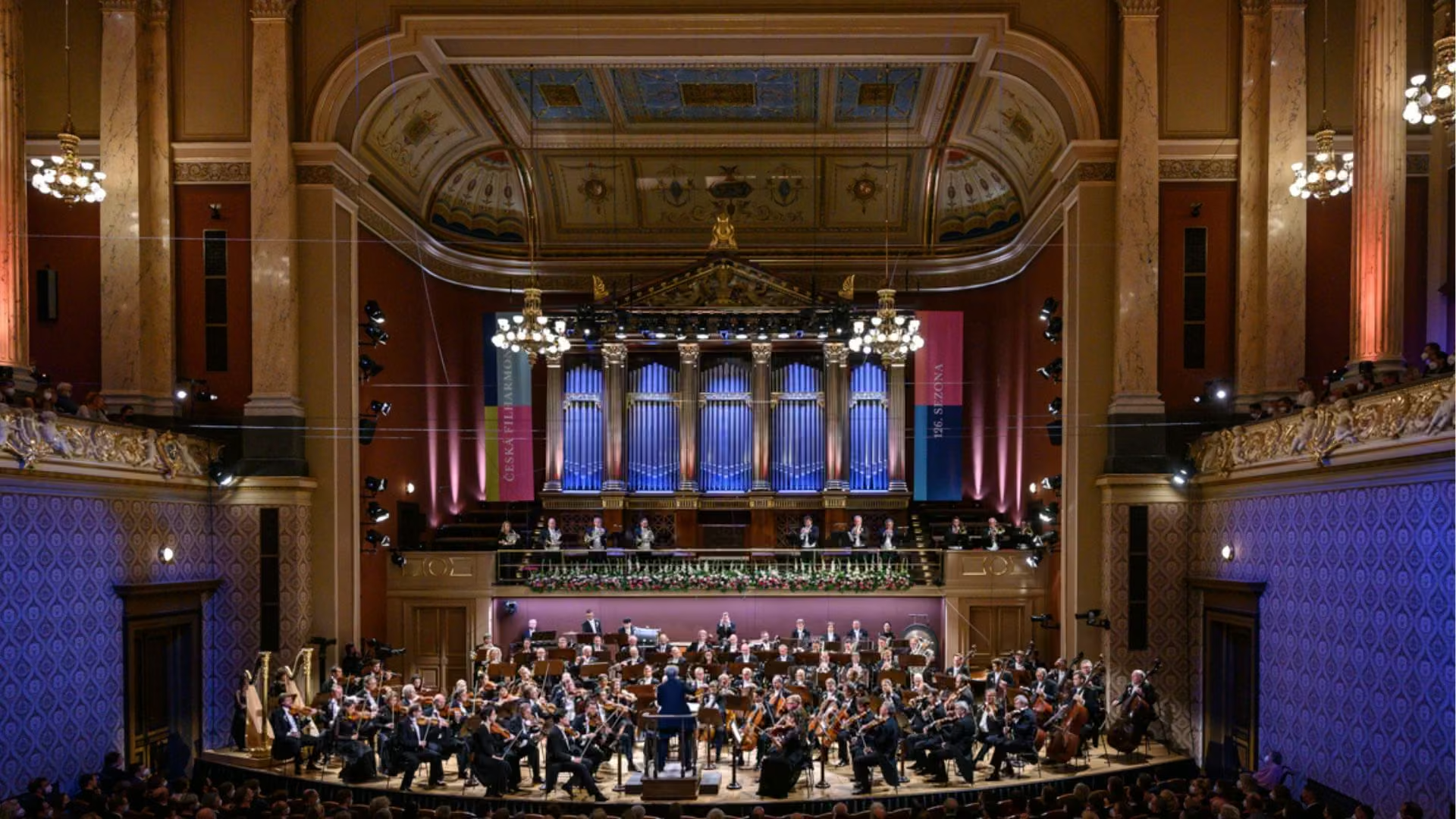
Named Gramophone’s Orchestra of the Year in 2024, the Czech Philharmonic is recognised as one of the world’s leading orchestras and remains the Czech Republic’s key cultural ambassador. Now in its 131st season, the orchestra combines a deep-rooted musical tradition with an international artistic outlook, expanding its profile through tours, residencies and recordings.
During the 2024 Year of Czech Music, the Czech Philharmonic and its Chief Conductor and Music Director Semyon Bychkov gave a three-day residency at New York’s Carnegie Hall. That same year saw the release of their recording of Smetana’s Má vlast (My Country), which went onto win the 2025 BBC Music Magazine Orchestral Award. In addition to Czech music, the orchestra’s long-standing relationship with composers such as Brahms, Tchaikovsky and Mahler has resulted in a series of benchmark recordings, including The Tchaikovsky Project (2019) and the first new cycle of Mahler symphonies in more than 40 years, released in 2026. The next release with Bychkov features Shostakovich’s Symphony Nos. 5 and 7.
The 131st season opens in Prague with Shostakovich’s Violin Concerto No. 1 featuring Artist-in-Residence Janine Jansen, alongside Dvořák’s Symphony No. 7. Touring highlights include the orchestra’s first visit in over 50 years to Sweden and Finland, a return to Lucerne Festival, and residencies in London, Vienna and Hamburg. At home, the Czech Philharmonic performs at the Rudolfinum in Prague and at leading Czech festivals including Dvořák Prague, Prague Spring, Smetana Litomyšl, and for the first time, Janáček Brno.
Repertoire this season with Bychkov includes Má vlast; works by Mussorgsky, Ravel, Adams, Strauss, Glanert and Britten; and a major focus on Rachmaninoff, presented both in Prague and on tour. Beethoven’s Ninth Symphony, performed with the Prague Philharmonic Choir, will mark the 200th anniversary of the composer’s death in 2027.
Principal Guest Conductors Simon Rattle and Jakub Hrůša both return this season. With Rattle, the orchestra presents music by Barber, Shostakovich, Debussy, Szymanowski and the Czech premiere of Composer-in-Residence Thomas Adès’s Aquifer. With Hrůša – appointed last year as the orchestra’s next Chief Conductor and Music Director (Renáta Kellnerová Chair) from the 2028/2029 season – they perform works by Strauss, Beethoven, Suk and a world premiere by Martin Smolka.
Guest conductors this season include Vasily Petrenko, Herbert Blomstedt, Elim Chan, Maxim Emilyanchev, and Daniel Harding, who closes the subscription season with the Accademia Nazionale di Santa Cecilia. Guest soloists include Yuja Wang, Behzod Abduraimov, Mao Fujita, Yunchan Lim, Seong-Jin Cho, Karen Gomyo, Radek Baborák and Kirill Gerstein.
The Czech Philharmonic’s distinguished history reflects the Czech Republic’s complex political past and its central European location. An early champion of the music of Martinů and Janáček, the Czech Philharmonic gave its first concert in 1896 with an all-Dvořák programme conducted by the composer itself.
Alongside its commitment to championing Czech composers, the orchestra’s belief in the power of music to transform lives remains a defining principle. The Czech Philharmonic Youth Orchestra, Orchestral Academy, and Jiří Bělohlávek Prize for young musicians, form part of the orchestra’s education strategy which engages with more than 400 schools. An inspirational music and song programme led by Ida Kelarová continues to support social inclusion by giving voice to Romany communities through music.
source: Česká filharmonie
marco-borggreve-022026-2-m.avif)
marco-borggreve-022026-2.avif)
One of the most sought-after artists of her generation, conductor Elim Chan embodies the spirit of contemporary orchestral leadership with her crystalline precision and expressive zeal. She served as Principal Conductor of the Antwerp Symphony Orchestra between 2019-2024 and Principal Guest Conductor of the Royal Scottish National Orchestra between 2018-2023.
Having conducted the First Night of the Proms with the BBC Symphony Orchestra in 2024, Elim Chan returns to the series in 2025 to conduct the renowned Last Night of the Proms. The 2025 summer period also sees her reunite with the Boston Symphony Orchestra, Los Angeles Philharmonic, and The Cleveland Orchestra, as well as touring with the Concertgebouworkest Young and making her debut at the Musikfest Berlin with the Staatskapelle Berlin.
Highlights in the 2025/26 season include return engagements with the Royal Concertgebouw Orchestra, New York Philharmonic, Los Angeles Philharmonic, The Cleveland Orchestra, London Symphony Orchestra, Toronto Symphony Orchestra, ORF Radio-Symphonieorchester, Staatskapelle Dresden, Luxembourg Philharmonic, and Orchestre de Paris, to mention a few; she also makes her subscription debut with the Philadelphia Orchestra and debuts with the Münchner Philharmoniker, Orchester der Oper Zürich, Bamberger Symphoniker, and Orchestre symphonique de Montréal.
Previous debuts include those with orchestras such as the San Francisco Symphony, Chicago Symphony, Pittsburgh Symphony, Philharmonia Orchestra, Hong Kong Philharmonic, Wiener Symphoniker, and Deutsches Symphonie-Orchester Berlin.
Born in Hong Kong, Elim Chan studied at Smith College in Massachusetts and at the University of Michigan. In 2014, she became the first female winner of the Donatella Flick Conducting Competition and went on to spend her 2015-16 season as Assistant Conductor at the London Symphony Orchestra, where she worked closely with Valery Gergiev. In the following season, Elim Chan joined the Dudamel Fellowship program of the Los Angeles Philharmonic. She also owes much to the support and encouragement of Bernard Haitink, whose masterclasses she attended in Lucerne in 2015.
source: Intermusica
photo © Marco Borggreve
chris-lee-022026-1-m.avif)
chris-lee-022026-1.avif)
It is one of the most exciting experiences to witness what it means to make music at the very highest level. The great violinist Gil Shaham is one of the few whose spontaneity, musical wit and ability to analyse soon turn every performance into an event.
Gil Shaham is a soloist with many of the great orchestras and conductors of our time. He has performed in Berlin and Munich, in Brussels, Amsterdam and Vienna, in New York, Tokyo, London, Chicago, Hamburg, Zurich, Paris, Boston, Philadelphia and San Francisco. His CD recordings have received the highest honours, including the Grammy, the Grand Prix du Disque, the Diapason d’Or and Gramophone Editor’s Choice. In 1990 and 2008 he was awarded the Avery Fisher Prize, and in 2012 he was honoured by Musical America as “Instrumentalist of the Year”.
Gil Shaham studied with Dorothy DeLay and Hyo Kang at the Juilliard School in New York. He made his debut with the Jerusalem Symphony Orchestra at the age of ten and played with the Israel Philharmonic Orchestra under Zubin Mehta for the first time at the age of fourteen.
Gil Shaham has recorded the great violin repertoire for the record label Canary Classics, which he founded in 2004. The violin concertos of the 1930s are particularly close to his heart. Following the release of the first album with five violin concertos from these years, Canary Classics released the second album with the second violin concertos by Bartók and Prokofiev.
Gil Shaham plays the 1699 Stradivarius Countess Polignac and lives in New York with his wife, violinist Adele Anthony, and their three children.
source: Concerto Winderstein
photo © Chris Lee
About the Programme
If we were to conduct a poll about the Festival’s most popular guest performer, violinist Gil Shaham would surely be among the winners – and perhaps even take first place. The shimmering, noble sound of Shaham’s Stradivari is captivating in itself, complemented by his radiant smile and irresistible charisma that infects everyone around him.
The Festival’s closing concert, performed by the Czech Philharmonic under conductor Elim Chan, recalls Antonín Dvořák with his Suite in A Major, whose variety and expressiveness evoke a cycle of songs without words. Although the suite belongs to Dvořák’s American-influenced period, the remainder of the programme highlights his sensitivity to Slavic inspiration and influences. Bohuslav Martinů – once an inattentive conservatory student, later a pupil of Josef Suk’s master class – provides the overture. Shaham’s instrument shines in Prokofiev’s Violin Concerto, and both the concert and the Festival conclude with magnificent music from Stravinsky’s fairy-tale ballet The Firebird.

With thanks to all who supported this concert

Rudolfinum, Dvořák Hall
The Rudolfinum is one of the most important Neo-Renaissance edifices in the Czech Republic. In its conception as a multi-purpose cultural centre it was quite unique in Europe at the time of its construction. Based on a joint design by two outstanding Czech architects, Josef Zítek and Josef Schultz, a magnificent building was erected serving for concerts, as a gallery, and as a museum. The grand opening on 7 February 1885 was attended by Crown Prince Rudolph of Austria, in whose honour the structure was named. In 1896 the very first concert of the Czech Philharmonic Orchestra took place in the Rudolfinum's main concert hall, under the baton of the composer Antonín Dvořák whose name was later bestowed on the hall.
Photo Gallery
petra-hajska-092026-1.avif)
petra-hajska-092026-2.avif)
petra-hajska-092026-3.avif)
petra-hajska-092026-4.avif)
petra-hajska-092026-5.avif)
petra-hajska-092026-6.avif)
petra-hajska-092026-7.avif)
petra-hajska-092026-8.avif)
petra-hajska-092026-9.avif)