marco-borggreve-022026-1.avif)
Date
16/9/2026
Location
Rudolfinum, Dvořák Hall
Time
8 pm
Doors Closed
7.55 pm
End of Concert
approx. 9.50 pm
Dress Code
dark suit
Programme Series


Programme
Georg Friedrich Händel
Antonio Vivaldi
Georg Friedrich Händel
Antonio Vivaldi
Antonio Vivaldi
Antonio Vivaldi
Georg Friedrich Händel
Georg Friedrich Händel
Artists
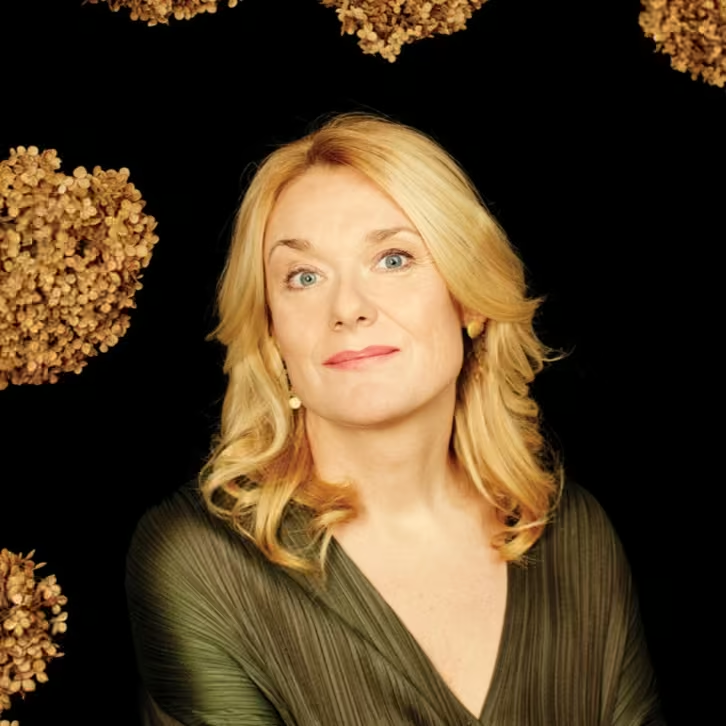
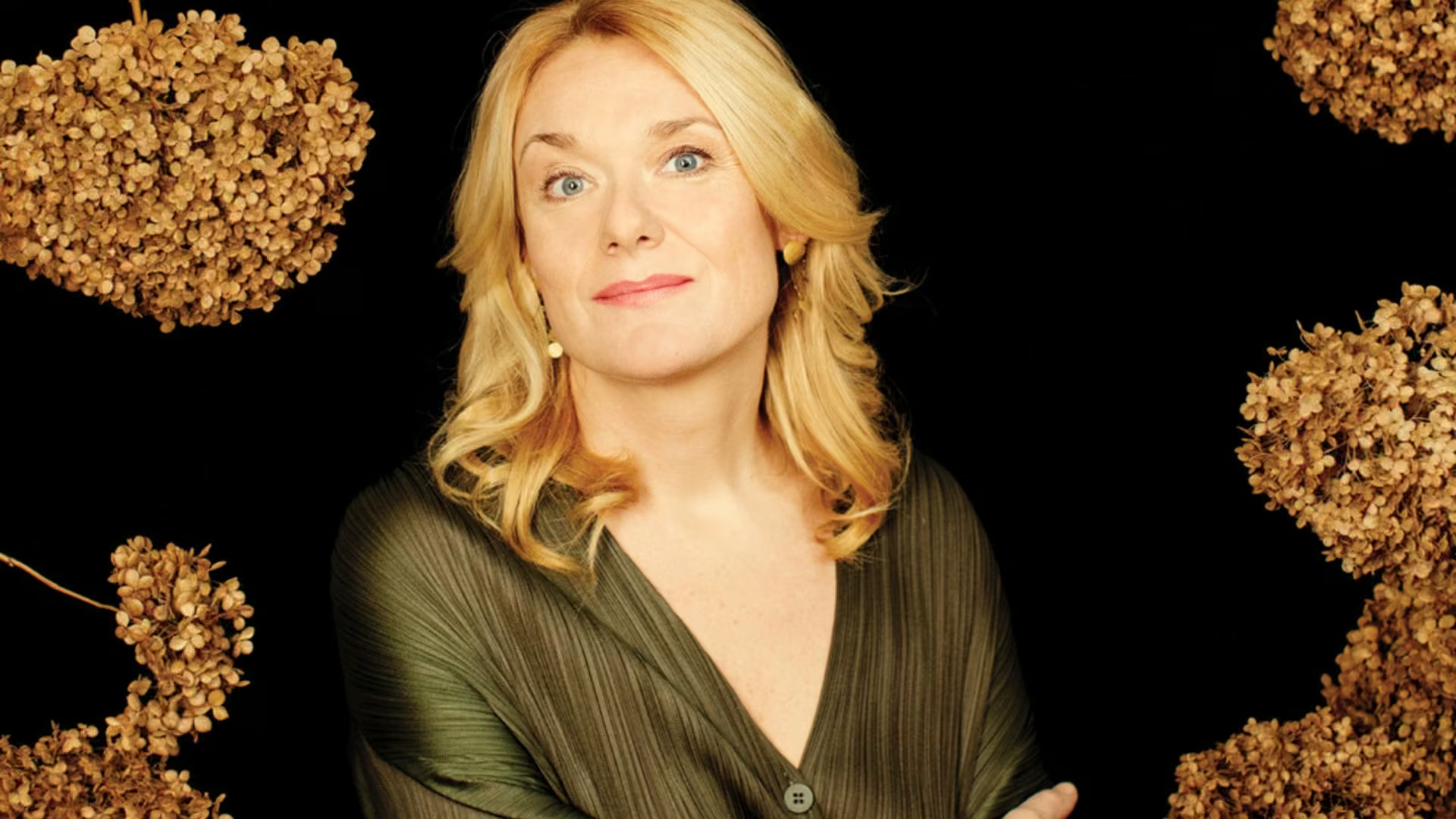
Magdalena Kožená is one of the most sought-after singers of our time. Her wide-ranging repertoire spans from Baroque music through works of the Classical and Romantic masters to 20th-century compositions. She studied singing at the Conservatory in Brno, her native city, and later with Eva Blahová at the Academy of Performing Arts in Bratislava. The most prominent of her many national and international competition successes was her first-place victory at the International Mozart Competition in Salzburg in 1995. During her prolific artistic career to date, she has appeared on many of the world’s leading concert stages and at renowned festivals and has performed numerous roles at celebrated opera houses including London’s Royal Opera House Covent Garden and the Metropolitan Opera in New York. Her recordings for Deutsche Grammophon, EMI Classics, Linn Records and Pentatone have won her virtually every major award bestowed by music magazines, including prestigious Gramophone Awards in several categories.
Magdalena Kožená is not only an outstanding singer, but also a cultural ambassador for the Czech Republic. She actively promotes Czech music and its cultural heritage abroad, both in concert and through her recordings. Her repertoire includes a rich selection of songs by classic Czech composers, especially Antonín Dvořák, Leoš Janáček and Bohuslav Martinů, as well as works by Petr Eben and Jewish composers born in the Czech lands such as Erwin Schulhoff and Hans Krása. She also performs works from the Czech operatic repertoire, as evidenced by acclaimed recordings of Janáček’s Katya Kabanova and Bohuslav Martinů’s Julietta.
Magdalena Kožená is also dedicated to advocating for primary arts education in the Czech Republic. To this end, she founded a charitable foundation that e.g. organises the nationwide Art Schools Open Festival for young performers. She has received numerous prestigious honours for her diverse musical activities. She is a Chevalier de l’Ordre des Arts et des Lettres of the French Republic and, in 2023, received the First-Class Medal of Merit in the Field of Art from the President of the Czech Republic. She has also been honoured with the Gratias Agit Award from the Czech Ministry of Foreign Affairs for promoting the country’s good name and the Gold Medal for Merit in the Arts from the Kennedy Center International Committee on the Arts in Washington, D.C. The city of Halle awarded her the Georg Friedrich Handel Prize, named after the city’s famous native. She holds an honorary doctorate from the Janáček Academy of Performing Arts. In 2025, Magdalena Kožená received the Antonín Dvořák Award in recognition of her outstanding contribution to Czech music and its international promotion.
source: C.E.M.A. – Central European Music Agency
photo © Julia Wesely
marco-borggreve-022026-2-m.avif)
marco-borggreve-022026-2.avif)
Born in Treviso in 1963, Andrea Marcon graduated from the Conservatory of Castelfranco Veneto and the Basel Academy of Music – Schola Cantorum Basiliensis. After making his mark in prestigious organ and harpsichord competitions, he embarked on an intense solo career across Europe. He collaborated with the Sonatori de la Gioiosa Marca ensamble for almost 20 years. In 1997, he founded the Venice Baroque Orchestra, leading it in performances in the most prominent concert halls of the world.
Since 2005, he has also been the artistic director of the Basel-based historical instruments orchestra La Cetra. In this role, he researches original sound in a repertoire ranging from Monteverdi to Beethoven's symphonies.
He has conducted more than 40 operas with over 300 performances at opera houses in Amsterdam, Frankfurt, Venice, Madrid, Seville, Valencia, Oviedo, Potsdam, Basel, New York, La Scala in Milan, the Bolshoi in Moscow and many others.
He has performed as guest conductor with the Berlin Philharmonic, Munich Philharmonic, Bavarian Radio Symphony Orchestra, Bamberg Symphony, as well as the national symphony orchestras of the German radio stations SWR, MDR, WDR, and HR. He has also conducted the Orchestra della Fenice, Orchestre de Chambre de Paris, Sinfonieorchester Basel, the Spanish Radio and Television Symphony Orchestra, Mahler Chamber Orchestra, Tenerife Symphony Orchestra, the City of Granada Orchestra, the National Symphony Orchestra of Malaysia and many others. He recently made his debut with the Wiener Symphoniker in three consecutive concerts at the Musikverein in Vienna.
A full professor at the Mozarteum in Salzburg, he also teaches harpsichord, organ, performance practice and ensemble music at the Basel Academy of Music. He has also held seminars and masterclasses for highly renowned academies and universities and is regularly invited to sit on the juries of prominent international competitions.
Since 2021, he has been artistic director of the Frau Musika historical instruments orchestra.
He has received prestigious awards including the Diapason d’Or, the German Record Critics’ Award, two Grammy nominations in Los Angeles, the Totila d'Oro of the city of Treviso, and the Handel Prize of the city of Halle.
source: Andrea Marcon
photo © Marco Borggreve
petra-hajska-022026-1.avif)
“It is the fulfilment of a dream we shared with Jiří Bělohlávek: after two years of preparations, we are ushering in concerts of the Czech Philharmonic Chamber Orchestra. This name does not stand for one particular ensemble; instead it represents a project in which the orchestra members will be performing in various chamber groups,” said David Mareček, Chief Executive Officer of the Czech Philharmonic, in the spring of 2018.
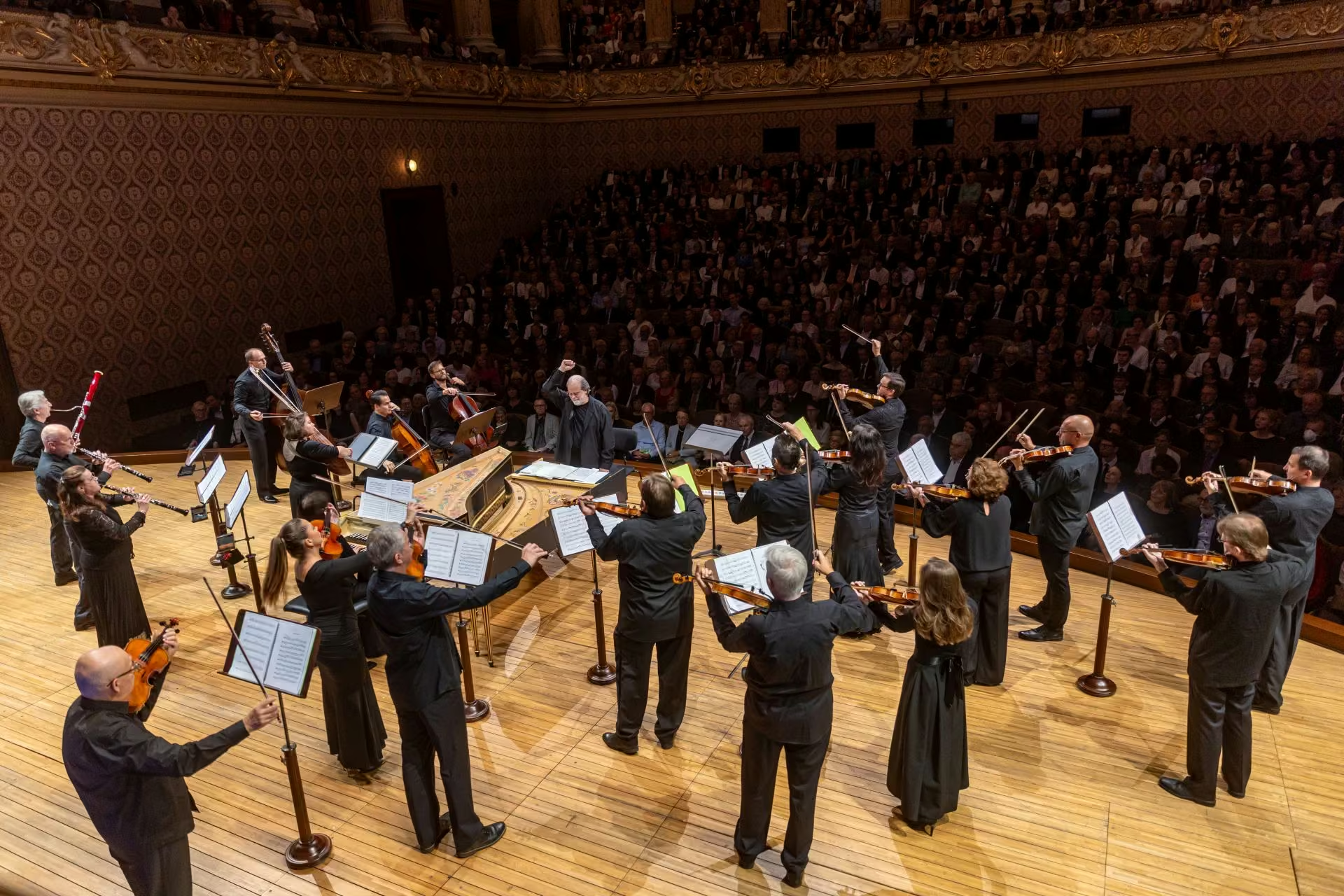
Jiří Bělohlávek was convinced that it was healthy for the Czech Philharmonic to play in a smaller ensemble with a repertoire spanning the Baroque to the present, where the musicians can hone their intonation, phrasing, and collaboration as individuals within a whole group. The Czech Philharmonic Chamber Orchestra, consisting exclusively of the members of the Czech Philharmonic assembled for a specific occasion, was officially established in the Czech Philharmonic’s 123rd season. Since then, the ensemble has already prepared fifteen projects presented both during the orchestra’s regular season at the Rudolfinum and at festival appearances.
source: Czech Philharmonic
photo © Petra Hajská
lucie-cermakova-052026-1-m.avif)
lucie-cermakova-052026-1.avif)
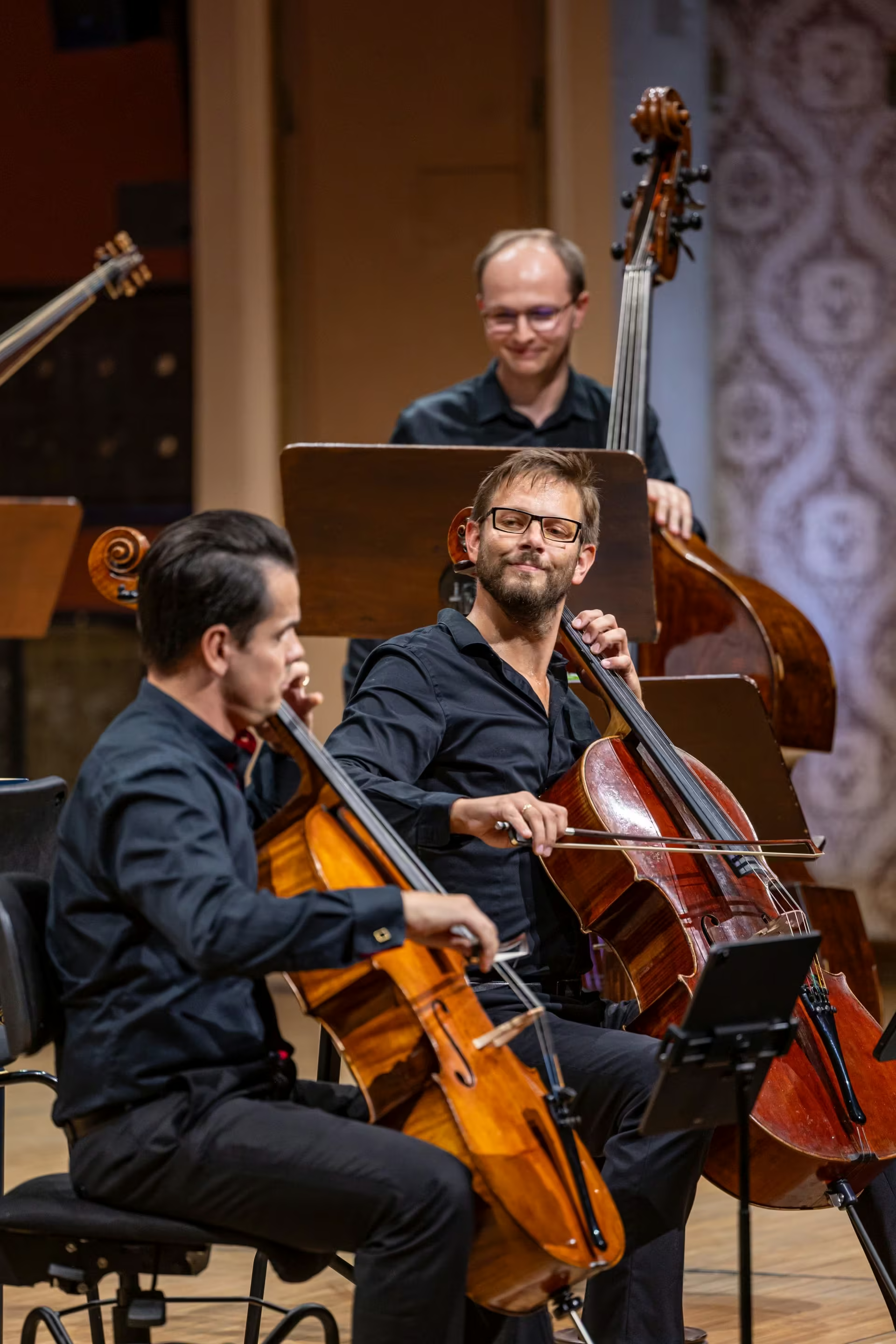
Václav Petr is one of the most important Czech cellists of his generation. He was a semi-finalist at the Grand Prix Emanuel Feuermann international cello competition and the winner of the prestigious 70th-annual Prague Spring Competition. Already in his childhood years, he began attracting attention by winning competitions, for example earning prizes at the Heran International Cello Competition, the International Cello Competition in Lietzen, Austria, and first prize at Prague Junior Note, then he was the overall winner of the Talents for Europe competition. He is a laureate of many other competitions: Concertino Praga, the David Popper International Cello Competition in Hungary, the Antonio Janigro International Cello Competition in Croatia, the Bohuslav Martinů Foundation International Music Competition in Prague, the Dotzauer International Competition for Young Cellists in Germany, and the Rudolf Matz International Competition for Strings in Dubrovnik.
Václav Petr learned the fundamentals of cello playing from Mirko Škampa at the Jan Neruda Grammar School in Prague. At the Academy of Performing Arts in Prague, he studied in the studio of Professor Daniel Veis, then he graduated from the studio of Michal Kaňka. He also perfected his playing under the guidance of Wolfgang Boettcher at the Universität der Künste in Berlin. In addition, Václav Petr took part in international masterclasses in Kronberg, Hamburg, and Vaduz, and he participated at the European Academy in Bonn as part of the International Holland Music Sessions, where he was chosen for the studio of Maria Kliegel. In 2015 he took part in masterclasses of the Carl Flesch Academy in Baden-Baden, making a solo appearance with the Baden-Baden Philharmonic.
He began giving solo performances at age 12, and he has appeared as a soloist with such orchestras as the Czech Philharmonic, the Prague Radio Symphony Orchestra, the Prague Philharmonia, the Prague Chamber Orchestra, the Pilsen Philharmonic, the Janáček Philharmonic in Ostrava, the Baden-Baden Philharmonic, and Bohdan Warchal’s Slovak Chamber Orchestra.
Last but not least, Václav Petr devotes himself tirelessly to chamber music. From 2009 to 2020 he was a member of the Josef Suk Piano Quartet, with which he won first prize at a competition of chamber music ensembles in Val Tidone, Italy, at the Salieri - Zinetti Chamber Music Competition, and at one of the most prestigious competitions for chamber ensembles with piano, the “Premio Trio di Trieste”.
In October 2013, Václav Petr won the post of concertmaster of the Czech Philharmonic cello section. At age 24, he became one of the youngest concertmasters in the orchestra’s history.
Václav Petr plays a master instrument from the workshop of Giovanni Battista Guadagnini, the “Teschenmacher” cello (1757), which is on loan from a private collection.
source: Artevisio
photo © Lucie Čermáková
ceskafilharmonie-092026-1-m.avif)
ceskafilharmonie-092026-1.avif)
He started playing the cello as a child, first attended private lessons with Professor Oldřich Kavale, then studied at the Prague Conservatory and the Academy of Performing Arts in Prague with Professor Miroslav Petráš. He attended masterclass courses in Kronberg (Germany) with S. Isserlis and B. Pergamenschikow and in Pilsen (Czech Republic) with R. Wallfisch. As a soloist, he has appeared at many festivals in the Czech Republic (Talich’s Beroun, Young Prague, Young Stage) as well as abroad (Festival l'Eté Musical en Bergerac in France, Music Home Alive Festival in the Netherlands). He regularly collaborates with the Czech Radio and the Czech TV.
He is the laureate of many international interpretation competitions. Among his greatest achievements are victories in Liezen (Austria, 2002), Dotzauer Competition in Dresden (Germany, 2005), Bohuslav Martinů competition in Prague (2008) and the overall winner title he received together with violinist Jakub Junek at Concertino Praga 2006. In 2010, he won the Yamaha Music Foundation of Europe scholarship and in 2012, he was a semi-finalist of the Prague Spring International Competition which made him the most successful Czech contestant. In 2013, he crowned his competition career winning the Leoš Janáček International Competition in Brno.
With the Taras Piano Trio, he won the Internationaler Johannes Brahms Wettbewerb competition (Pörtschach, Austria) in 2007 and Rovere d'Oro (San Bartolomeo, Italy) in 2008. With the Lobkowicz Trio, he won the 3rd prize and the award for the best performance of composition by Antonín Dvořák at the Antonín Dvořák International Chamber Music Competition and the 1st prize at the Johannes Brahms International Competition (Pörtschachu, Austria). The ensemble also won the Czech Chamber Music Society Award 2017. Besides playing the cello, he is the pianist of the Escualo Quintet.
Bohuslav Martinů’s music has always been very close to his heart but he has recently also fallen for Gustav Mahler’s Symphony No. 2 “Resurrection”. His secret passion is jazz.
source: Czech Philharmonic
photo: Czech Philharmonic
About the Programme
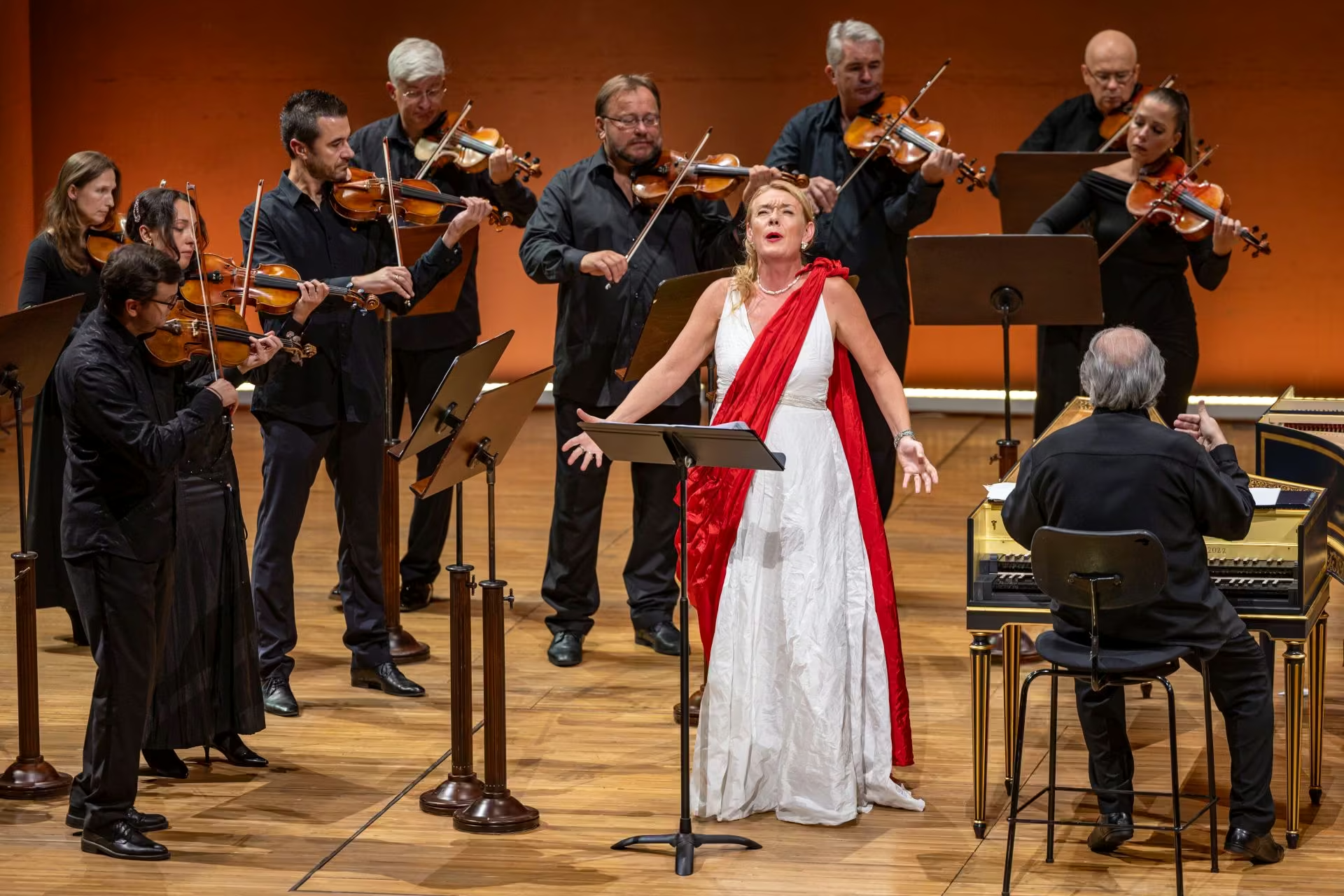
For many Czech listeners, the name Magdalena Kožená elicits an immediate association with early music. Although her residency at the Dvořák Prague Festival demonstrates a far broader artistic range, her profile would not be complete without the Baroque. For admirers of period instruments and powdered wigs, it comes as no surprise that Antonio Vivaldi was also a master of opera, while George Frideric Handel’s music has, in recent decades, returned fully to the operatic stage, once again becoming a theatrical attraction.
A selection of operatic scenes by these two composers offers Magdalena Kožená another opportunity to demonstrate what she does best: to grasp music born of an inspiring text and deliver it to the audience in perfect form, with ideal equilibrium between technique and emotion. The Czech Philharmonic Chamber Orchestra will be conducted by Andrea Marcon, with whom Kožená has collaborated for many years. He will add three instrumental concertos to the operatic scenes. The concert promises mastery from two leading artists and positions the Czech Philharmonic in a strikingly unusual stylistic role.

With thanks to all who supported this concert

Rudolfinum, Dvořák Hall
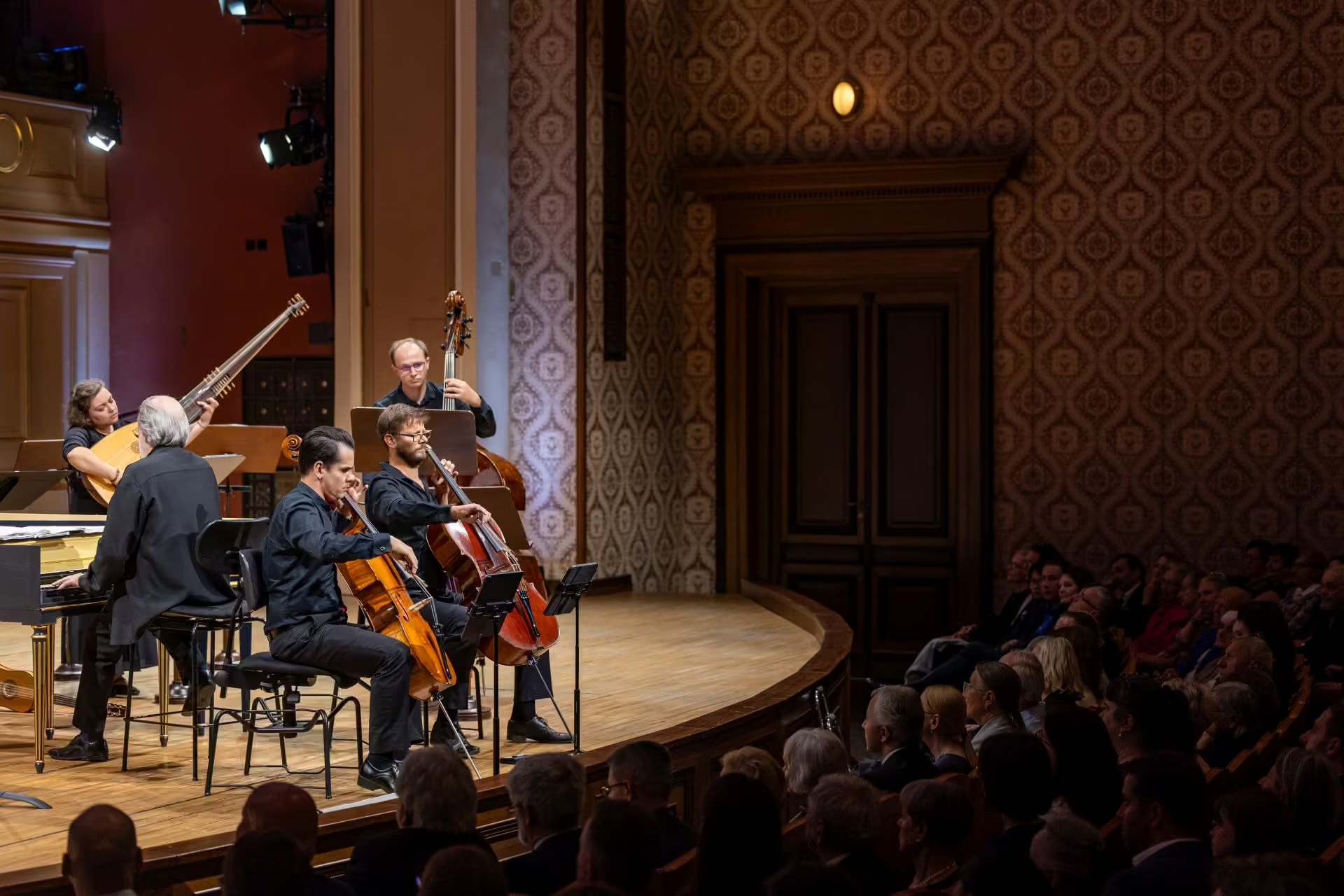
The Rudolfinum is one of the most important Neo-Renaissance edifices in the Czech Republic. In its conception as a multi-purpose cultural centre it was quite unique in Europe at the time of its construction. Based on a joint design by two outstanding Czech architects, Josef Zítek and Josef Schultz, a magnificent building was erected serving for concerts, as a gallery, and as a museum. The grand opening on 7 February 1885 was attended by Crown Prince Rudolph of Austria, in whose honour the structure was named. In 1896 the very first concert of the Czech Philharmonic Orchestra took place in the Rudolfinum's main concert hall, under the baton of the composer Antonín Dvořák whose name was later bestowed on the hall.
Photo Gallery